
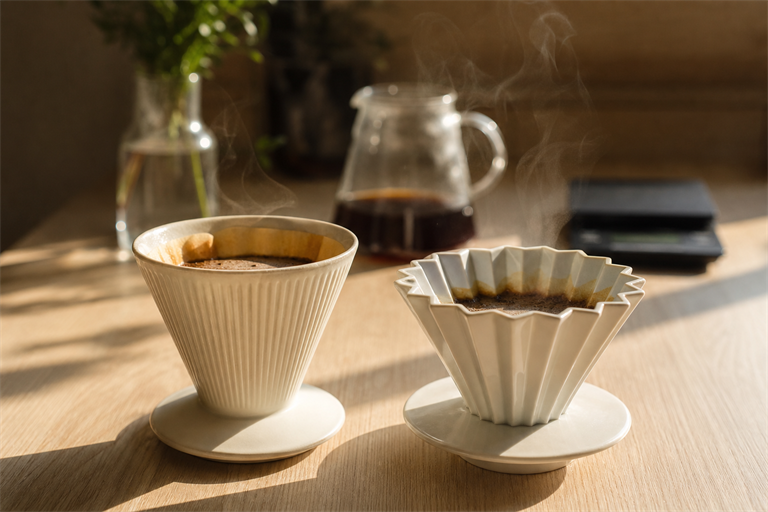
Short answer: neither dripper can be declared the universal winner for light-roast clarity from specifications alone. The Hario V60 02 is the simpler value choice with a familiar cone-filter workflow. The ORIGAMI M offers a second variable—the choice of cone or wave paper—and its 20 vertical ribs are designed to keep space between the paper and dripper. That flexibility is useful, but it also means filter choice, grind and pouring technique can matter as much as the brewer itself.
This is a specification-based comparison, not a report of controlled brews or blind tasting by Home Coffee Journal. Product details below come from Hario and ORIGAMI; flavor and drawdown will still vary with the coffee, paper, grinder, water and pouring method.
Origami M vs V60 02 at a glance
| Feature | Hario V60 Ceramic 02 | ORIGAMI Dripper M | Why it matters |
|---|---|---|---|
| Body | Porcelain | Porcelain | Both benefit from thorough preheating before a small brew. |
| Rated serving range | 1–4 cups | 2–4 cups | The makers use different cup conventions, so choose your recipe by grams and milliliters rather than “cups.” |
| Interior | Spiral ridges | 20 vertical ribs | Both designs create paths beside the paper, but they manage paper contact differently. |
| Paper options stated by maker | V60 cone paper | Cone or wave paper | ORIGAMI gives you two bed shapes without buying another dripper. |
| Flow control | Hario describes minimal flow restriction, leaving flow largely to pouring, grind and paper | ORIGAMI says its ribs provide an air path and support stable flow | Neither design makes drawdown time fixed or automatic. |
| Best fit | A repeatable cone-filter workflow and broad availability | Brewers who want to compare cone and wave papers | The practical difference is workflow flexibility, not a guaranteed flavor score. |
Sources: Hario V60 Ceramic 02 specifications and ORIGAMI Dripper M specifications.
What the V60 design actually offers
Hario describes the V60 as a conical brewer with spiral ridges and little built-in flow restriction. In practical terms, the paper, grind size and way you add water do much of the regulating. A faster pour can maintain a higher water level; pulses can change agitation and contact time; a finer grind can slow the brew. That control is why the V60 is adaptable, but it is also why a recipe can behave differently when the kettle, grinder or coffee changes.
The ceramic 02 model is rated for 1–4 cups and uses porcelain. Hario sells the V60 in other materials too, but comparisons should keep material constant when possible. Comparing a plastic V60 with a porcelain ORIGAMI and attributing every difference to geometry would mix two variables.
What the ORIGAMI design actually offers
The porcelain ORIGAMI M has 20 evenly spaced vertical ribs. ORIGAMI says those ribs preserve an air path between the wall and paper, helping water flow smoothly. Its most distinctive practical feature is compatibility with both cone and wave papers.
That does not make the two papers interchangeable. ORIGAMI explains that a wave paper creates a thinner coffee bed and can support a more even extraction through the depth of that bed. A cone paper creates a deeper bed, so water encounters a different path through the grounds. Paper material and fit also affect flow, so “ORIGAMI with a cone” and “ORIGAMI with a wave” should be treated as separate setups.
ORIGAMI also makes the Dripper Air M from AS resin. The manufacturer describes it as lightweight and impact-resistant and says it is easier to maintain brewing-water temperature with the resin model than with porcelain. That is a reason to consider the Air for travel or low-dose brews; it is not evidence that it will taste clearer.
Which setup is more likely to suit a clarity-focused workflow?
“Clarity” usually means that flavors feel distinct rather than blended together, but there is no manufacturer specification that measures it. A dripper cannot promise clarity independently of grind distribution, water chemistry, extraction level, filter and coffee quality.
Use these decision rules instead:
- Choose the V60 02 if you already have a reliable cone-paper recipe, want widely available replacement papers and prefer to change one variable at a time.
- Choose the ORIGAMI M with cone paper if you want a cone workflow but are interested in how its vertical-rib geometry behaves with your existing grinder and pouring style.
- Choose the ORIGAMI M with wave paper if you specifically want a shallower bed and a second filter geometry in the same brewer.
- Choose the ORIGAMI Air M if low weight and impact resistance matter more than the appearance and feel of porcelain.
None of those choices guarantees a faster drawdown or a higher extraction. Cone and wave papers from different manufacturers can have different permeability, and fines from the grinder can dominate the result.
A fair way to compare them at home
If you own both, a useful comparison changes only one major variable at a time. It does not require a refractometer.
- Use the same coffee, water, dose and beverage mass.
- Start with the same brand and shape of cone paper in both drippers. Comparing a V60 cone paper with a wave paper changes both brewer and bed geometry.
- Rinse the papers and preheat both porcelain brewers thoroughly.
- Use the same grinder setting and pouring schedule for the first pair.
- Record total drawdown, but do not treat it as a quality score.
- Taste after both cups have cooled to similar temperatures.
- Only then adjust grind separately for each brewer.
A neutral starting point for a small light-roast brew is 15 g coffee to 250 g water, water near 93–96°C, a bloom followed by two controlled pours, and a medium-fine grind. This is a dialing-in framework, not a manufacturer-mandated recipe or a tested Home Coffee Journal result. If the cup is sharply sour and finishes quickly, try a finer grind or more agitation. If it is drying and the drawdown stalls, try a coarser grind or gentler agitation.
Common comparison mistakes
- Declaring a winner from one drawdown: each brewer may need its own grind setting.
- Changing brewer and paper together: that prevents you from knowing which change mattered.
- Ignoring material: preheating porcelain and resin identically does not guarantee the same thermal behavior.
- Using “cups” as a recipe unit: manufacturer cup ratings are not a reliable substitute for grams of water.
- Equating faster with clearer: fast flow can be useful when paired with an appropriate grind, but it can also produce an under-extracted cup.
Verdict
The V60 02 is the safer recommendation for someone who wants an established cone-filter workflow, broad paper availability and a lower-complexity purchase. The ORIGAMI M is the more flexible tool because it officially supports cone and wave papers. For a light-roast drinker who enjoys dialing in and comparing bed geometries, that flexibility is the strongest reason to choose it.
There is no responsible specification-only basis for saying that the ORIGAMI always produces more clarity or that the V60 always produces more sweetness. Pick the workflow you will use consistently, then tune grind and pouring to the coffee in front of you.