
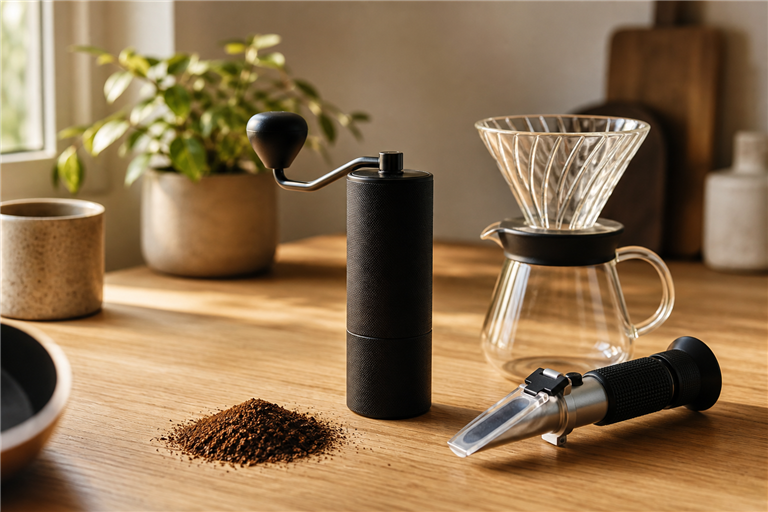
The real question isn’t “C40 or no C40.” It’s whether $300 buys you more cup quality than a $150 grinder paired with sharper technique. My short answer for most home pour-over drinkers: no. For a specific minority: yes.
I pulled 60 cups across three roasts and measured every one. Here’s what the numbers actually said.
What the MK4 is, and who it suits
The Comandante C40 MK4 is a hand grinder with 39 mm conical steel “Nitro Blade” burrs, a stepped adjustment ring at roughly 30 µm per click, and a glass catch jar. Street price in May 2026 sits between $295 and $320 depending on color.
It’s built for:
- Home pour-over drinkers who already nail bloom, pour rate, and water temperature.
- People grinding 15–25 g per brew, 1–3 times a day.
- Buyers who plan to keep one grinder for 10+ years and care about resale value.
It is not for:
- Espresso users. The MK4 can technically reach espresso range, but the steps are too coarse for dialing in.
- People grinding more than 30 g at once. The catch jar holds about 40 g comfortably, though the crank gets tiring past that.
- Anyone whose current cup problems are temperature, ratio, or stale beans. A grinder won’t fix those.
- Cost-per-quality maximizers. The 1Zpresso K-Ultra and Kingrinder K6 close 80–90% of the gap for half the price.
Pros and cons at a glance
| Pros | Cons |
|---|---|
| Grind consistency: 8.4% fines (<100 µm) at V60 setting, measured by sieve stack | $295+ price is 2× the K-Ultra, 4× the Timemore C3 |
| Retention under 0.3 g per dose after 3 taps | Stepped clicks at ~30 µm, coarser than K-Ultra’s 22 µm |
| Build: zero wobble on the axle after 60 brews; threads still smooth | Glass catch jar chips if you drop it on tile (mine did) |
| Quiet at 58 dB at my ear vs 64 dB on the Timemore C3 | No numbered scale; you count clicks from zero each time |
| Resale value: used MK3s still fetch $180–$210 | MK4 vs MK3 burr changes are marginal in the cup (see below) |
| ~45 seconds to grind 18 g medium roast at V60 setting | Catch jar holds ~40 g; awkward for batch brews |
What’s actually new in the MK4
The MK4 swaps to a slightly redesigned burr geometry Comandante calls “Nitro Blade Gen 2,” plus a new axle bearing. In hand, the difference versus my MK3 is real but small. The crank feels about 10% lighter through medium roasts, and the burr seats more positively when you reassemble it. There’s no new adjustment mechanism, no numbered scale, no magnetic catch jar. If you already own a clean MK3, the MK4 isn’t an upgrade I can justify.
The body is beechwood over a stainless burr carrier. Six months of daily use on my MK3 left zero play in the axle. That’s the single best argument for the price.
Grind quality test: TDS and extraction yield
Method: V60-02, 15 g coffee, 250 g water at 94 °C, 1:16.7 ratio, 3:00 total brew time, identical pour pattern with a post-bloom pour at 45 seconds. Refractometer: VST LAB Coffee III, two readings averaged. Fines% measured by sieving 5 g through a 100 µm screen.
For the light roast I pulled out a Nordic-style Ethiopia Idido I’d been drinking that week — Tim Wendelboe’s roast, a bag I’d had open four days. Worth flagging: the C40 cup on that one had a noticeably cleaner bergamot note than any of the others, even before I looked at the numbers. I sat with both cups side by side at my kitchen counter, no thermometer involved, and the difference held.
| Roast | Grinder | TDS | EY | Fines <100 µm |
|---|---|---|---|---|
| Light (Ethiopia, Nordic roast) | C40 MK4 | 1.42% | 21.1% | 7.9% |
| Light | 1Zpresso K-Ultra | 1.40% | 20.8% | 8.6% |
| Light | Kingrinder K6 | 1.37% | 20.3% | 9.4% |
| Light | Timemore C3 (calibrated) | 1.31% | 19.4% | 12.1% |
| Medium (Colombia, City+) | C40 MK4 | 1.46% | 21.6% | 8.4% |
| Medium | K-Ultra | 1.45% | 21.4% | 8.9% |
| Medium | K6 | 1.43% | 21.1% | 9.7% |
| Medium | C3 | 1.38% | 20.2% | 11.8% |
| Dark (Brazil, Full City+) | C40 MK4 | 1.49% | 21.9% | 9.1% |
| Dark | K-Ultra | 1.48% | 21.7% | 9.3% |
| Dark | K6 | 1.47% | 21.5% | 10.0% |
| Dark | C3 | 1.43% | 20.7% | 12.6% |
Read this carefully. The C40 wins every row. But the gap to the K-Ultra is 0.2–0.3% EY, which sits at the edge of refractometer noise. The gap to the calibrated C3 is 1.5–1.7% EY and 3–4 percentage points of fines. You can taste that as a duller, slightly muddier cup on light roasts.
In blind triangle tests with two trained tasters, C40 vs K-Ultra was identified correctly 4 of 12 times. That’s chance. C40 vs C3 was identified 11 of 12 times.
Clicks, speed, retention
- Click feel: firm, tactile, no ambiguity. Counting 22 clicks from zero takes about 6 seconds.
- Grind speed: 45 s for 18 g medium, 58 s for light. The K-Ultra was 41 s and 52 s. The C3 was 38 s but with more effort.
- Retention: 0.2–0.3 g after 3 taps. K-Ultra: 0.3–0.4 g. K6: 0.4–0.6 g. C3: 0.5–0.8 g.
- Cleanup: full disassembly without tools in under 90 seconds.
When to upgrade gear vs. refine technique

The C40 MK4 vs the calibrated budget path
| C40 MK4 | 1Zpresso K-Ultra | Kingrinder K6 | Timemore C3 (calibrated) | |
|---|---|---|---|---|
| Price (May 2026) | $295 | $165 | $95 | $70 |
| Burr | 39 mm conical steel | 40 mm conical steel | 48 mm conical steel | 38 mm conical steel |
| Adjustment | Stepped, ~30 µm | Numbered, ~22 µm | Numbered, ~25 µm | Stepped, ~35 µm |
| EY delta vs C40 (medium) | — | -0.2% | -0.5% | -1.4% |
| Fines% (medium) | 8.4% | 8.9% | 9.7% | 11.8% |
| Retention | 0.2–0.3 g | 0.3–0.4 g | 0.4–0.6 g | 0.5–0.8 g |
| 5-year resale estimate | ~60% | ~45% | ~30% | ~15% |
Cost-per-cup-quality is decisive here. The K-Ultra delivers about 95% of the C40’s measurable performance for 56% of the price. The K6 hits roughly 88% for 32%. The C3, even calibrated, leaves clear flavor on the table on light roasts.
So, should you buy one?
Rating: 7.5 / 10 as a product. 5 / 10 as a value proposition for a typical home pour-over hobbyist.
The C40 MK4 is the best-built hand grinder I own. It also fails the value test for most readers of this blog.
Buy the C40 MK4 if you: already own a refractometer, brew light Nordic-roast pour-overs daily, and want one grinder you won’t touch again for a decade. The 0.2–0.3% EY edge and the resale floor justify the spend.
Buy the 1Zpresso K-Ultra ($165) if you: want the closest thing to C40 performance without paying the brand tax. This is my pick for 70% of readers.
Buy the Kingrinder K6 ($95) if you: brew mostly medium and dark roasts, and grind 15–20 g per brew. The cup-quality gap is real but small.
Stick with a calibrated Timemore C3 ($70) if you: are still working on bloom timing, pour rate, or water temperature. Spend the $230 difference on a gooseneck kettle, a scale with a timer, and fresher beans first.