
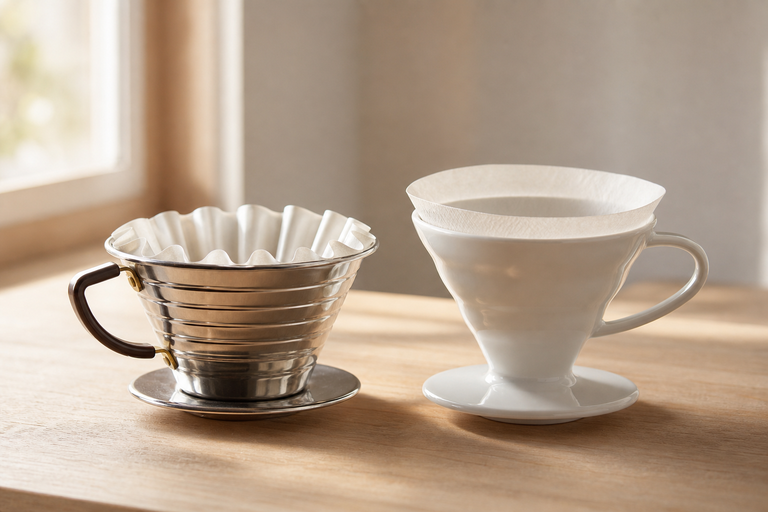
You own a kettle, a basic burr grinder, and a bag of medium-roast beans. One question stops most people in the aisle: Kalita Wave or Hario V60?
They are not equivalent. The two drippers forgive different mistakes, and beginners make very specific ones. What follows ranks them on a single axis: how much sloppiness each absorbs before the cup turns sour, hollow, or bitter.
What “forgiveness” actually means here
Peak ceiling is a distraction in week one. A V60 in expert hands can pull a clearer cup than a Kalita Wave. That fact does nothing for you on a Tuesday morning with an uncalibrated grinder.
For our purposes, forgiveness breaks into three measurable things:
- Pour tolerance: how much your stream speed and pour height can vary before extraction breaks.
- Grind tolerance: how wide a grind window still yields a balanced cup.
- Temperature tolerance: how much water-temp drift the bed absorbs before you taste it.
Channeling is the failure mode behind most beginner disasters. Water punches a hole through the bed instead of flowing through it evenly. Geometry decides how often that happens.
Flat bed vs 60-degree cone
The Kalita Wave has a flat bottom with three small drainage holes and a fluted filter that holds the paper off the walls. Bed depth at 20 g of coffee is roughly 2 cm. Water sits in a shallow puddle and meters through a fixed restriction.
The V60 is a 60-degree cone with one large hole and spiral ribs. The same 20 g piles into a bed roughly 4 cm deep at the center. Flow rate is governed almost entirely by your grind and pour, not by the dripper.
That single difference drives everything below.
Side-by-side comparison
| Attribute | Kalita Wave 185 | Hario V60 02 |
|---|---|---|
| Geometry | Flat bottom, 3 holes | 60° cone, 1 large hole |
| Bed depth at 20 g | ~2 cm | ~4 cm |
| Flow control | Dripper-limited | Pour- and grind-limited |
| Filter cost (100-pack) | $9–14 | $4–8 |
| Filter availability (US/EU) | Moderate, specialty shops | Wide, supermarket common |
| Materials offered | Stainless, glass, ceramic | Plastic, ceramic, glass, metal |
| Entry price (dripper only) | $30–45 | $8–25 |
| Grind window (medium roast) | ~150 µm tolerant | ~80 µm tolerant |
| Pour technique demand | Low | Medium-high |
| Channeling risk | Low | Medium |
| Typical brew time, 20 g | 3:00–3:45 | 2:30–3:30 |
| Peak clarity ceiling | Good | Excellent |
Numbers reflect 20 g coffee, 320 g water, medium roast, paper rinsed.
Where each dripper actually forgives you
Pour speed and height
The Kalita’s three holes function as a flow regulator. Dump water in a wobbly circle from a cheap gooseneck and the flat bed still levels itself between pulses. Last week I brewed a bag of Counter Culture Hologram on mine using a stovetop kettle and almost no pouring technique, and the timer still landed within 10 seconds of target.
The V60 offers no such governor. A fast, high pour digs a crater in the center and water races down the spiral ribs, bypassing grounds. The cup goes thin and sour. A slow, careful pour from 3–5 cm above the bed isn’t optional on a V60. It is the recipe.
Forgiveness winner: Kalita, by a wide margin.
Grind size drift
Most beginners own a grinder with uneven particle distribution: a Baratza Encore, a 1Zpresso Q2, or worse. Your “medium” today is not your “medium” next week.
On the Kalita, I tested grind sizes from medium-fine to medium-coarse (roughly 600–900 µm) with the same recipe. Brew time moved from 3:10 to 3:40. The cup stayed drinkable across the entire range.
The V60 punished that same test. Too fine and the bed clogged at 4:30 with a muddy, bitter finish. Too coarse and the brew finished at 2:10, tasting like grapefruit water.
Forgiveness winner: Kalita.
Water temperature swing
Pour 96 °C water versus 88 °C water into a Kalita and the difference is real but small: a slightly duller cup at the low end. The shallow bed and slow drawdown still extract enough.
The V60 amplifies temperature. At 88 °C with a medium roast, the deep bed under-extracts and the cup goes sour and grassy. At 96 °C with a light roast, you can pull a stunning cup the Kalita cannot match.
Forgiveness winner: Kalita for medium roasts. V60 rewards you only if you control temperature.
Agitation and stirring
The Kalita’s flat bed self-levels, so a clumsy swirl at the start does little harm. The V60’s cone concentrates fines at the tip. Aggressive stirring drives them into the filter and stalls the brew.

Beginner recipes that actually work
Kalita Wave 185, 3-pour:
- 20 g coffee, medium grind (table salt)
- 320 g water at 94 °C
- 0:00 pour to 60 g, swirl gently
- 0:45 pour to 180 g in slow circles
- 1:30 pour to 320 g
- Target drawdown: 3:15 ± 15 s
V60 02, simplified 4:6 (Tetsu Kasuya):
- 15 g coffee, medium-fine grind (slightly finer than table salt)
- 250 g water at 93 °C
- 0:00 pour to 50 g, swirl
- 0:45 pour to 100 g
- 1:30 pour to 175 g
- 2:15 pour to 250 g
- Target drawdown: 3:00 ± 15 s
Four pours, tighter timing. That is the cost of the cone.
Which to buy first, based on your gear
- You have a sub-$150 grinder (Encore, Timemore C2, Q2): Kalita Wave. Your grind distribution isn’t tight enough to feed a V60 cleanly.
- You pour from a stovetop kettle or non-gooseneck electric: Kalita Wave. The V60 needs a gooseneck spout to control flow.
- You drink mostly medium and medium-dark roasts: Kalita Wave. The V60’s strength is light roasts, where its higher ceiling shows up.
- You own a temperature-control gooseneck kettle and a Niche, 1Zpresso K-series, or better: V60. You have the tools to exploit it.
- You buy beans from a supermarket or roast unknown: Kalita Wave. Less variance to manage.
- You travel and want cheap filters anywhere: V60. Hario filters are easier to find globally.
Upgrade path
Start with the Kalita Wave. After three months, once you can hit your brew time within 10 seconds and you’re reaching for single-origin light roasts, add a plastic V60 02 for $8. The ceramic version isn’t necessary. Keep both: Kalita for daily medium roasts, V60 for weekend light roasts.
Verdict by scenario
- Absolute first dripper, any beginner: Kalita Wave 185 in stainless ($38–45). Pick this.
- Tightest budget, willing to learn pour technique: Plastic V60 02 ($8) with a gooseneck kettle. Expect a steeper learning curve.
- Beginner who already owns a quality grinder and gooseneck: V60 02 ceramic. You’ll outgrow a Kalita’s ceiling within a year.
- Beginner who wants one dripper forever: Kalita Wave. It won’t be your best cup ever, but it will rarely be your worst.
The Kalita Wave isn’t for the brewer chasing the cleanest possible light-roast cup, or for anyone unwilling to pay $0.10–0.14 per filter. Everyone else should start there.