
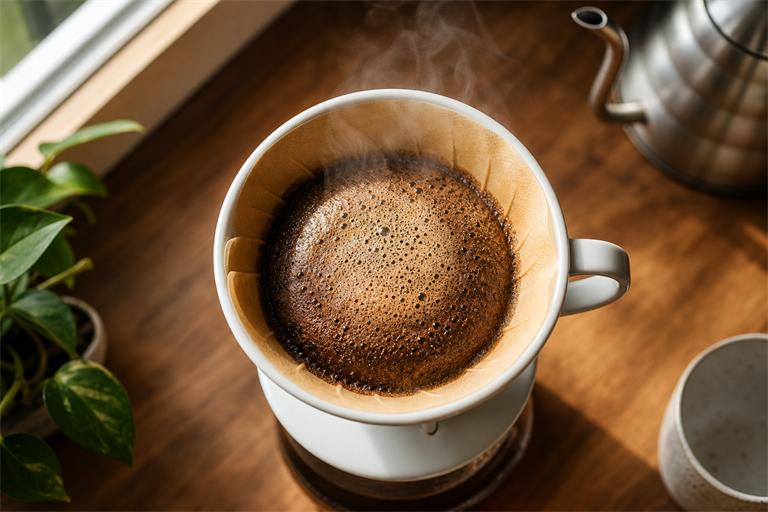
A practical V60 bloom starts with a simple goal: wet the entire coffee bed, then give retained gas a short opportunity to escape before the main pour. Hario’s published starting instruction is to moisten the grounds and wait about 30 seconds. That is a useful baseline, not a universal rule for every roast, coffee or recipe.
For a weighed recipe, begin with roughly twice the coffee dose in bloom water—for example, about 30 g of water for 15 g of coffee—and add more only if that amount does not wet the full bed. Keep the water temperature the same as the main brew. Evaluate complete wetting and repeatability rather than chasing a required dome size or bubble count.
What the coffee bloom actually does
Roasting creates carbon dioxide. Some remains inside the porous roasted bean and leaves gradually in storage, then more rapidly after grinding and when water contacts the coffee. A peer-reviewed time-resolved degassing study links carbon dioxide release to grinding, extraction, freshness and sensory behavior.
During the initial pour, visible bubbles show that gas is escaping while the grounds are becoming wet. Bloom size is not a direct quality score. Roast profile, roast degree, species, grind, dose, pouring and coffee age all affect what is visible.
Mistake 1: using too little water to wet the bed
What to look for: dry islands, pale clumps or an outer ring that remains unwetted when the main pour begins.
A fixed one-to-one bloom ratio may not provide enough liquid because ground coffee absorbs water and the pour is never distributed perfectly. Starting near two-to-one is practical, but the target is complete wetting rather than a sacred number.
Fix: weigh the initial pour and cover the whole bed. If 30 g does not wet a 15 g dose, use a little more on the next brew while keeping every other variable fixed. Do not infer channeling from one dry speck; correct the repeatable wetting problem first.
Mistake 2: treating bloom time as an exact freshness test
What to look for: a recipe that always waits the same long period even when the coffee’s gas activity and drawdown behavior have changed.
Hario’s official V60 guidance uses a 30-second moistening period, and its Drip Scale manual gives the same general sequence. That supports 30 seconds as a clear starting point. It does not support a precise age chart such as “dark roast equals 25 seconds” or “day-nine light roast equals 40 seconds.”
Degassing rate varies with much more than age. A study of roasting conditions and carbon dioxide release found effects from roast degree, time-temperature roast profile and grind size.
Fix: begin around 30 seconds and keep it constant while dialing in. If testing a longer or shorter bloom, change only that duration and judge the finished cup across repeated brews.
Mistake 3: leaving obvious dry pockets
What to look for: clumps that stay visibly dry after the initial pour or a bed wetted only in the center.
Research on extraction uniformity in porous coffee beds identifies incomplete wetting and nonuniform water delivery as factors that can promote uneven extraction. This is a stronger reason to focus on full coverage than any claim that the bloom must form a particular shape.
Fix: pour across the bed with a controlled pattern. A gentle swirl or careful stir can help expose dry material, but choose one method and repeat it consistently. Do not combine a new pour pattern, stronger stirring and a grind change in the same test.
Mistake 4: assuming lower is always better when pouring
What to look for: a weak stream that wets only one region, or an inconsistent stream that breaks into droplets before reaching the slurry.
Common advice says that pouring high automatically drills a hole and creates a channel. Current evidence is more nuanced. A 2025 Physics of Fluids pour-over study found that pour height and flow rate affect bed mixing. An intact jet can create avalanche-like movement in the granular bed, and slower, effective pours can extend mixing and change extraction.
Fix: use a height at which the kettle produces a controllable, unbroken stream and the full bed can be covered. Keep height and flow consistent. Avoid both a stationary jet that excavates one point and a rigid “always 3 cm” rule that ignores kettle geometry.
Mistake 5: making unsupported temperature corrections
What to look for: changing to boiling or much cooler bloom water because a cup is sour or bitter, while grind, flow and strength remain uncontrolled.
Water at boiling temperature does not “scorch” roasted coffee during a bloom, and a cool bloom cannot be assigned a single flavor outcome. Temperature affects extraction dynamics, but taste depends on interacting variables.
In a controlled Scientific Reports sensory study of drip coffee, brews made at 87°C, 90°C and 93°C showed little sensory difference when total dissolved solids and extraction yield were held constant. The experiment used an automated drip brewer rather than a V60, so it does not prove temperature is irrelevant. It does show why “93°C tastes sweet and 100°C tastes ashy” is too categorical.
Fix: use the same measured temperature for bloom and main pours. Adjust temperature only after establishing a repeatable recipe, and change it in small increments. A timer after boiling is not a thermometer; cooling depends on kettle, water mass and room conditions.
Mistake 6: reading bloom drip as a grind-size meter
What to look for: changing the grinder solely because a certain number of grams did—or did not—reach the carafe during the first 20–35 seconds.
Bloom drip depends on the dripper, filter, filter seating, dose, grind distribution, initial water mass, agitation and pouring pattern. There is no supported universal rule that 5–15 g of drip is correct or that “no drip” proves the grind is too fine.
Fix: diagnose grind from repeated full brews. If otherwise identical cups always drain quickly and taste thin, test one step finer. If they consistently stall, test one step coarser. If drawdown varies widely without a grind change, standardize wetting, filter placement and pouring first.
A repeatable V60 bloom baseline
| Variable | Starting point | What matters most |
|---|---|---|
| Coffee dose | Use the amount required by the chosen recipe | Weigh it consistently |
| Bloom water | About 2× coffee mass | Add enough to wet the full bed |
| Bloom time | About 30 seconds | Treat it as Hario’s baseline, not a universal law |
| Temperature | Same as the main brew | Measure rather than guessing from time off boil |
| Pour | Controlled full-bed coverage | Keep flow, height and pattern repeatable |
| Agitation | None or one gentle, consistent motion | Use only what is needed for complete wetting |
How to test one bloom change
- Write down dose, total water, grind, temperature and main-pour schedule.
- Brew once with the 30-second, approximately two-to-one baseline.
- Record dry pockets, drawdown time and the cup’s acidity, sweetness, body and finish.
- Repeat the same brew to check whether the result is stable.
- Change one bloom variable: water amount, time, pattern or agitation.
- Compare only after the cup cools to a similar drinking temperature.
Quick bloom troubleshooting table
| Observation | First adjustment |
|---|---|
| Dry grounds remain | Improve coverage or add a small amount of bloom water |
| One deep crater forms | Move the stream rather than holding it on one point |
| Results vary greatly between brews | Standardize water mass, pour timing, filter placement and agitation |
| Consistently fast full drawdown with a thin cup | Test one grinder step finer |
| Consistently stalled full drawdown | Test one grinder step coarser or reduce unnecessary agitation |
| Large bloom but good flavor | Do not fix a visual that is not causing a cup problem |
| Small bloom but good flavor | Keep brewing; small bloom does not prove staleness |
The takeaway
A good pour-over bloom is a repeatable initial wetting step, not a performance. Start with enough water to wet the bed and about a 30-second wait, use the same temperature as the main brew, and keep pouring consistent. Then judge the entire brew. Complete wetting has scientific support; exact bubble counts, age-based bloom tables, fixed drip weights and automatic flavor diagnoses do not.