
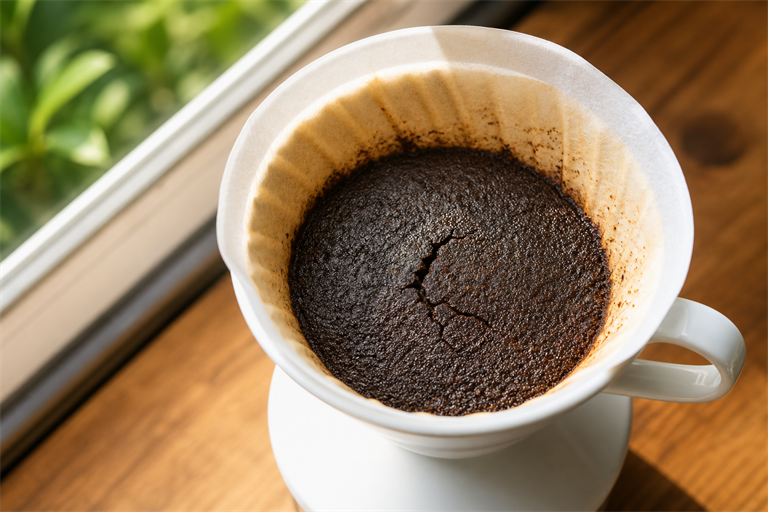
Channeling in pour-over means water does not travel uniformly through the coffee bed. Some regions receive more flow while others receive less, producing uneven extraction. The practical challenge is that a spent V60 bed cannot reveal every path the water took. A crater, wall ring or unusual drawdown is a reason to investigate, not proof by itself.
The best fix is a controlled repeatability check: level and fully wet the grounds, use the same pour each time, compare several brews, and change only one variable.
What channeling is—and what it is not
A coffee bed is a porous material. Water tends to move more readily through regions with higher permeability and more slowly through regions with greater resistance. Differences in particle size, bed structure, wetting and water delivery can therefore create nonuniform flow.
Peer-reviewed computational fluid-dynamics research on porous coffee beds examined both cylindrical and truncated-cone geometry similar to drip and pour-over brewing. The authors found that bed geometry and nonuniform flow affect extraction uniformity, and noted that incomplete wetting, nonuniform water delivery and an inhomogeneous bed can promote uneven extraction.
That evidence supports the underlying mechanism. It does not establish that every sour-and-bitter cup is channeled, that a specific crater proves a channel, or that one total brew time works for every V60 recipe.
Observable signs worth checking
| Observation | What it can tell you | What it cannot prove |
|---|---|---|
| Dry grounds remain after the initial pour | Initial wetting was incomplete | The exact route water later followed |
| A deep crater forms under the stream | The pour strongly displaced the bed | That the finished cup must be under-extracted |
| Drawdown changes greatly between identical recipes | The process is not repeatable | Whether grind, pouring, filter seating or another factor is responsible |
| The cup is simultaneously sharp and drying | Extraction may be uneven | Channeling as the only possible cause |
| Grounds remain high on the paper wall | The final bed shape or pour pattern moved particles outward | That water bypassed the coffee |
Use two or more repeatable observations before diagnosing the process. Taste, drawdown and preparation notes are more informative together than a photograph of the spent bed alone.
Step 1: make the starting bed repeatable
- Use the same V60 size and filter for each comparison.
- Rinse and seat the paper consistently so folds or poor placement do not become a new variable.
- Add a weighed dose of freshly ground coffee.
- Gently shake or tap to create a level bed without compacting it heavily.
- Make a small center indentation only if it is part of the chosen recipe; keep it the same every time.
A separate dry-ground needle routine is not required by Hario and is not proven to eliminate most V60 channeling. If any distribution technique is tested, compare it against an otherwise identical brew rather than presenting it as a universal cure.
Step 2: wet the whole bed
Hario’s published V60 instructions tell users to moisten the grounds and wait 30 seconds before continuing. Hario’s V60 Drip Scale manual likewise instructs a slow initial pour to moisten the coffee, followed by about 30 seconds of dripping.
Use enough initial water to visibly wet all grounds. A two-to-one water-to-coffee bloom is a common recipe starting point, but it is not a law; highly absorptive coffee or a very gentle pour may need more water for full coverage. The objective is complete wetting with a repeatable amount and pattern.
If dry clumps remain, correct the pour before changing grind. A gentle swirl or careful stir can be tested, but aggressive agitation may move fine particles and change drawdown, so use the same motion each time.
Step 3: make the main pour consistent
Choose a simple pattern—centered circles or controlled pulses—and repeat the same water mass and timing. Keep the stream unbroken when possible and avoid striking one point for the entire brew.
Rigid rules such as “always pour 3 cm above the bed” are not supported by current research. A 2025 Physics of Fluids study of pour-over mixing used transparent granular beds to observe flow and real coffee to measure extraction. It found that pour height and flow rate change bed mixing; an intact jet from greater height can create useful avalanche-like mixing, while slower effective pours can prolong mixing and alter extraction.
The lesson is not “pour as high as possible.” A stream that breaks into droplets behaves differently, and every kettle has a different jet. The defensible advice is to choose a controllable height and flow, keep them consistent, and evaluate the result rather than treating low height as automatically safer.
Step 4: separate a grind problem from a process problem
| Pattern across repeated brews | More likely direction | Next test |
|---|---|---|
| All brews drain consistently fast and taste thin | Grind may be too coarse for the recipe | Move one small step finer |
| All brews drain consistently slowly | Grind may be too fine or fines may be restricting flow | Move one small step coarser |
| Drawdown swings widely with the same grind | Pouring, wetting, filter placement or measurement may be inconsistent | Standardize technique before changing grind |
| Time is repeatable but taste is unbalanced | Recipe or coffee may need adjustment | Change one of ratio, grind or temperature, not all three |
There is no universal “too fast” or “too slow” time for a 15 g V60. Dripper size, paper, coffee, roast, grind distribution, water and pour structure all affect drawdown. Compare against the normal range of the same recipe.
A three-brew channeling test
- Brew one: establish the baseline. Record dose, water, temperature, grind, bloom amount, pour schedule, drawdown and taste.
- Brew two: repeat without adjustment. If time and taste differ greatly, technique repeatability needs attention before grind changes.
- Brew three: change one suspected cause. Improve complete wetting, simplify the pour, or move one grind step—only one.
Repeatability is the central test. One clean-looking bed can accompany an uneven brew, and one untidy bed can still produce a good cup.
What about TDS and the SCA brewing chart?
A refractometer measures beverage concentration, not the uniformity of every region in the coffee bed. A channeled and an evenly extracted brew can potentially reach similar average readings while differing internally.
The Specialty Coffee Association’s Certified Home Brewer requirements use 1.15–1.45% soluble concentration and 18–22% extraction as equipment test criteria. They also require that all coffee in the basket be wetted during the first minute for an opportunity at proper extraction. Those values are useful context, but they are not a universal V60 taste guarantee or a channeling detector.
Fast troubleshooting checklist
- Weigh coffee and water.
- Use the same filter and rinse routine.
- Level the dry bed consistently.
- Wet every visible area during the initial pour.
- Keep bloom mass and wait time repeatable.
- Use a controlled, unbroken stream and a simple pattern.
- Do not diagnose from spent-bed appearance alone.
- Compare at least two unchanged brews before adjusting.
- Change only one variable per test.
The takeaway
V60 channeling is best understood as nonuniform flow through a porous coffee bed. Research supports complete wetting and consistent water delivery as important controls, but it does not validate universal crater rules, fixed drawdown cutoffs or a single distribution trick. Build a repeatable baseline, compare several brews, and use one-variable tests. That will fix more uneven pour-overs than chasing the shape of the final bed.