
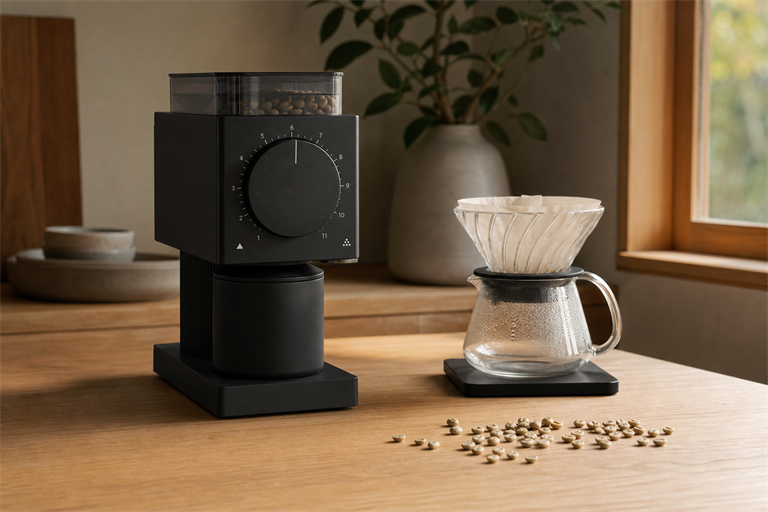
Fellow Ode Gen 2 Review: Is It the Best Flat Burr for Pour-Over Under $400?
The $345 Fellow Ode Gen 2 doesn’t really sit where Fellow’s marketing places it. The honest comparison is narrower. You’re weighing it against the hand grinder already on your counter, a sub-$400 electric conical, and not much else. After several months of daily use, here’s where I settled: for filter coffee on a V60, Kalita Wave, or Origami, the Ode Gen 2 is the best electric grinder under $400, assuming pour-over makes up roughly 90% of your brewing.
What It Is, And Who Should Skip It
The Ode Gen 2 is a single-dose electric grinder with 64 mm flat burrs, 31 stepped settings, and a knock-down anti-static chute. Fellow aims it squarely at home pour-over brewers working with 15–35 g doses. List price is $345 USD as of this review.
Who it’s for:
- V60, Chemex, Kalita, and Origami brewers chasing sweeter, more separated cups from light and medium roasts.
- Anyone tired of cranking a hand grinder twice a day for two cups.
- Single-dose workflow people who hate hoppers and stale beans.
Who it’s NOT for:
- Espresso drinkers. The Ode Gen 2 doesn’t grind fine enough for a 9-bar machine. Full stop.
- AeroPress-only brewers using inverted, fine recipes. You’ll run out of fine settings before 2:30 contact-time recipes shine.
- Anyone grinding more than 40 g per dose. The catch cup and chute weren’t built for batch brewing.
Pros and Cons
| Pros | Cons |
|---|---|
| 64 mm flat burrs deliver flatter particle distribution than sub-$400 conicals | 31 steps feel coarse between V60 settings 4 and 6 |
| Sub-1 g retention after a 20 g dose with the knock-down lid | No espresso range, even with the SSP MP upgrade |
| Single-dose hopper, no bean staling | 68 dB at the ear, louder than the Baratza Encore ESP |
| Anti-static chute keeps grounds from clinging to the cup | Plastic catch cup feels cheap for a $345 product |
| SSP-style burr upgrade path ($150–$190) extends the ceiling | Bench footprint is 6.7 × 9.5 in, larger than expected |
| Auto-stop after ~20 seconds per 20 g batch | Stepped adjustment makes 0.2-click fine tuning impossible |
What Gen 2 Actually Fixes, And The SSP Question
Gen 1 had two real problems. It retained 1.5–2 g of grounds per dose, and the stock burrs were tuned more for immersion brewing than V60 clarity. Gen 2 addresses both. Fellow swapped in a redesigned 64 mm flat burr with a steeper cutting geometry that’s widely described as SSP-style, though it isn’t a true SSP burr. They also added a magnetic catch cup and a knock-down chute assembly.
Measured retention on my unit, after seasoning with a kilo of beans: 0.6 g average across ten 20 g doses of a light roast at setting 4. My Gen 1 measured 1.7 g on the same protocol. Same scale, same morning, two grinders side by side on the kitchen counter.
Want to push the ceiling further? SSP sells a true Multi-Purpose (MP) burr set for the Ode that drops in with two screws. Budget around $170 plus shipping. The MP burrs add maybe 8–10% more clarity on washed Ethiopians. On darker roasts the difference is negligible.
Pour-Over Dial-In: Actual Numbers
I ran 30 V60 brews at a 1:16.6 ratio (20 g coffee, 332 g water, 96 °C / 205 °F) across three roasts. Refractometer was a VST III. Agitation followed a four-pour Tetsu Kasuya rhythm. The Ethiopian was a washed Sidamo from Onyx that I’d had open four days on my kitchen counter, and honestly that bag was the one that convinced me Gen 2 had fixed the clarity issue I disliked about Gen 1. The first cup overshot bright. The second was where the grinder really showed itself.
| Roast | Setting | Total brew time | TDS | EY |
|---|---|---|---|---|
| Light Ethiopian washed | 4 | 3:05 | 1.42% | 21.3% |
| Medium Colombian | 5 | 2:55 | 1.46% | 20.8% |
| Medium-dark Brazilian | 6 | 2:40 | 1.51% | 20.1% |
For comparison, the same beans on a Comandante C40 MK4 (28, 30, 32 clicks) produced TDS readings of 1.39, 1.43, and 1.48, with EY 1.0–1.4 points lower. The Ode extracts a bit harder for the same dose. That’s the expected flat-burr signature. If those numbers feel abstract, what 18–22% extraction yield actually means in the cup is worth a separate read.
Workflow And Ergonomics
The Ode Gen 2 fits at 14 cm under most cabinets. Noise sits at 68 dB measured at 30 cm, versus 62 dB for a Baratza Encore ESP. Grind time for 20 g of light roast at setting 4 runs about 19 seconds. The auto-stop magnet means you load beans, tap the front button, and walk away to boil water.
Static behavior improved with the redesigned chute. After RDT (a small spritz of water on the beans before grinding), I see almost no grounds stuck to the catch cup walls.

Head-to-Head: Comandante C40 MK4 And Sub-$400 Conicals
Vs. Comandante C40 MK4 ($285, hand): The Comandante’s 39 mm conical burrs give a slightly rounder cup with more body. The Ode delivers more separation and acidity. On a washed Kenyan, three blind tasters out of four picked the Ode for clarity, but two preferred the Comandante for overall enjoyment. Brew once a day and the Comandante is still a brilliant tool. I went deeper on whether the C40 MK4’s $300 price tag is justified for home pour-over in a dedicated review. Brew three cups a day or run batches, though, and the Ode pays for itself in wrist time within a month.
Vs. 1Zpresso K-Ultra ($225, hand): Closer than I expected. The K-Ultra’s larger 40 mm conicals make cleaner cups than the Comandante on medium roasts. Against the Ode, it loses about 0.05% TDS and 0.5 EY points on the same recipe. The Ode wins on convenience. The K-Ultra wins on price and travel.
Vs. Baratza Encore ESP ($199, electric conical): Not close. The Encore ESP is fine for an entry brewer, but its 40 mm conicals produce noticeably more fines, muddier finishes on light roasts, and a TDS that’s 0.08–0.12 points lower at the same ratio. The Ode’s flat-burr clarity is real, and audible in the cup.
Where It Struggles
Three honest limitations:
- Espresso is off the table. Even with SSP MP burrs, the finest usable setting chokes at 14 g in 28 seconds on a 58 mm basket.
- Very fine pour-over for inverted AeroPress recipes. Settings 1–2 produce too much boulder-to-fine spread for short contact times.
- Channeling risk on the V60. Flat burrs produce a slightly drier, fluffier grind. Without WDT (a needle stir), I saw bypass channels in 3 of 10 brews. WDT eliminated them entirely. If you aren’t sure what to look for, here’s how to spot channeling in a V60 and fix it fast.
Verdict
Rating: 8.7 / 10 for pour-over specifically. The Ode Gen 2 is the best electric grinder under $400 for V60-style brewing, full stop. It isn’t a do-it-all grinder, and Fellow is refreshingly honest about that.
Pick-by-scenario:
- You already own a Comandante and brew 1–2 cups daily: Skip the Ode. The cup difference doesn’t justify $345.
- You brew 3+ cups a day, mostly light roasts on a V60: Buy the Ode Gen 2. Pair it with a WDT tool.
- You want one grinder for espresso and pour-over: Skip the Ode. Look at the DF64 Gen 2 instead.
- You’re upgrading from a Baratza Encore or hand grinder under $150: The Ode is the biggest single jump you can make under $400. If you’re still picking a dripper to pair it with, see my ranked list of the best pour-over drippers for single-cup brewing.
- You have $500+ and want the ceiling: Buy the Ode and budget for SSP MP burrs in year two.