
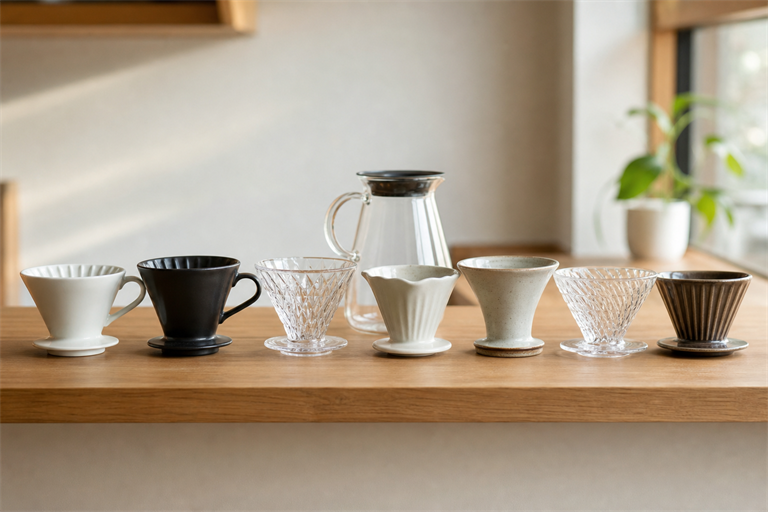
Seven single-cup drippers. Same Kenya, same water, same pour. I ranked them on what I actually noticed in the cup, not on spec sheets, and clarity carried the most weight.
How I ran the test
One variable changed per brew: the dripper itself. Everything else was locked down.
- Beans: Washed Kenya Kirinyaga (light roast), 12 days off roast.
- Dose: 15 g in, 250 g out (1:16.7 ratio).
- Grinder: 1Zpresso K-Ultra at 70 clicks (about a fine-medium pour-over grind).
- Water: Third Wave Water Classic profile, brewed at 94°C (201°F).
- Method: 45 g bloom for 40 seconds, then three 70 g pulses, finish by 3:15.
- Filters: OEM filter for each dripper, rinsed with 200 g of hot water.
I scored each dripper 1–10 on four axes: clarity (can I taste distinct notes?), sweetness (does it pull sugars before bitterness?), body (mouthfeel weight), and forgiveness (how badly a sloppy pour wrecks the cup). Clarity counts double.
A quick map of how dripper geometry affects extraction:

1. Origami Dripper M (with conical Cafec filter), Clarity 9.5/10
Ribbed walls hold the filter off the cone, so airflow stays high and the bed drains evenly. With a conical filter, it behaves like a fast V60, only the flow rate stays steadier across the brew. My Kenya pulled blackcurrant and tomato-leaf notes that flatter drippers smudged together. About $58 in ceramic.
- Body: light-to-medium, very articulate.
- Ideal roast: light to light-medium.
- Not for you if: you brew dark roasts or want a thick, syrupy cup.
- Takeaway: the most clarity per dollar if you grind fresh and pour cleanly.
2. Hario V60-02 (ceramic), Clarity 9.0/10
Still the reference conical. A single large hole and spiral ribs hand the brew over to your pour, for better and worse. With a careful 4-pulse pour, acidity was bright and defined, and the finish was clean. Sloppy pours got astringent fast. About $28.
- Body: light, tea-like.
- Ideal roast: light to medium.
- Not for you if: you’re new to pour-over and don’t want to learn pour discipline.
- Takeaway: highest clarity ceiling at the lowest price, if you put in the reps.
3. Orea V4 (with flat-bottom paper), Clarity 8.7/10
Flat bed, wide drainage, very low flow restriction. Set next to a Kalita, the Orea drained faster and pulled more sweetness without losing definition. With the V4 base it ran nearly as fast as a V60, but kept the even bed of a flat-bottom. Around $50.
- Body: medium, juicy.
- Ideal roast: medium and medium-light, especially Ethiopians.
- Not for you if: you already own a Kalita Wave and brew only one roast level.
- Takeaway: the best hybrid pick if you want clarity without conical fussiness.
4. April Plastic Brewer, Clarity 8.5/10
Flat-bottom shape, three small holes, tall walls that trap heat. Forgiving to off-center pours because the bed self-levels. Last week I ran this with a washed Colombian from Onyx at my kitchen counter, and the sweetness was the standout: caramelized sugar, almost panela. Plastic also keeps temperature stable shot to shot. Around $32.
- Body: medium, rounded.
- Ideal roast: medium-light to medium.
- Not for you if: you hate plastic in your brew kit.
- Takeaway: the easiest dripper here to get a sweet, clean cup on the first try.
5. Kalita Wave 155 (steel), Clarity 8.0/10
The classic flat-bottom for one cup. Three small holes meter the flow, so the brew stays stable even when your pour wobbles. Clarity is good but not surgical. Notes blend into a comfortable “sweet and balanced” register. Steel cools faster than ceramic, so preheat the dripper. About $42 with a 50-pack of filters. If you’re still torn between geometries, my head-to-head comparison of the Kalita Wave and V60 for beginners goes deeper into which dripper forgives mistakes.
- Body: medium-full.
- Ideal roast: medium to medium-dark.
- Not for you if: you chase floral or fruit-acid clarity in light roasts.
- Takeaway: the most forgiving cup on this list, and the easiest daily driver.
6. Cafec Flower Dripper CFD-1, Clarity 7.8/10
Twenty vertical ribs, single large hole. Similar in spirit to a V60, only faster-draining. It rewards a slower pour because it drains so quickly. With a 3:30 total brew time, the cup was sweet and clean, though slightly thinner than the V60. About $22 in plastic, $30 in ceramic.
- Body: light, brisk.
- Ideal roast: light to medium-light.
- Not for you if: you want a slow, meditative brew rhythm.
- Takeaway: cheap entry to conical brewing if you can pour patiently.
7. Clever Dripper (small, 300 ml), Clarity 7.2/10
Immersion-then-drain. Technique barely matters. Steep 3 minutes, release into the cup, done. Clarity is the lowest here because the long immersion extracts more solubles uniformly, including some bitter ones near the end. On a busy morning, it still beats a rushed V60 every time. About $25.
- Body: full, heavy.
- Ideal roast: medium to dark.
- Not for you if: you specifically want light-roast clarity.
- Takeaway: the best dripper for people who don’t want to think before coffee.
Geometry matters more than brand
| Geometry | Best for | Weakness |
|---|---|---|
| Conical (V60, Cafec) | Clarity, light roasts | Punishes sloppy pours |
| Flat-bottom (Kalita, April) | Sweetness, beginners | Less articulate on lights |
| Hybrid (Orea, Origami) | Clarity + body | Costs $50+ |
| Immersion (Clever) | Convenience, dark roasts | Lower clarity ceiling |
Filter and pour notes that shifted the ranking
- Cafec Abaca+ filters in the V60 improved clarity by roughly half a point versus the standard Hario tabbed filter. They drain faster and contribute less paper taste.
- Rinse with at least 200 g of water. Skipping the rinse cost me clarity on every dripper, especially the April and Kalita.
- Pour height matters. A 5 cm pour from the kettle agitated the bed and added body. A 15 cm pour added clarity but risked channeling.
- Preheat the metal and ceramic drippers. A cold Kalita 155 dropped slurry temperature 3°C in my tests.
Best pick by scenario
- Light-roast clarity, money no object: Origami M with a conical Cafec filter.
- Light-roast clarity on a budget: Hario V60-02 ceramic plus Cafec Abaca+ filters.
- Medium-roast sweetness: Orea V4 with the flat base.
- Beginner, wants a good cup on day one: April Plastic Brewer.
- Daily driver, low fuss: Kalita Wave 155.
- Travel or office: Clever Dripper.
- Dark roasts or you want body over clarity: Clever Dripper or Kalita.
Verdict
For single-cup flavor clarity in 2026, the Origami M with a conical filter wins outright. The V60-02 is the smarter buy if you’re willing to practice your pour. Everything else on this list earns its spot, but those two define the clarity ceiling. Once you’ve picked your dripper, the next clarity gains usually come from your bloom. The most common pour-over bloom mistakes that wreck extraction are worth fixing before you blame the gear. And if you want to put real numbers behind these clarity scores, learning what 18–22% extraction yield actually means in TDS terms will sharpen how you taste every brew on this list.