
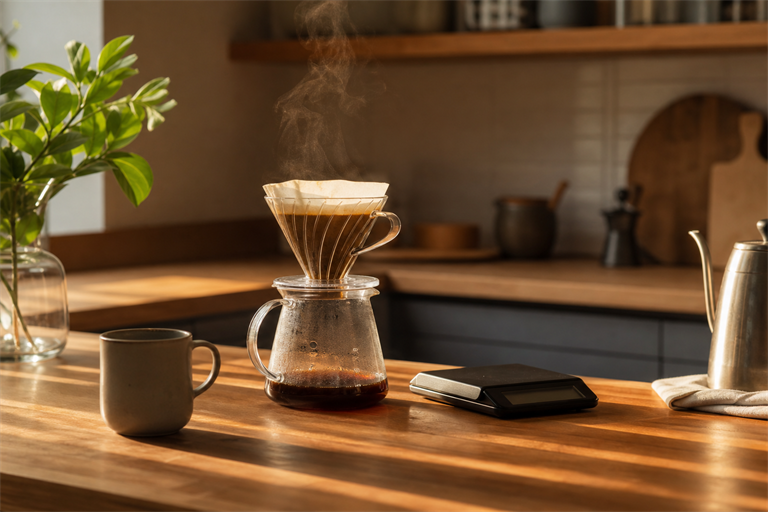
Here’s the puzzle that sent me down this rabbit hole last winter: two mornings in a row, same bag, same 15 g, same 250 g, same kettle. One cup sang. The next tasted like wet paper with a lemon squeeze. Nothing in the recipe had changed on paper.
The fix lives inside two numbers most home brewers never look at directly: TDS and extraction yield. Once they click, recipes online stop reading like incantations.
The Two Numbers That Decide Every Cup
TDS describes how strong the coffee tastes. Extraction yield describes how much you actually pulled out of the grounds. For pour-over, the SCA-mapped sweet spot sits around 1.15–1.45% TDS paired with an 18–22% extraction yield. You can land in it by palate alone.
TDS (Total Dissolved Solids) is the percentage of your brewed cup made of dissolved coffee rather than water. A reading of 1.35% means 1.35 grams of every 100 grams in your mug are coffee solids. Water is the rest.
Extraction yield (EY) is the percentage of the dry grounds that ended up in the cup. If 15 g of coffee gives up 3 g of solids into the brew, that’s a 20% extraction.
A worked example. Brew 15 g of coffee with 250 g of water, and roughly 225 g of liquid arrives in the server (the bed holds the rest). If that liquid reads 1.35% TDS, you dissolved about 3.04 g of coffee. That works out to a 20.2% extraction yield. Dead centre.
Why the SCA Brewing Control Chart Still Matters
The Specialty Coffee Association plotted these two values on a grid called the brewing control chart. Across decades of taste panels, the same window kept coming back as “balanced”:
- Under 18% EY: under-extracted. Sour, salty, sharp, vegetal.
- 18–22% EY: the sweet spot. Sweet, balanced, clear flavours.
- Over 22% EY: over-extracted. Bitter, drying, ashy, hollow finish.
TDS sets the thickness of those flavours. Below 1.15% the cup tastes watery. Above 1.45% it starts to taste muddy. Pour-over reads best at roughly 1.15–1.45%.
Those two numbers are tied together by your brew ratio (coffee-to-water). At 1:16.7 (15 g coffee, 250 g water), a 20% extraction lands near 1.35% TDS on its own. That’s why nearly every V60 recipe online sits somewhere between 1:15 and 1:17.

Strength and Extraction Are Not the Same Thing
A common move when a cup tastes weak is to scoop in more coffee. That raises TDS, sure. It does nothing for a sour, under-extracted brew. The grounds are still under-extracted. You just have more of them in the mug.
Here’s how to tell which problem is actually on the counter:
- Sour or salty up front, fades fast? Under-extracted. Grind finer or brew longer.
- Bitter, drying, lingers unpleasantly? Over-extracted. Grind coarser or brew shorter.
- Tastes correct but watery? Strength issue. Use more coffee or less water.
- Tastes correct but heavy and muddy? Use less coffee or more water.
Extraction is governed by grind size and contact time. Strength is governed by ratio. Fix them separately, in that order, and the cup tends to fall into place.
Walking the Chart Without a Refractometer
Pick a baseline recipe. Change one variable at a time. For a Hario V60 02:
- Start at 15 g coffee, 250 g water (1:16.7), 93°C water, medium grind (roughly coarse table salt). Bloom for 30–45 s with 45 g of water, then keep steady pours so the full brew finishes between 2:45 and 3:15.
- Taste it. Decide: sour, balanced, or bitter?
- If sour, grind one notch finer. If bitter, grind one notch coarser. Keep everything else identical.
- Brew again. Repeat until the cup is sweet and clean with no sharp edges.
That single loop walks you across the brewing control chart by feel. I ran it last week with an Ethiopian Yirgacheffe from Onyx Coffee Lab. First try landed sour and lemony. One notch finer on my Kingrinder K6 pulled the sweetness forward, and the total brew time drifted from 2:50 to 3:05 on its own. No math. No meter.
Do You Actually Need a Refractometer?
A coffee refractometer (VST or DiFluid) runs $150–$700. It reads TDS in seconds, and a free app does the extraction-yield math for you. Useful? Yes. Necessary? No.
Buy one if you’re dialing in three or more new coffees a month, or you can’t yet reliably separate sour from bitter and want a second opinion. Skip it if you stay on the same beans for two weeks at a stretch. Your palate will catch up faster than the gear pays off.
The Numbers Worth Pinning Above the Kettle
- Ratio: V60 at 1:16.7, AeroPress at 1:14–1:16, Chemex at 1:16–1:17.
- Water temperature: 92–96°C (198–205°F), measured, not guessed.
- Total brew time: V60 2:45–3:15, AeroPress 1:30–2:00, Chemex 4:00–5:00.
- Grind check: sour cup, finer; bitter cup, coarser. Change nothing else on that brew.
- Taste log: write down the grind setting and the verdict (sour / balanced / bitter) after every cup.
One job for tomorrow morning. Brew your usual recipe, note whether it leans sour, balanced, or bitter, then move only the grind on your next pour. That one habit drops you inside the 18–22% window faster than any new gadget will.