
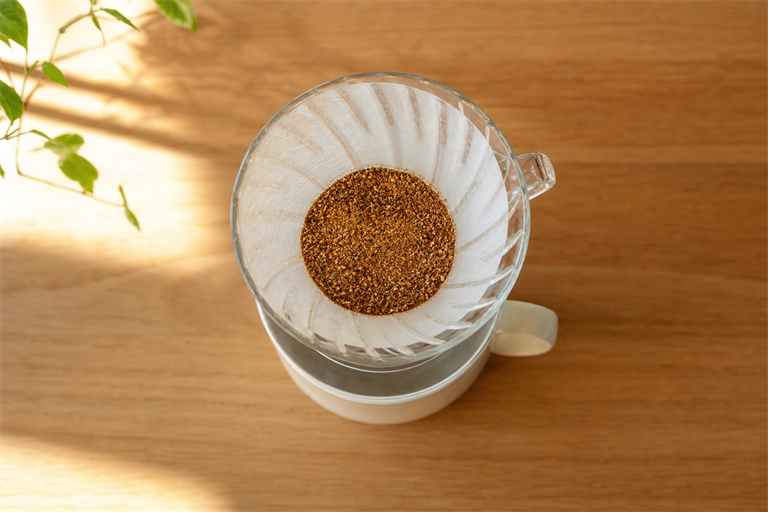
Six months ago my standard pour-over was 19g in, 305g out, every morning, no thinking required. Now it’s 12g. So is my partner’s. So is the recipe printed on the back of the last three light-roast bags I’ve bought. Something has shifted in home pour-over, and once you spot it on one bag you start seeing it everywhere.
From a 20g Default to 12g Brews
For roughly a decade, the default home pour-over has been 20g of coffee to 300–320g of water, a 1:15 to 1:16 ratio popularised by competition recipes and the original Hario V60 guide. That default is breaking down.
Three things shifted in 2026. Arabica futures spent most of the year above $3.80/lb after the 2025 Brazilian frost reports, pushing 250g specialty bags in the US to $24–32. Roasters leaned harder into light and ultra-light profiles to showcase washed Ethiopians and Colombian Geshas, which extract differently than the medium roasts the 20g recipe was built around. And the 2025 World Brewers Cup top six all used doses at or below 15g, with two competitors brewing 12g.
Home brewers followed. Reddit’s r/pourover saw “low dose” mentioned in roughly 4x as many threads in Q1 2026 as in Q1 2025, by the moderators’ own published thread counts.
The Numbers Behind the Shift
| Metric | 2022 baseline | 2026 current |
|---|---|---|
| Typical home pour-over dose | 20g | 12–15g |
| Common ratio | 1:15 – 1:16 | 1:16.5 – 1:18 |
| Average US specialty 250g bag | $18 | $24–32 |
| Brews per 250g bag (at typical dose) | ~12 | ~18–20 |
| Arabica futures (NY-C, year avg) | $2.10/lb | $3.80+/lb |
| WBrC finalists using ≤15g dose | 2 of 6 | 6 of 6 |
The bag-economics line is the one most home brewers actually feel. Dropping from 20g to 13g per brew turns a $28 bag from about 12 cups into about 19. That math survives a Tuesday morning.
Who Pushed This Forward
- Tetsu Kasuya, His “4:6 Method” videos and 2025 update tour pushed a 15g/225g recipe (1:15) as the default for light roasts, but his more recent demos use 12g/200g for single-origin Ethiopians.
- Lance Hedrick, His YouTube channel has spent 2025–2026 systematically testing sub-15g recipes, popularising the “Hario Switch low-dose” approach and a 12g/210g flat-bottom recipe that home brewers have cloned widely.
- James Hoffmann, His updated V60 video (late 2025) explicitly acknowledged shrinking competition doses and tested 15g/250g (1:16.6) as a new starting point for lighter roasts.
- Onyx Coffee Lab and Sey Coffee, Both now print 13–15g recipes on their light-roast bags, where the back label used to say 20g.
- Hario, The 2026 release of the V60-01 Clear in larger numbers signals real demand for a single-cup dripper sized for 10–14g doses, not the 18–22g the 02 was designed around.
Why Sub-1:16 Works for Today’s Light Roasts
A 12g bed in a V60-02 is shallow, roughly 8–10mm deep instead of 18–22mm. Shorter water path. That means you can grind finer without choking the brew, and finer grind plus higher water temperature (96–98°C / 205–208°F) is exactly what dense, lightly-roasted Geshas and washed Ethiopians need to hit 21–23% extraction.
A 1:17 or 1:18 ratio compensates for the smaller dose by giving each gram of coffee more solvent, which lifts clarity and florals without thinning the cup. I ran this last week with a 100g bag of Onyx’s Kayon Mountain on my Comandante C40, dropping from a 19g/305g brew to 12g/204g, and the cup went from a heavy, slightly muddled stone-fruit to a clean apricot-and-jasmine thing my partner noticed before I said anything.
Anatomy of a 12g Recipe
A practical starting point for a single-cup light-roast brew:
- Dose: 12g
- Water: 204g (1:17)
- Grind: 1–2 clicks finer than your usual V60 setting
- Temp: 96°C (205°F)
- Dripper: V60-01 or Origami S, paper filter
- Bloom: 36g water, swirl, wait 35 seconds
- Pour 1: to 120g by 1:15
- Pour 2: to 204g by 1:50
- Total brew time: 2:30–2:45
- Target TDS: 1.40–1.45% (within the SCA 1.15–1.45 brewing chart band)
Where Low-Dose Brews Go Wrong
They fail in specific, predictable ways. The cup goes thin when the ratio stretches past 1:18 without a finer grind to match. Sourness shows up when temperature drops below 94°C on a shallow bed, because there isn’t enough thermal mass to finish extraction. Channeling is more visible because the bed is thinner, so an uneven bloom pour ruins the brew in a way a 20g bed would have hidden.
Body is the real concession. A 12g/204g brew tastes cleaner and more tea-like than a 20g/320g brew of the same coffee. If you like a syrupy cup, low-dose isn’t for you.
What It Means at Your Kitchen Counter
Brewing light-roast single origins at home? A 12–15g recipe will stretch your bag, suit your beans, and match what competition brewers are doing. You’ll need to regrind. Your old V60 setting is too coarse for the shallower bed. Think about a smaller dripper too, because a V60-02 with 12g leaves too much exposed paper and cools the slurry too fast.
What to Watch Next
Three signals will tell you whether this is a lasting shift or a 2026 spike:
- Hario V60-01 sales outpacing the V60-02 in retailer year-end reports, which would confirm hardware is following the recipe trend.
- Roaster brew cards on new releases from Onyx, Sey, Tim Wendelboe, and April defaulting to ≤15g, which would confirm the supply side is committed.
- Arabica futures falling back below $2.50/lb without doses returning to 20g, which would prove the trend is taste-driven, not just economic.
Watch your own cup for the tell. A 12g brew that tastes thin and sour usually means your grind didn’t follow your dose down. Fix the grind first, the ratio second.