
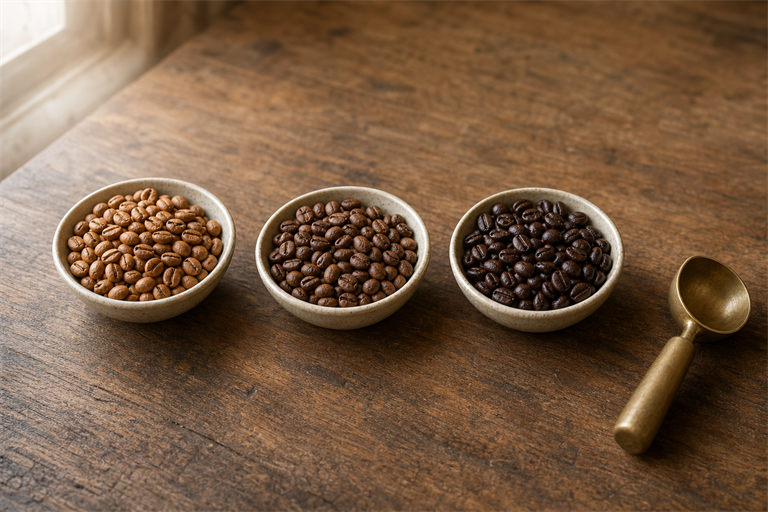
Last Tuesday I weighed out 15 g of a Kenyan from Sey at what my Baratza Encore calls setting 18, poured 250 g of water at 96 °C, and pulled a 3:10 brew that tasted like sweet grapefruit. Same grinder, same kettle, same V60 on Wednesday with a dark Italian blend from a supermarket bag. The cup came out flat, ashy, and almost syrupy. The recipe did not change. The bean did.
That gap is what roast level actually means at your kitchen counter. Not a flavor wheel. A different physical object going into the same brewer.
What the roaster is doing to the bean
A green coffee bean is about 10 to 12 percent water, dense, and grassy-smelling. Roasting drives off moisture, browns sugars and proteins (the Maillard reaction), then caramelizes them, and eventually pyrolizes the structure into smoky compounds.
Two audible milestones matter to you as a buyer.
First crack happens around 196 to 205 °C inside the drum. Steam pressure cracks the bean open, sugars are browning, acids are still bright. A roast stopped 30 to 90 seconds after first crack ends is what most specialty roasters call light.
Second crack kicks in around 224 to 230 °C. Cell walls fracture, oils migrate to the surface, the bean shines. Anything taken into or past second crack is dark. The space in between is medium.
That is not folklore. It is a temperature window you can read off any home roaster’s data log.
Agtron numbers and moisture loss, in plain terms
Roasters do not eyeball color anymore. They use an Agtron meter, which shines near-infrared light at ground coffee and returns a number from roughly 25 (very dark) to 95 (very light). Lower number, darker roast.
A rough field guide for what you will find on bags:
| Roast | Agtron (ground) | Moisture loss | Surface oil |
|---|---|---|---|
| Light | 70–85 | 11–13% | None, dry and matte |
| Medium | 55–70 | 13–16% | None to slight sheen |
| Dark | 25–55 | 16–22% | Visible, sometimes wet |
Why the moisture number matters: every percent of water the roaster drives off makes the bean lighter, more porous, and more brittle. A dark roast bean weighs less per scoop and breaks apart faster in the grinder. That changes everything downstream.
Why dark roasts give up their flavor faster
Here is the part that took me years to internalize. Light and dark roasts are not on a single “strength” slider. They are physically different to extract.
A light roast bean is dense, low in soluble fragments, and full of trapped organic acids. Water has to work to get inside. If your grind is too coarse or your water too cool, you pull mostly sourness and not much else.
A dark roast bean is porous, full of broken cellulose, and loaded with already-soluble bitter compounds and roast oils. Water rips through it. The same grind that under-extracts a light roast will over-extract a dark one, dragging out the ashy, hollow notes.
Freshly roasted dark beans also off-gas more CO2, which is why a dark-roast bloom on the V60 can fountain up over the rim if you pour too aggressively in the first 10 seconds.
A cheat sheet you can tape to the cupboard
Start here, then move one variable at a time. All numbers assume a 15 g dose, V60-style cone, paper filter, 1:16 ratio (240 g water) unless noted.
| Variable | Light | Medium | Dark |
|---|---|---|---|
| Grind (Encore clicks, reference) | 15–18 | 20–22 | 24–28 |
| Water temperature | 95–96 °C | 92–94 °C | 86–90 °C |
| Ratio (coffee:water) | 1:15 to 1:16 | 1:16 to 1:17 | 1:17 to 1:18 |
| Bloom water | 45 g, 45 sec | 45 g, 40 sec | 45 g, 30 sec |
| Target total time (V60) | 3:00–3:30 | 2:45–3:15 | 2:30–3:00 |
The pattern is consistent. Darker bean, coarser grind, cooler water, more dilute ratio, shorter contact. You are slowing extraction on a coffee that wants to give everything up too fast.
For AeroPress, push the same direction: with a dark roast I drop to 80 °C, 1:17, 1:30 steep, gentle press. With a light roast I go 92 °C, 1:14, 2:00 steep, and grind two notches finer than my V60 setting.
What the cup should actually tell you
Brew the same bean two ways and taste side by side. That is the only feedback loop that teaches your palate faster than reading.
A correctly extracted light roast tastes juicy and sweet, with a clean acidity that reminds you of fruit (apricot, blackcurrant, citrus depending on origin). If it puckers your cheeks and feels thin, grind finer or push the water hotter.
A correctly extracted medium roast lands on caramel, baked apple, toasted nuts, with a rounder body. If it tastes flat, you are usually too coarse or too cool.
A correctly extracted dark roast is chocolatey, smoky, low in acidity, with a syrupy mouthfeel. If it is bitter and ashy, back off the temperature 4 °C and try again before you blame the bean.
Picking a roast that matches your brewer
V60 and other paper-filter pour-overs flatter light to medium roasts, because the paper traps oils and the open bed lets bright acids shine. A Hario Switch or Clever Dripper in immersion mode buys you extra contact time, which is forgiving for medium roasts on the cusp of being light.
AeroPress handles anything but does its best work with medium roasts at lower temperatures. Espresso machines, including the Flair and Cafelat Robot, traditionally favor medium-dark, because the 9-bar pressure needs the solubility a developed roast provides.
The single most useful thing you can do tomorrow: look at the next bag you buy, find the roast date and the descriptor (light, medium, dark, or an Agtron number if the roaster prints one), and pick your starting grind and temperature from the table above before you guess.