
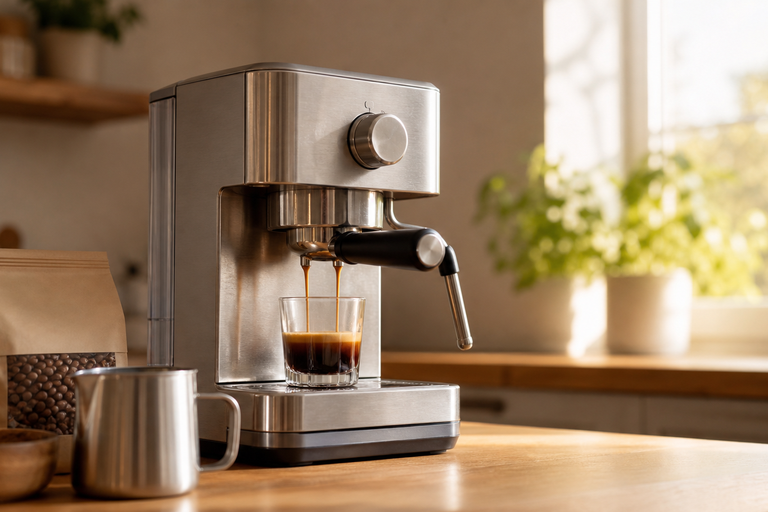
The bag of single-origin Ethiopian I picked up last week listed an espresso grind setting before the V60 one. That’s new. Same roaster, two years ago, led with pour-over and tucked espresso into smaller type at the bottom. A small detail, sure. But it tracks with what NCA, Square, and Google Trends data have been saying for about eighteen months: the casual coffee drinker is buying an espresso machine, and the industry has clocked it.
This isn’t the 2018 prosumer wave. That one moved Slayers, Decents, and Londinium levers to people who already owned a refractometer. The 2026 shift is sitting in the $300 to $700 band, in apartments, often as somebody’s first real coffee purchase.
The numbers behind the inflection
The National Coffee Association’s 2025 NCDT report flagged espresso-based drinks as the fastest-growing category of at-home consumption, with past-day espresso drink preparation up roughly 55% versus 2020. Square’s 2024 Future of Commerce report put the average US cafe latte at around $5.50 in major metros, up from about $4.25 in 2021. Google Trends shows worldwide search interest in “Bambino Plus” and “Gaggia Classic” hitting all-time highs through late 2025. No single data point is dramatic on its own. Together they describe one behaviour: people priced out of a daily cafe habit are putting the cafe equivalent of three months of lattes toward a machine instead.
| Signal | 2020-2021 baseline | 2025-2026 reading | Source |
|---|---|---|---|
| US past-day at-home espresso drink prep | ~14% of coffee drinkers | ~22% | NCA NCDT 2025 |
| Avg. US cafe latte (major metro) | ~$4.25 | ~$5.50 | Square Future of Commerce 2024 |
| “Bambino Plus” Google search interest | index 30 | index 100 (peak) | Google Trends |
| #homeespresso TikTok views | ~200M (2022) | 3B+ cumulative | TikTok public count, Q1 2026 |
| Sub-$500 machines with PID + pre-infusion | 2 mainstream models | 7+ mainstream models | Manufacturer specs |
Who the new buyer actually is
The 2020 prosumer was usually a 35-to-50-year-old hobbyist swapping out a Rancilio Silvia. The 2026 buyer skews younger, often 22 to 35, frequently arrives via a TikTok or Reels clip of someone pouring a tulip, and has rarely owned a burr grinder before. La Marzocco’s 2025 home survey reported that 41% of Linea Micra buyers had no prior espresso machine at all. At the cheaper end, Breville’s Bambino Plus has reportedly been the company’s top-selling home machine in North America since 2023, and a meaningful share of those buyers come from pod machines rather than manual brewers.
Casual doesn’t mean uninformed. It means the entry point is a drink, usually a latte or cortado, not a workflow.
The three forces pulling them in
Sub-$500 machine quality finally caught up. The Gaggia Classic Evo Pro, Breville Bambino Plus, Flair 58, and the newer Wirsh and Casabrews entrants now deliver 9-bar pressure, PID-controlled temperature, and at least basic pre-infusion at price points that didn’t exist five years ago. A 2021 buyer at $400 got a thermoblock and a pressurised basket. A 2026 buyer at the same price gets something that, with a competent grinder, pulls a drinkable shot.
Cafe inflation did the marketing for them. At $5.50 a latte, a 250-day-a-year habit costs $1,375. A Bambino Plus plus a DF54 grinder lands around $700. The payback math is now visible to people who never used to do the math.
TikTok turned latte art into a hobby of its own. Creators like Lance Hedrick, Morgan Eckroth, and James Hoffmann have collectively pushed home espresso content into feeds that previously surfaced none of it. The bloom video that converted a friend of mine was 22 seconds long and had no voiceover.
Where casual buyers still hit a wall
The gear-and-skill gap is concentrated in one place: the grinder. A $300 machine paired with a $40 blade grinder produces sour, channelled, gushing shots, and the new buyer almost always blames the machine. The fix is unglamorous and expensive. A capable single-dose grinder (DF54, Eureka Mignon Specialita, Baratza Encore ESP at the absolute floor) costs as much or more than the machine. Roasters have started shipping bags with espresso-specific grind recommendations partly because so many first-time buyers cannot dial in on their own.
The second wall is dose discipline. Casual buyers tend to under-dose, over-extract, and chase an 18 g in 36 g out shot in 18 seconds because that’s what the YouTube video showed. Climate-resilient naturals from Brazil and lighter Ethiopian washed lots want different recipes, and nobody told them.
What this means if you brew pour-over at home
The crossover is real and runs both directions. If you already own a quality grinder, adding a Bambino Plus or a used Gaggia is a much smaller jump than it was in 2020. Your V60 palate transfers; your grind-by-feel does not. Expect two to three weeks of mornings dialling in before a shot tastes like the same bean did through your Hario V60. Budget for a bottomless portafilter early. The visual feedback shortens the learning curve by months. If your pour-over baseline still wobbles, it’s worth pressure-testing your routine against the recipe mistakes most beginners repeat before you blame the espresso machine.
I ran a small version of this myself in March, pulling the same washed Ethiopian Yirgacheffe through a Bambino Plus at 18 g in, 36 g out, 28 seconds, and then brewing it the next morning on a Hario V60 at 1:16. The espresso took six sessions before it stopped tasting like grapefruit pith; the V60 was dialled in by cup two. That gap is the whole article in miniature.
Three signals to watch through 2026
- Sub-$500 lever revivals. If Flair, Cafelat, or a new entrant ships a temperature-stable lever under $400, the casual segment expands again.
- Smart-machine adoption past novelty. Watch whether the Decent-style guided-profile approach shows up in a sub-$1,000 machine from Breville or De’Longhi. That would mark the casual buyer graduating, not churning.
- Roaster SKU shifts. If specialty roasters like Onyx, Black & White, and Sey start listing dedicated espresso roasts as a majority of their menu rather than a sidebar, the trend has consolidated. If those SKUs shrink by Q4, the boom was a spike. For a running read on which launches are actually moving the needle, the latest coffee gadget digest is a useful weekly check.
The bag on my counter says espresso first. I’m watching what the next one says.