
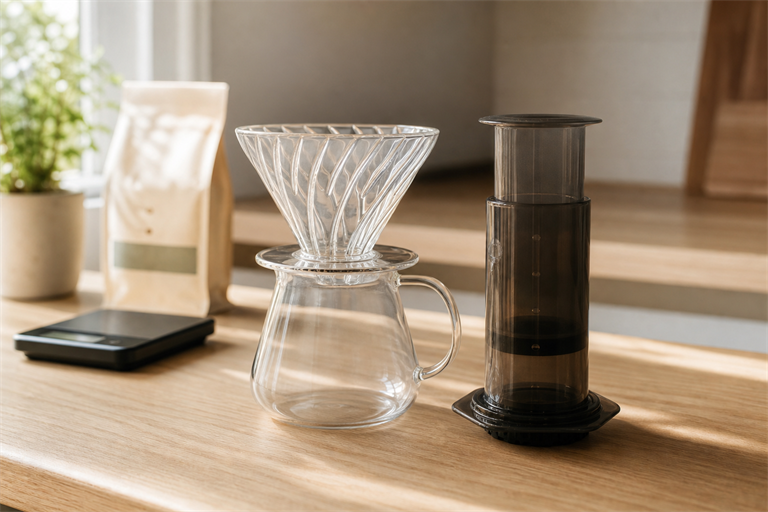
Most “V60 vs AeroPress” posts read like spec sheets in a trench coat. The question almost every first-time buyer is actually asking is narrower: you have one slot on the counter and roughly fifty dollars, and you want better coffee tomorrow morning. Which brewer earns the spot?
I have owned both for years. The Hario V60-02 ceramic lives next to my kettle. The AeroPress goes in a suitcase or to a friend’s kitchen. They aren’t rivals so much as different answers to “what do you want from a cup?” This piece is for the reader buying their first proper brewer, not their fourth.
The 60-second answer
If you mostly drink one cup at a time, you grind on a hand grinder, and you like sweetness and body more than florals, buy the AeroPress. If you drink light roasts from named roasters, already own a gooseneck kettle (or plan to), and you care about clarity in the cup, buy the V60.
Default pick for a true beginner with no other gear: AeroPress. It tolerates a wider grind range, forgives water-temperature drift, and the failure modes are gentler. The V60 rewards precision the beginner hasn’t built yet.
That’s the short version. The rest of the piece is the honest fine print.
Side-by-side at a glance
| Attribute | Hario V60-02 (ceramic) | AeroPress Original |
|---|---|---|
| Typical price (2026) | $25–32 dripper, $5 filters (100ct) | $40 brewer, $5 filters (350ct) |
| Brew method | Percolation pour-over | Immersion + pressure press |
| Cup volume per brew | 200–500 ml | 200–250 ml (up to ~470 ml diluted) |
| Brew time | 2:30–3:30 | 1:15–2:30 |
| Required gear to start | Gooseneck kettle, scale, timer | Scale and timer (kettle optional) |
| Grinder demand | High. Uneven grind shows up as sourness | Moderate. Forgives medium grinders |
| Cup profile | Clean, tea-like, aromatic | Heavier body, lower acidity |
| Filter type | Paper, cone | Paper micro-filter (or metal) |
| Learning curve | 15–30 sessions to consistent | 3–5 sessions to drinkable |
| Travel friendly | No (fragile cone, needs kettle) | Yes (plastic, packs flat) |
| Best with | Light, washed single origins | Medium roasts, blends, darker beans |
| Failure mode | Sour, thin, stalled drawdown | Slightly muddy or over-extracted |
Prices reflect what I have actually paid in the last six months at Prima Coffee and a local roaster here in town. Your numbers may drift ten percent either way.
Cup profile: clarity versus body
The V60’s spiral ribs and 60-degree cone create a fast, even percolation path. Water moves through the bed and picks up the lighter, more volatile aromatics. A well-pulled V60 on a Kenyan washed coffee tastes like blackcurrant and bergamot, with a thin, almost wine-like body. That same coffee in an AeroPress reads like cooked plum jam: same fruit, lower resolution, more weight.
The AeroPress brews by immersion first, then presses through a paper micro-filter under gentle hand pressure. You get a thicker mouthfeel, less perceived acidity, and a cup that hides roast defects better. For supermarket beans or a medium-roast blend, that’s a kindness. For a $22 bag of Gesha, it’s a waste.
Quick rule I keep coming back to: if your bean bag has a tasting note like “jasmine” or “white peach”, the V60 will show it. If the bag says “chocolate, almond, caramel”, the AeroPress will sing.
The learning curve tax
Time-to-decent-cup is the metric beginners underweight. With an AeroPress and the standard inverted recipe (15 g coffee, 220 g water at 85 °C, two-minute steep, 30-second press), most people hit drinkable on session two and good on session five. The variables you control are limited: grind, temperature, steep time. That is the point.
The V60 demands more. You’re managing pour rate, bloom volume, pour pattern, total brew time, and bed agitation, on top of grind and temperature. My own first month of V60 was mostly thin, sour cups while I learned to pour at a steady 4 ml per second. Scott Rao’s recommended bloom (2x coffee weight, 45 seconds) gave me a baseline. The rest was repetition.
If you find tinkering relaxing, that curve is the appeal. If you want coffee, not a hobby, it’s a tax.
Kitchen reality and total cost

The hidden line item with the V60 is the gooseneck kettle. A Fellow Stagg EKG runs $165. A Brewista variable-temp is around $95. A stovetop Hario Buono is $55 if you can read a thermometer separately. Without a gooseneck, the V60 underperforms; your pour wanders, the bed channels, the cup tastes hollow. Not snobbery, fluid mechanics.
The AeroPress needs a kettle, but any kettle works. I recently ran a side-by-side using a $20 electric jug with a $15 clip-on thermometer against my Stagg EKG, and the AeroPress cups were honestly within rounding distance of each other. The V60 cups were not. Total entry cost (brewer plus kettle plus a basic hand grinder, either the 1Zpresso Q2 at $109 or the Timemore C2 at $75) looks like this:
- V60 starter, decent: dripper $28 + Stagg EKG $165 + Timemore C2 $75 + filters $5 = $273
- V60 starter, scrappy: dripper $28 + Hario Buono $55 + thermometer $15 + Timemore C2 $75 + filters $5 = $178
- AeroPress starter: brewer $40 + basic electric kettle $25 + Timemore C2 $75 + filters $5 = $145
If you already own a scale (and you must, because guessing grams ruins both brewers), the AeroPress path costs roughly $130 less to reach the same “I am proud of this cup” threshold.
Six drinker profiles
- The “I just want a good morning cup” reader. AeroPress. Five-session learning curve, hides bean variation, easy to clean.
- The light-roast convert buying Onyx or Sey by the bag. V60. The AeroPress will mute what you paid for.
- The dorm-room or rental-kitchen brewer. AeroPress. Plastic survives drops; cleanup is a single puck ejected into the bin.
- The two-cup household. V60-02 brews 500 ml in one go. AeroPress requires two brews or bypass dilution.
- The frequent traveller. AeroPress, no contest. The Go version fits inside a mug.
- The reader who already owns a Fellow Stagg or Brewista. V60. You have paid the kettle tax; collect the reward.
When to just buy both
Here is the escape hatch. A Hario V60-02 ceramic ($28), 100 filters ($5), and an AeroPress Original with 350 filters ($45) total $78. If you already own a scale and a kettle, that is your full brewing kit for under eighty dollars, and you can match the brewer to the bean each morning. I do this. Most weeks the AeroPress wins on weekdays, the V60 on Saturday.
Who each is not for
The V60 is not for the reader who refuses to buy a gooseneck kettle, drinks darker roasts, or finds fiddling with pour rate stressful. You will brew worse coffee than a $40 AeroPress for triple the money. That is the gear-reviewer math, and it doesn’t care how pretty the ceramic looks on the shelf.
The AeroPress is not for the reader chasing high-clarity light roasts, brewing for more than one person at a time, or planning to go down the rabbit hole of pour technique. You will outgrow it in a year.
The pick
Buy the AeroPress first if you are starting from zero gear, drink one cup at a time, and want better coffee by next weekend. Buy the V60 first if you already own a gooseneck kettle, are buying light single origins from named roasters, and find process satisfying. Buy both if you have $78 and a shelf. It is the cheapest way to stop asking this question.