
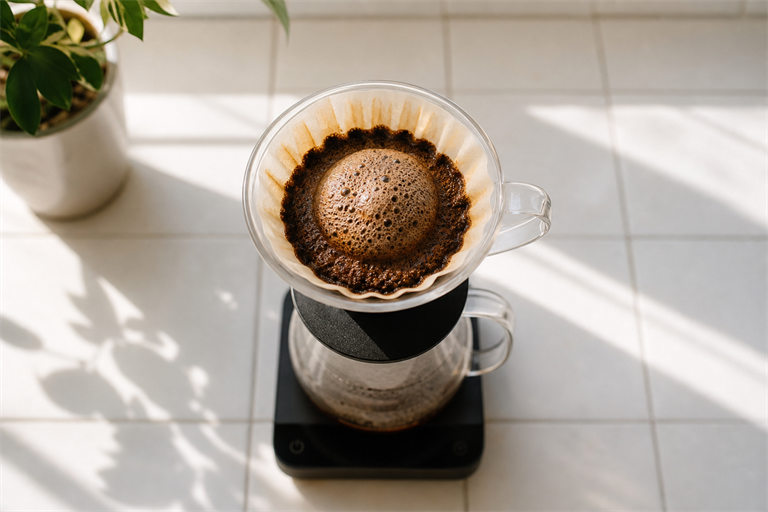
Most beginners pour a quick splash, watch the bubbles fizz for a second or two, and start the main pour the moment the foam settles. That shallow wet is usually why the cup lands sour or thin. A proper bloom is its own stage with its own numbers, and once it clicks, everything downstream of it gets easier.
What follows is the routine I run most mornings, narrated from a brew I made yesterday with a bag I’d just opened.
Yesterday’s session, on the counter
Bean: Onyx Coffee Lab Monarch blend, roasted nine days ago. Grinder: Baratza Encore at setting 18. Brewer: Hario V60 size 02, paper filter rinsed with hot water. Dose: 18 g of coffee, ground medium. Total brew water: 300 g, which puts the ratio at 1:16.6. Kettle: gooseneck at 96°C (205°F).
The bloom itself was 40 g of water, a hair over twice the bean weight. I poured it in around eight seconds, gave the V60 a gentle swirl, and held off until the timer read 0:45 before starting the main pour. The grounds rose into an even dome about 1.5 cm tall, with small, tight bubbles, and that dome held steady until the next pour broke it. That’s the picture I’m chasing.
What the bloom is actually doing
Roasted coffee is loaded with trapped CO2. When hot water meets dry grounds, the gas rushes out as foam and bubbles. Until most of it escapes, water can’t fully saturate the bed, and extraction stays uneven. You get sour, thin liquid from the under-wet patches, and a hollow body in the cup overall.
A bloom is a small, controlled pour that wakes the grounds up, lets the gas out, and pre-wets every particle before the real brew starts. Freshly roasted beans (under two weeks off roast) carry more CO2 and want a longer, slightly larger bloom. Older bags need less.
Three numbers that travel with you
Almost everything comes down to three parameters. Memorise these and you can bloom on a V60, a Kalita Wave, or a Chemex without thinking.
| Parameter | Target | Why |
|---|---|---|
| Bloom water weight | 2x to 3x bean weight | Enough to wet every ground without starting real extraction. Fresh beans want 3x, older beans 2x. |
| Water temperature | 92–96°C (198–205°F) | Same as your brew temp. Cooler water under-extracts and the bloom stalls. |
| Bloom duration | 30–45 seconds | Long enough for most CO2 to escape, short enough that the bed doesn’t dry out. |
| Agitation | One gentle swirl OR one shallow stir | Saturates dry pockets. Skipping this leaves dry clumps that ruin the brew. |
A basic kitchen scale, a burr grinder, and a gooseneck kettle are all the hardware you need to hit those numbers.
The procedure, step by step
- Weigh and grind 18 g of coffee. Medium grind, roughly the size of table salt. Too fine and the bloom turns to mud that chokes the filter. Too coarse and water rips through the bed before the gas can escape.
- Rinse the paper filter with hot kettle water, then pour the rinse water out. Wet paper seals to the cone and washes out that papery taste. Skip the rinse and your first pour gets spent flattening the filter instead of brewing.
- Tare the scale with the brewer on top, then add the grounds. Give the V60 a small tap so the bed is level. An uneven bed sends water down the deeper side, and the bloom comes out lopsided.
- Start your timer and pour 36–40 g of water in a slow spiral from the centre out. That’s roughly 2x to 2.5x your dose. Try to finish pouring by 0:08, and cover every dry spot you can see.
- Swirl the brewer once, gently, in a small circle. Hold the cone by the rim and rotate from the wrist; don’t slosh it. The swirl collapses dry clumps without breaking the bed. If swirling feels awkward, use a chopstick and make two shallow passes across the surface instead.
- Wait until the timer reads 0:40 to 0:45, then start the main pour. Look for a domed surface with fine bubbles. The dome should still be puffed when you pour again. If it has collapsed into a flat, glossy puddle, you waited too long and the bed has started to dry and crack.
For a 12 g AeroPress brew the logic is the same: 30 g of water, swirl, wait 30 seconds, then top up. The numbers scale, the principles don’t.
Reading the bloom and adjusting
The bloom is feedback. Three things to watch.
Dome height and bubble size. A tall dome with fine bubbles means fresh beans with active CO2. A flat surface with almost no bubbles means beans that are more than four weeks past roast, or water that ran too cool. With stale beans, drop the bloom to 2x and 30 seconds; extra time won’t coax out gas that’s no longer there.
Cracks across the bed during the wait. Cracks mean the bed is drying. Either the bloom was too small or you waited too long. Next brew, bump the bloom water up by 5 g, or start the main pour at 0:35.
Drawdown after the main pour. If the total brew finishes faster than 2:45 on an 18 g V60, your grind is too coarse and the bloom didn’t have enough body to slow water down. If it stalls past 3:30, grind one notch coarser.
Tomorrow morning, weigh the bloom water for the first time. That single change, going from “a splash” to a measured 2x, is the biggest jump in cup quality most beginners ever make.