
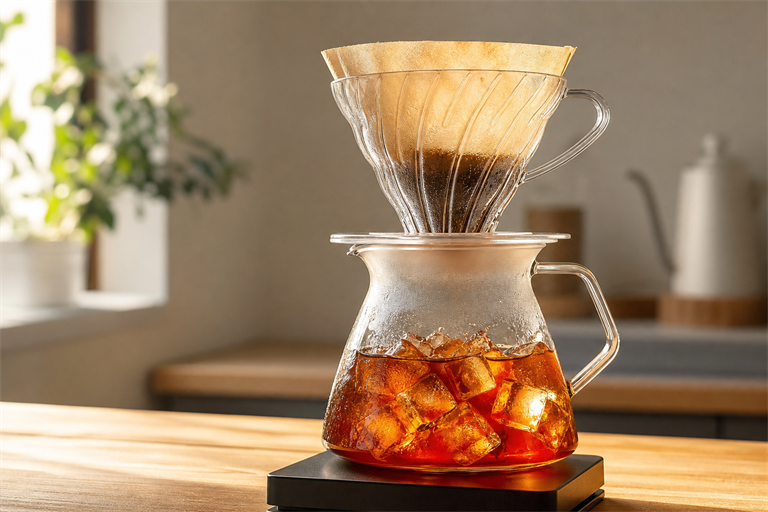
Iced pour-over has a specific failure mode that shows up around the third or fourth try. The glass smells like coffee but drinks like coffee-tinted water. Grind looks right. Bloom rose evenly. Timing was within ten seconds of the recipe. Cup is still thin, a little sour. The fix usually isn’t more coffee. It’s the relationship between hot water and ice.
Japanese flash-brew (sometimes called flash-chilled) treats ice as part of the recipe rather than a garnish on top. You brew a concentrated cup directly over ice that melts into it, so the drink lands on your target strength exactly when drawdown finishes.
The numbers that actually matter
Aim for a 1:16 total brew ratio in the glass, clear and aromatic. Three things drive the result:
- Hot-to-ice split: 60% hot water, 40% ice, by weight of total brew water.
- Dose ratio: 1 gram of coffee per 16 grams of total water (hot plus melted ice).
- Grind: one notch finer than your hot V60 setting, because contact time is shorter.
Why flash-brew reads cleaner than cold brew
Cold brew steeps for 12–18 hours at room temperature. The result is smooth and heavy, but most of the volatile aromatics, the floral, citrus and stone-fruit notes you get from a hot V60, never make it into the cup. Those compounds need heat to dissolve out of the grounds in the first place.
Flash-brew pulls them with 93°C (200°F) water and then crashes the coffee on ice within seconds. Cold locks the aromas in solution before they can evaporate. You end up with a transparent, tea-like cup that holds onto the same flavor clarity as a hot V60.
What you need on the counter
- V60 (size 02) or Kalita Wave 185
- Paper filter, rinsed
- Gooseneck kettle
- Digital scale with 0.1g resolution
- Burr grinder
- Server or carafe that fits on the scale
- Fresh beans, ideally a light or medium roast (2–4 weeks off-roast)
- Filtered water
The hot-to-ice ratio formula
Pick your final brewed volume, then split it:
- Hot water = 60% of total brew weight
- Ice = 40% of total brew weight
- Coffee dose = total brew weight ÷ 16
The 60/40 split is the lever. With less ice, the coffee lands too hot and dilutes weakly as it sits in the glass. Push the ice higher and the hot water cools mid-pour, under-extracting the bed. The bed never gets the energy it needs.
A real V60 flash-brew, start to finish
Total brew water: 370g. Hot 220g plus ice 150g. Dose: 22 g coffee on a Hario V60-02 (a higher dose is normal for flash-brew because the ice dilutes the cup). Final cup: about 350g. Here’s what I ran on my kitchen counter last week: an Ethiopian Yirgacheffe from Onyx Coffee Lab, roasted ten days out, on my Baratza Encore at setting 18.
- Weigh 150g of ice into your server. Use freezer ice, not the wet chunks from a fridge dispenser. Frozen-solid cubes melt at a predictable rate and stop the temperature curve the instant coffee hits them.
- Grind 22g of coffee one notch finer than your hot V60 setting. On the Encore that’s about 18 instead of 20. The finer grind compensates for shorter total brew time (~2:30 vs. ~3:30 hot). If your grinder’s clicks feel imprecise, dialing in a cheap hand grinder is worth doing before you trust this offset.
- Rinse the paper filter with hot water, discard the rinse, then set the dripper on top of the iced server. Rinsing removes paper taste and pre-warms the cone, so the first pour doesn’t lose 5–8°C to cold paper.
- Tare the scale to zero with everything in place. Measure only the hot water going in. The ice already counts toward your total.
- Heat water to 93°C (200°F). Lighter roasts can go to 95°C. Drop lower and you mute the floral notes that make flash-brew worth the trouble in the first place.
- Bloom with 50g of hot water. Wait 35 seconds. Bloom is degassing, CO₂ escaping the grounds. Skip it and the bed channels, leaving you with a sour, uneven extraction. If your blooms keep collapsing or doming, the common bloom mistakes that wreck extraction apply here too.
- Pour in two pulses: 85g, then 85g, finishing at the 1:45 mark. Slow concentric circles, bed kept flat. Pulses give better extraction than one long continuous pour at this small scale.
- Let drawdown finish around 2:30. All 220g of hot water should pass through. If it stalls past 3:00, your grind is too fine.
- Swirl the server gently to melt remaining ice. Any unmelted ice means you over-iced, and the cup will keep diluting in front of you.
- Pour into a glass with fresh ice and drink within 10 minutes. Aromatics fade fast once exposed to air.
The first try on that Yirgacheffe overshot. Finished at 2:50 with a slightly hollow finish. Second pour, same grind, tighter pulses on the second addition: jasmine and lemon zest, right where they should be.
When something tastes off
| Symptom | Likely cause | Fix |
|---|---|---|
| Watery, thin cup | Too much ice melted in, or under-extracted | Reduce ice to 35% of total water; grind one notch finer |
| Sour and sharp | Under-extracted; brew finished too fast | Grind finer; extend pour to 2:00 before drawdown |
| Bitter, dry finish | Over-extracted; grind too fine or pour too slow | Coarsen one notch; finish all pours by 1:45 |
| Ice still solid at end | Too much ice for the hot water volume | Drop ice to 130g; the 60/40 split is a ceiling, not a floor |
| Cup tastes flat, no aroma | Water too cool, or coffee too old | Heat to 94°C; use beans within 4 weeks of roast |
Scaling for Kalita Wave and larger batches
The 60/40 split holds at any size. For a Kalita Wave 185 brewing 500g total:
- Hot water: 300g
- Ice: 200g
- Coffee: 31g (500 ÷ 16)
- Grind: slightly coarser than V60 (the Kalita’s flat bed extracts faster). If you’re deciding between the two drippers, Kalita Wave vs V60 for beginners breaks down which one tolerates these tweaks better.
- Pulses: three pours of 100g each, finishing by 2:15
For a 1-liter batch in a larger dripper, multiply everything by the same factor. The ratio is what makes the recipe portable. Not the grams.
Your next step today
Weigh your ice tomorrow morning before you brew. That one change, treating ice as a measured ingredient rather than a topping, is what separates a clean flash-brew from a watery accident.