
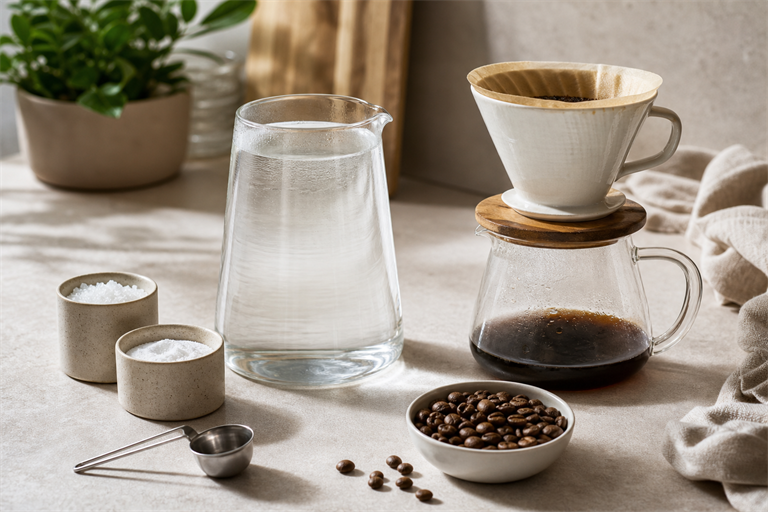
Last Sunday I weighed a Kenyan washed bean to 15.0 g, ground it on my Kingrinder K6 at my usual click, and the kettle clicked off at exactly 94 °C. The cup tasted hollow. Not bad, just absent, as if someone had turned the volume down on the fruit. For two weeks I’d been chasing grind size. The one thing I hadn’t touched was the water, and water makes up roughly 98.7% of what ends up in the cup.
Why a “dialed-in” recipe can still taste flat
Distilled and reverse-osmosis water arrive at your kitchen with almost nothing dissolved in them. Clean, yes. But minerals are the hooks that flavor compounds grab during extraction, and with no hooks the brew tastes one-dimensional. The coffee mutters behind a closed door.
Tap water has the opposite problem in most cities. Too much calcium scales the kettle and dulls acidity. Too much bicarbonate flattens the bright notes you paid $22 a bag to taste. Neither extreme belongs in your cup.
The Specialty Coffee Association target sits in a narrow window: roughly 150 mg/L total dissolved solids (TDS), general hardness (GH) near 68 mg/L as CaCO₃, and alkalinity (KH) near 40 mg/L. That’s the closest thing pour-over has to a control setting. This recipe aims squarely at it.
The three variables that decide the cup
Magnesium pulls flavor out of the grounds. It gives body and that juicy quality you taste in a really good light roast. Bicarbonate is the acidity brake. Too little and the cup goes sour and thin; too much and fruit notes collapse into wet cardboard. Total mineral load decides whether the cup feels bright or muddy.
You can hit all three with two pantry ingredients and a $3 jewelry scale.
What you need before you start
- 1 gallon (3.8 L) of distilled or RO water from the grocery store
- Epsom salt (magnesium sulfate, MgSO₄·7H₂O), plain, unscented
- Baking soda (sodium bicarbonate, NaHCO₃)
- A 0.01 g jewelry scale. A 1 g kitchen scale is not precise enough.
- Two clean 1 L bottles for concentrates, labeled
- One clean bottle or jug for finished brew water
Mixing the two concentrates
1. Hardness concentrate: 5.0 g Epsom salt into 1 L distilled water
Weigh 5.00 g of Epsom salt on the 0.01 g scale and dissolve it fully in 1 L of distilled water. Cap and shake for 30 seconds. The sulfate sharpens aromatics; the magnesium does the heavy lifting on extraction.
2. Buffer concentrate: 3.4 g baking soda into 1 L distilled water
In a second bottle, dissolve 3.40 g of baking soda in 1 L of distilled water. Label it. You do not want to mix these up at 6 a.m.
3. Brew water: 5 mL of each concentrate per 1 L distilled water
For every 1 L of distilled water you plan to brew with, add 5 mL of the hardness concentrate and 5 mL of the buffer concentrate. A teaspoon is roughly 5 mL if you have nothing else, though a cheap oral syringe is far more accurate. This lands you near 75 ppm hardness, 40 ppm buffer, and ~150 ppm TDS, squarely inside the SCA target. Shake gently. Let it sit a minute before brewing.
Brew once before you change anything else
Use the new water at your normal ratio (I default to 1:16, so 15 g coffee to 240 g water on a Hario V60-02) and your normal temperature: 92–94 °C for light roasts, 88–90 °C for dark. Don’t touch the grinder. Don’t change your pour pattern. You’re isolating water as a variable, and any other tweak will muddy the result.
Taste it next to a cup brewed with whatever you used yesterday. The difference is usually obvious within the first three sips. The first time I tried this with an Ethiopian Yirgacheffe from a local roaster, the jasmine note that had been hiding for a week walked right into the front of the cup.
Calibrating to your roast
- Light roasts (Ethiopian, Kenyan, washed): bump the hardness concentrate to 6 mL per liter. More magnesium drags those delicate florals and acids forward. If grind and ratio are still in flux for these beans, my V60 dial-in walkthrough for light roast single-origins pairs well with this water recipe.
- Medium roasts: stay at the 5 mL + 5 mL baseline. For grind and pour structure at this roast level, see the medium-roast pour-over recipe.
- Dark roasts (espresso blends in V60, Indonesian): drop hardness to 4 mL and raise buffer to 6 mL. Less extraction pressure, more smoothing of the bitter edges.
When the cup still isn’t right
| Symptom in the cup | Likely cause | Fix |
|---|---|---|
| Flat, hollow, “watery” | Not enough magnesium | Add 1 mL more hardness concentrate per liter |
| Sour, thin, aggressive | Not enough buffer | Add 1 mL more buffer concentrate per liter |
| Chalky, dry, dulled fruit | Too much buffer | Cut buffer to 3 mL per liter |
| Harsh, astringent finish | Too much hardness | Cut hardness to 4 mL per liter |
| Muddy and heavy | Total minerals too high | Reduce both concentrates by 1 mL |
| No change from distilled | Concentrate not dissolved | Re-shake bottle; warm water helps Epsom dissolve |
If you honestly can’t tell which way to push it, brew two cups side by side: one with 5 mL + 5 mL, one with 6 mL hardness + 4 mL buffer. Whichever cup you reach for a second sip of is your answer. If sour-and-thin sounds familiar from your AeroPress brews too, the same buffer logic applies. Walk through the sour AeroPress troubleshooting guide before blaming the grinder.
How long the concentrates keep
Keep both concentrates capped at room temperature. They’re stable for about 4 weeks. Sodium bicarbonate slowly degrades into sodium carbonate, which over-buffers your brew water and starts pushing cups toward chalky. If a concentrate older than a month tastes soapy on a clean spoon, or your coffee suddenly goes dull, remake it.
Never store mixed brew water more than 24 hours. It’s distilled water with trace minerals and no preservatives, full stop. One pleasant side effect of low-mineral brew water is far less scale in the kettle. If your gooseneck already shows white crust though, descale it before your next pour so old deposits don’t leach back into the cup.
The numbers in one place
| Parameter | Value |
|---|---|
| Epsom salt concentrate | 5.00 g per 1 L distilled |
| Baking soda concentrate | 3.40 g per 1 L distilled |
| Brew water mix | 5 mL each concentrate per 1 L distilled |
| Target hardness (GH) | ~75 ppm as CaCO₃ |
| Target buffer (KH) | ~40 ppm as CaCO₃ |
| Target TDS | ~150 ppm |
| Light roast tweak | 6 mL hardness, 5 mL buffer |
| Dark roast tweak | 4 mL hardness, 6 mL buffer |
| Concentrate shelf life | 4 weeks, room temp |
Mix the two concentrates tonight. Label them. Tomorrow morning, brew one cup with 5 mL of each in 1 L of distilled water and another with whatever you used yesterday. Taste them side by side. That single A/B test will teach you more about your coffee than another month of fiddling with the grinder.