
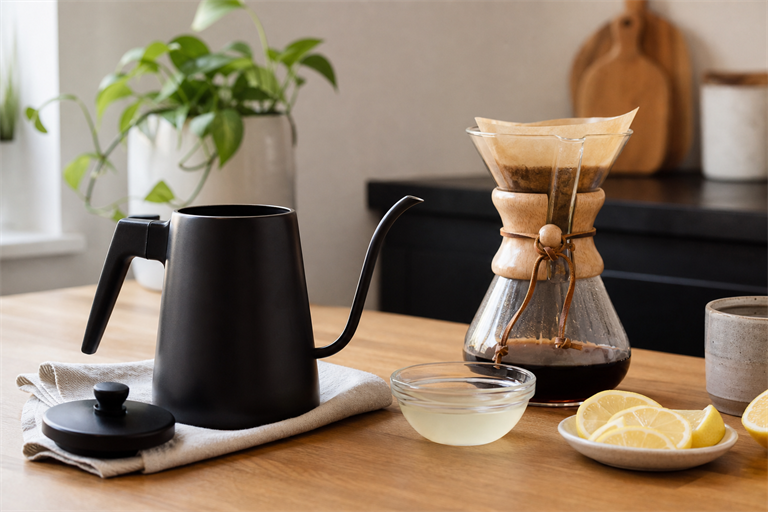
The first sign isn’t taste. It’s the pour. That pencil-thin ribbon you used to lay onto the bloom now surges, sputters, surges again, and the Ethiopian you bought for its jasmine note tastes like wet paper. Before you touch the grinder, look inside your kettle.
What scale actually does to a gooseneck
Limescale is calcium carbonate, the residue hard water leaves behind when it evaporates. Inside a gooseneck kettle it causes three specific problems, and each one shows up in the cup differently.
- It throttles the spout. Even a 0.5 mm crust at the spout base narrows the opening and turns a steady 4 g/s pour into a pulsing 6 g/s gush. You lose agitation control right when you need it most, during the bloom.
- It adds thermal lag. Scale on the heating element or base insulates it. A Fellow Stagg EKG set to 96 °C may actually deliver water at 91–93 °C, dropping extraction yield by roughly 1–2% TDS.
- It leaches off-flavors. Old scale traps coffee oils and chlorine residue, releasing a chalky, papery note that mutes acidity and clarity in light roasts.
I noticed the throttling before either of the other two. My Stagg started doing the surge-sputter dance about six weeks after I moved into an apartment with notably harder water, and I spent two mornings fiddling with my Comandante before I thought to peer down the spout.
How to spot scale buildup
- Visual: White or grey flakes near the spout, a cloudy film on the interior base, or rainbow discoloration on stainless steel.
- Taste: A flat, slightly mineral or cardboard finish in coffee that used to taste bright.
- Pour behavior: Your usual slow pour now requires tilting the kettle further; the stream wobbles or splits into two threads.
Picking an agent: citric acid wins, usually
| Agent | Concentration | Coffee-safe? | Notes |
|---|---|---|---|
| Citric acid (food grade) | 10 g per 1 L water | Yes, best pick | Neutral residue, no lingering smell, cheap |
| White vinegar (5%) | 1:1 with water | Acceptable | Works, but smell lingers; needs 4+ rinses |
| Commercial descaler (Urnex Dezcal) | Per packet | Yes | Convenient, slightly pricier |
| Lemon juice | Not recommended | No | Sugars and pulp can coat the element |
I default to citric acid. It’s odorless after rinsing, food-safe, and costs about $0.10 per descale. Vinegar works if it’s what you have, but the smell really does outstay its welcome, and four rinses has never been quite enough in my kitchen.
The protocol, start to finish
1. Empty and inspect (1 minute)
Pour out any standing water. Shine a flashlight inside. Why: Knowing whether you have light film or thick crust tells you whether one cycle is enough.
2. Mix 10 g citric acid into 1 L of warm tap water (2 minutes)
Stir until fully dissolved. Why: A 1% solution is strong enough to dissolve carbonate scale but mild enough not to pit stainless steel or damage silicone seals.
3. Pour into the kettle and heat to 60 °C (about 3 minutes)
For a stovetop kettle, heat on low until you see the first wisps of steam, then kill the heat. On a Fellow Stagg EKG, set 60 °C. Why: Warm acid reacts roughly 3× faster than cold, but boiling can splatter the solution and stress the seals.
4. Soak for 30 minutes (no heat)
Set a timer. Why: Most descaling failures come from impatience. Carbonate dissolution is a chemical reaction; it needs contact time, not more heat.
5. Swirl and pour through the spout (1 minute)
Gently swirl the kettle, then pour half the solution out through the gooseneck spout into the sink. Why: This flushes loosened scale from inside the narrow spout tube, where it most affects pour rate.
6. Triple rinse with fresh water (5 minutes)
Fill, swirl, pour out. Repeat three times. On the final rinse, heat to a full boil and discard. Why: Citric residue tastes sour and will reach your next brew. The boiling rinse drives off the last traces.
7. First-brew calibration (10 minutes)
Brew your standard V60 recipe (15 g coffee, 240 g water at a 1:16 ratio, 96 °C) and time the total drawdown. Why: Post-descale, your pour rate will be faster. Most people need to grind one notch finer on a Comandante (about 2 clicks) to restore a 2:30–3:00 total brew time.
When something still feels off
| Symptom after descaling | Likely cause | Fix |
|---|---|---|
| Coffee tastes sour or tangy | Citric residue from incomplete rinse | Two more boil-and-discard rinses |
| Pour still pulses | Scale wedged in spout tip | Second descale cycle, or push a soft pipe cleaner through the spout |
| Brew runs too fast now | Spout fully cleared, grind unchanged | Grind 2 clicks finer; expect a brighter, more acidic cup |
| White haze returns within a week | Very hard tap water (>180 ppm) | Switch to filtered or third-wave water for brewing and refilling |
If the sour note hangs around even after extra rinses, the cause is probably brew-side rather than kettle-side. Work through this sour AeroPress troubleshooting guide to isolate grind, dose, and temperature variables.
Cadence and prevention
The numbers I keep taped inside my cabinet door: 10 g citric acid, 1 L water, 60 °C, 30 minutes, three rinses, final one a full boil. Run it every four weeks if your tap water is over 120 ppm, every eight if it’s under 60. Post-descale, grind one or two clicks finer and re-time the drawdown.
Prevention is mostly habit. Fill the kettle with filtered water (a basic Brita pitcher cuts hardness by roughly 50%), empty it after each session so standing water can’t concentrate as it evaporates, and mark your descale dates on a kitchen calendar. That’s it.
Try this today: pour 1 L of water into your kettle and weigh what comes out the spout in 10 seconds. If it’s over 50 g, descale tonight before your next brew. Once flow is restored, it’s worth revisiting how to dial in a V60 recipe for light-roast single-origin beans. And if you’re still building your routine, this beginner’s step-by-step pour-over guide covers the fundamentals a clean kettle lets you actually taste.