
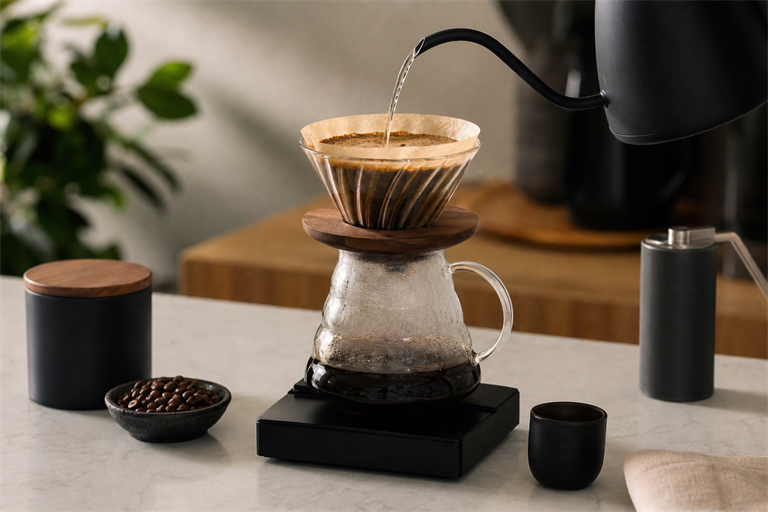
You finally got your light roast V60 tasting bright and clean. Then you opened a bag of medium roast, ran the same recipe, and the cup came out muddy and flat. The recipe didn’t break. The beans changed underneath it.
Three parameters need to shift so a dialed-in light roast recipe becomes a dialed-in medium roast recipe, without starting from scratch.
The three dials that actually move
You want a sweet, balanced cup with no bitter aftertaste. Three variables do most of the work:
- Grind: coarsen by roughly 2 clicks on most hand grinders.
- Water temperature: drop from 96 °C to about 90 °C (205 °F to 194 °F).
- Pour structure: fewer, gentler pulses instead of aggressive agitation.
Ratio stays at 1:16. Total brew time stays close to 3:00. Everything else follows from those three changes.
Why medium roast behaves differently under the same water
Medium roast beans are less dense and more porous than light roast. They release flavor (and CO₂) faster, so the same recipe over-extracts them, pulling out bitter and ashy compounds after the sweetness is already in the cup.
Three things change at once:
- Solubility is higher. Fewer minutes of contact give you the same yield.
- Density is lower. Water flows through faster at the same grind setting.
- Degassing is quicker. A 7-day-old medium roast behaves like a 14-day-old light roast.
So your job is to slow extraction down on purpose. That framing matters, because most light-roast habits push in the opposite direction.
What you’ll need on the counter
- A V60 (or similar conical dripper) and paper filters
- Burr grinder with adjustable settings
- Gooseneck kettle with temperature control (or a thermometer). If yours pours unevenly, it may be time to descale the spout
- 0.1 g scale and timer
- 15 g of medium roast, ideally rested 7–21 days past roast date
- Filtered water around 100–150 ppm total dissolved solids
Side-by-side: the two recipes
| Parameter | Light Roast | Medium Roast |
|---|---|---|
| Dose | 15 g | 15 g |
| Water | 240 g | 240 g |
| Ratio | 1:16 | 1:16 |
| Grind (Comandante clicks) | ~22 | ~24 |
| Water temp | 96 °C / 205 °F | 90 °C / 194 °F |
| Bloom water | 45 g (3×) | 30 g (2×) |
| Bloom time | 45 s | 30 s |
| Pours after bloom | 3–4 pulses | 2 pulses |
| Total brew time | 3:00–3:30 | 2:45–3:15 |
Coarsen the grind, then read the clock
Open your grinder about 2 clicks coarser than your light roast setting (roughly 50 microns on a Comandante or 1MM). Medium roast extracts faster, so a finer grind compounds the problem and the bed clogs.
Target a total drawdown of 2:45 to 3:15 for 240 g of water. If the brew finishes before 2:30, grind one click finer. If it stalls past 3:30, grind one click coarser. Without a refractometer, flow time is the cleanest signal you have.
I tried this last week with a bag of Counter Culture Big Trouble that had been resting at day 10 post-roast. Two clicks coarser on my Comandante, water at 90 °C, and the cup landed sweet on the first try. Drawdown clocked in at 3:02.
Cooler water, shorter bloom
Bring water to a boil, then let it sit for about 90 seconds, or set the kettle to 90 °C (194 °F). Hotter water aggressively pulls bitter compounds from softer medium-roast beans.
Pour 30 g of bloom water (2× the dose, not 3×) and swirl gently so every ground is saturated. Stop the bloom at 30 seconds. Medium roast releases CO₂ faster, so a 45-second bloom wastes extraction time and drops the brew temperature too far before your first real pour.
Restructure the pour: fewer, gentler pulses
Here’s where most light-roast brewers go wrong. They keep agitating the bed with 3–4 fast pulses, which over-extracts a roast that is already eager to give.
Use two pulses after the bloom:
- Pour 1: Add water to 150 g total over 30 seconds. Pour in a slow spiral from the center outward, staying off the filter wall.
- Pour 2: Add water to 240 g total over the next 30 seconds, again slow and centered.
Let it draw down. No final stir, no Rao spin. Reduced agitation keeps the fines settled and prevents the muddy, over-extracted finish that ruins so many medium-roast brews.
Tasting and iterating, sweetness first
Taste at brewing temperature and again as the cup cools. Cooling is the moment defects reveal themselves.
- Sweet, balanced, clean finish? Lock in the recipe.
- Bitter or ashy? Grind 1 click coarser OR drop temp 2 °C.
- Sour or thin? Grind 1 click finer OR raise temp 2 °C.
- Muddy or heavy? Cut to 1 pulse after the bloom, or pour slower.
- Watery despite long brew time? Beans may be stale. Check the roast date and review how you’re storing opened beans.
Change one variable at a time. Make two changes at once and you can’t tell which one fixed (or broke) the cup. Scott Rao makes the same point in Coffee Brewing, and honestly it’s the single discipline that separates dialing in from guessing.
One brew today, one adjustment tomorrow
Here’s the short version to keep next to the kettle:
- 15 g coffee, 240 g water (1:16)
- Grind: 2 clicks coarser than your light roast setting
- Water: 90 °C / 194 °F
- Bloom: 30 g, swirl, 30 seconds
- Pour 1: up to 150 g by 1:00
- Pour 2: up to 240 g by 1:30
- Drawdown complete by 2:45–3:15
- Taste hot and cool, adjust one variable next brew
Weigh out 15 g of your medium roast, set your grinder 2 clicks coarser, and brew at 90 °C. Note the drawdown time on your phone. That single data point tells you what to change tomorrow. If any step above feels unfamiliar, the pour-over fundamentals for beginners are worth a quick refresher before you dial in.