
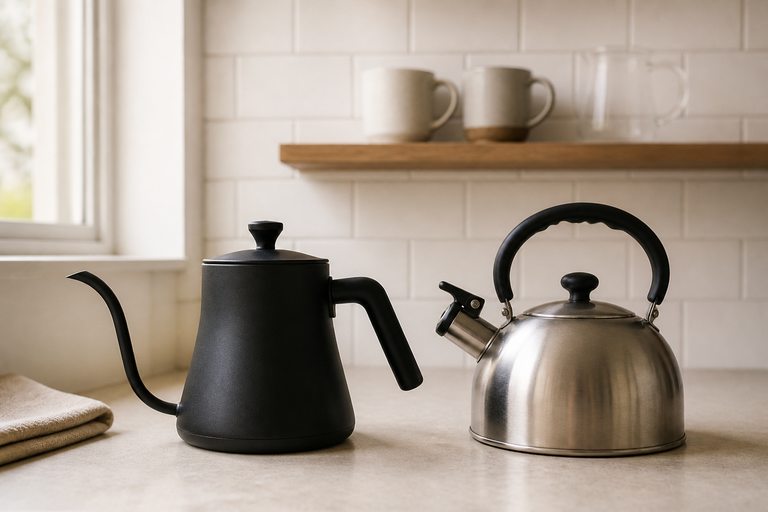
Most kettle debates skip the decision a home brewer actually needs to make: does an $80–$200 gooseneck change what lands in the cup, or does a $20 kitchen kettle plus better technique get you close enough?
Honest answer: it depends on your dripper, your pour speed, and how much you value repeatability. What follows is a specification-based comparison drawn from published pour rates, brewer geometry, and independent brew guides, not from one home-kitchen test.
Three variables that separate the two kettles
Spout geometry, achievable pour rate, and temperature control. That’s the whole argument.
A gooseneck’s long, narrow spout produces a laminar stream you can aim at a specific spot on the coffee bed. Reported flow on a controlled tilt sits around 2–10 ml per second, roughly 120–600 ml per minute (InstaCuppa). A regular kitchen kettle has a shorter, wider spout designed to fill a pot fast. Its stream is turbulent, arrives at a steeper angle, and typically dumps 15–30 g per second even at a modest tilt.
Temperature is the second axis. The Fellow Stagg EKG holds a set point to the degree between 40–100°C using PID control, with a 1200W element for quick heat-up (Fellow). A standard stovetop or electric kettle boils to 100°C, then you wait. SCA filter-brewing guidance for the point of contact with the grounds sits at 92–96°C (Wildkaffee summary of SCA standards).
Side-by-side spec sheet
| Criterion | Gooseneck kettle | Regular kettle |
|---|---|---|
| Typical pour rate (tilted) | 2–10 g/s | 15–30 g/s |
| Stream character | Narrow, laminar, aimable | Wide, turbulent, hard to place |
| Temperature control | To the degree on PID models; none stovetop | None; boil and wait |
| Price band | $25 stovetop / $80–$200 electric PID | $15–$60 |
| Best fit dripper | V60, Origami, Kalita, Chemex, AeroPress | Kalita, Chemex, AeroPress |
| Time to a workable pour | Fast; consistent flow lowers variability | Slower; needs deliberate technique |
| Repeatability across brews | High | Low |
How the pour actually changes the cup
The mechanical link between spout and cup runs through three effects that show up in most home setups.
Bloom coverage. A standard 60 g/L V60 recipe uses roughly twice the coffee mass in bloom water, wetted in 5–10 seconds (Perfect Daily Grind). A gooseneck lets you spiral that water across the bed and finish with no dry patches. With a wide-spout kettle, one side of the bed soaks first or the whole thing floods, and dry pockets stay dry until the main pour hits them.
Channeling risk on a V60. The V60’s single large hole and 60° conical wall let any concentrated stream carve a track through the grounds. Water then drops past the bed unrestricted (Stumptown). A gooseneck’s low-momentum stream disturbs the bed less. A regular kettle’s high-momentum stream drills straight into it.
Extraction spread. Uneven saturation widens the spread in extraction across the bed. That commonly shows up as a sour or hollow cup at the same recipe you brewed fine last week. Kalita Wave and Chemex mitigate this because both meter flow at the base rather than at the bed surface. Several guides describe the Kalita as “forgiving” of variable pour rates for exactly this reason (Podium Coffee Club).
Where a regular kettle is genuinely fine
Skip the upgrade if all three of these are true:
- You brew on a Kalita Wave, Chemex, or AeroPress. All three tolerate a fast, imprecise pour better than a V60 does.
- You dose 20 g or less, so the bed is shallow and thermal loss during the pour stays small.
- You’re willing to boil, rest for 30–45 seconds off heat, and decant into an intermediate vessel if your kettle spout is very wide.
That third point is the workaround most guides skip. Boil in a stainless kettle. Decant into a lipped pitcher or a small measuring jug with a narrower spout. You get a controllable stream at a defensible temperature. It won’t match PID, but 92–94°C at sea level is easy to hit with a 45-second rest.
Technique workarounds if you’re stuck with what you own
Three habits close most of the gap on a wide-spout kettle:
- Pour from lower. Drop the spout to 2–3 cm above the bed to cut impact energy.
- Slow the flow with a smaller tilt angle. Pause between pulses instead of pouring continuously.
- Switch to a flat-bed dripper. The Kalita Wave 155 or 185 forgives uneven pours because its three small holes cap the drawdown rate (Stumptown).
An AeroPress sidesteps the pour question almost entirely. You’re filling a sealed chamber, so stream shape does not matter to extraction.
Cost and buying thresholds
Three price bands are worth knowing:
- $25–$40. Stovetop gooseneck (Hario Buono, Bee House). Solves stream geometry, not temperature. Fine if you already own a thermometer or an infrared probe.
- $80–$110. Basic electric gooseneck with fixed presets (Bonavita, Cosori). Solves both variables at a reasonable floor.
- $165–$200. PID electric gooseneck (Fellow Stagg EKG, Brewista Artisan). Adds 1° control, hold time, and a counterbalanced handle that discourages fast pours (Fellow).
If your budget is under $50 and you’re on a Kalita or Chemex, the technique workarounds above cost nothing. If you brew V60 daily at 25 g or more, the stream matters. A $25 stovetop gooseneck pays back within a bag of coffee.
What to buy for each brewer
- V60 or Origami. Buy a gooseneck. Stovetop is fine if temperature is otherwise handled. Geometry hurts most here.
- Kalita Wave 155/185. Regular kettle is genuinely fine. The flat bed and three metering holes hide a lot of pour variance.
- Chemex. Regular kettle works for a 30 g+ dose because drawdown is slow. Consider a gooseneck if you brew smaller doses often.
- AeroPress. Skip the gooseneck. The chamber decouples pour shape from extraction. Put the money into your grinder instead.
- Beginner on a tight budget. Start with a Kalita or AeroPress plus a regular kettle. Learn the recipe. Upgrade the kettle only when you switch to a V60, or when repeatability rather than stream shape becomes your ceiling.
Buying a gooseneck to paper over a bad grinder is the wrong order of operations. Buying one to finally lock in a repeatable V60 is exactly right.