
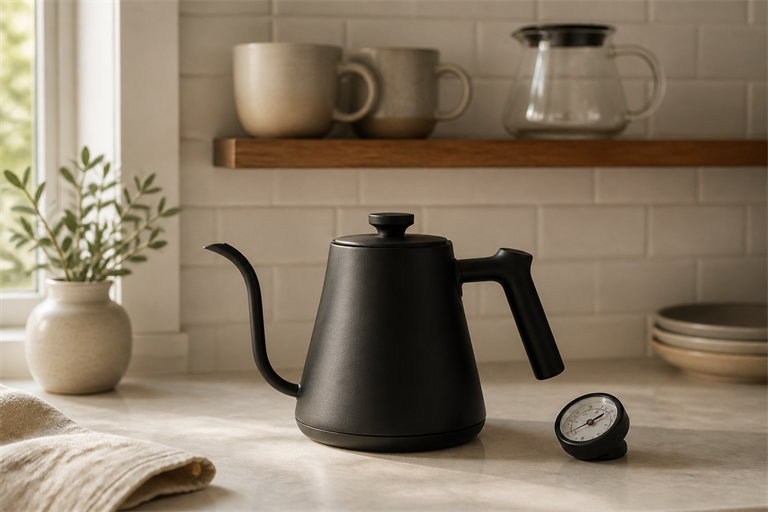
Most “best kettle” roundups lead with electric PID models. This one is for home brewers who cook on a real stove and either own a probe thermometer or trust off-boil timing. Picks are ranked on published spout geometry, balance-relevant handle specs, and stovetop compatibility drawn from current manufacturer pages. Specification-based comparison. Not a lab test.
What actually makes a stovetop gooseneck good
Three specs matter more than the badge on the side.
- Spout geometry. A narrow, straight-taper spout gives a thin, controllable stream at roughly 3–5 g/s. Wide or belled spouts dump fast and choke slow pours.
- Handle balance. A handle counter-weighted toward the palm reduces wrist fatigue, which is what actually causes uneven pours after the 30-second mark.
- Base compatibility. Not every gooseneck runs on induction. The Kalita Wave Pot doesn’t. Match this to your hob before you buy.
You don’t need PID temperature control if you own a $12 probe thermometer. Water off a rolling boil sits close to 96 °C after a 30-second rest, which falls inside most SCA-aligned brew targets (SCA brewing best practices).
1. Fellow Stagg Pour-Over Stovetop Kettle (1 L)
The Stagg stovetop pairs a precision gooseneck spout with a counter-balanced handle that pulls the mass back toward your palm (Fellow). A brew-range thermometer sits on the lid, so you can pour without a probe. Body is 301 18/8 stainless. Compatible with gas and electric; induction is not listed as supported on Fellow’s product page.
Best for: brewers who want the tightest-looking pour without buying an electric.
Takeaway: the closest stovetop analog to Fellow’s own EKG electric on spec sheet alone.
2. Hario V60 “Buono” Drip Kettle (1.0 / 1.2 L)
The Buono is the classic Japanese slim-spout gooseneck that shaped modern pour-over (Hario USA). Hario’s 1.2 L version works on gas, electric, and induction. The 1 L model (VKBR-100-HSV) is also induction-compatible. Phenol-resin handle stays cool. Practical fill is around 800 ml before the balance shifts forward.
Best for: V60 users who want a proven spout at a moderate price.
Takeaway: if you brew for one or two, the Buono remains the reference stovetop.
3. Kalita Wave Pot Stainless Steel (1 L)
Kalita’s “dragon-neck” spout and sharply pinched lip are built for slow ribbon pours on flat-bottom brewers (Kalita USA). The removable wooden handle is dishwasher friendly. Body is stainless with a chrome-plated base. Kalita states this pot is not suitable for induction, and some retailers also caution against gas burners.
Best for: Wave 155/185 dripper owners who want a matched pouring profile.
Takeaway: natural pairing for a Kalita Wave dripper on an electric coil hob.
4. Bonavita 1.0 L Stovetop Gooseneck (BV3825ST)
Bonavita’s stovetop model is the utilitarian option: brushed stainless, heat-resistant angled handle, no thermometer, no gimmicks (Bonavita). Dishwasher safe. Availability has been intermittent through 2025–2026, and some retailers list it as discontinued. Check current stock before committing.
Best for: brewers who want a clean shape and don’t need a built-in temperature readout.
Takeaway: dependable geometry if you already brew by probe thermometer.
5. Takahiro Shizuku 0.9 L
The Takahiro Shizuku is the Japanese specialty benchmark. Made in Tsubame, Niigata from SUS304 stainless, it uses an extra-thin spout that Takahiro lists as 4 mm narrower than the original model (Japanese Taste). Empty weight is 375 g. Works on direct heat and most induction hobs, though Takahiro flags that IH compatibility varies by model.
Best for: competitive single-cup brewers chasing the slowest, thinnest controllable stream.
Takeaway: the spout profile most cited by professional pour-over judges.
6. Barista Warrior Gooseneck with Thermometer (1 L / 1.2 L)
Barista Warrior’s 18/8 stainless body carries a built-in lid thermometer marked at the 195–205 °F pour-over range (Barista Warrior). A double-layer base is rated for gas, electric, induction, and halogen. Handle diameter is thinner than the Stagg’s, without a counter-balance. Sold in 1 L and 1.2 L versions.
Best for: first-time pour-over buyers who want a temperature gauge under about $50.
Takeaway: an honest value pick when you don’t yet own a probe thermometer.
7. Coffee Gator 34 oz Stovetop Gooseneck
Coffee Gator’s kettle publishes a rare number: a 2.5 mm/s spout flow rate through a 360°-rotating gooseneck (Amazon listing). A triple-layer base runs on gas, electric, induction, and halogen. The built-in thermometer reads 71–100 °C. Product listings and reviewers commonly flag heat transfer at the handle base, so plan on a towel grip.
Best for: budget-first buyers who want an all-hob kettle with a gauge under $40.
Takeaway: fine to start with, worth upgrading once your pours stabilize.
Spec comparison at a glance
| Kettle | Capacity | Induction? | Built-in thermometer | Notable spec |
|---|---|---|---|---|
| Fellow Stagg Stovetop | 1.0 L | Not listed | Yes, lid gauge | Counter-balanced handle |
| Hario Buono | 1.0 / 1.2 L | Yes | No | Slim spout classic |
| Kalita Wave Pot | 1.0 L | No | No | Pinched dragon-neck lip |
| Bonavita BV3825ST | 1.0 L | Check listing | No | Angled handle |
| Takahiro Shizuku | 0.9 L | Model-dependent | No | Extra-thin spout, 375 g |
| Barista Warrior | 1.0 / 1.2 L | Yes | Yes, lid gauge | Marked pour range |
| Coffee Gator | 1.0 L | Yes | Yes, lid gauge | Published 2.5 mm/s flow |
Specs sourced from the manufacturer or retailer pages linked in each entry above.
Stovetop versus electric: when non-PID is the smarter buy
If you own a probe thermometer, water off a rolling boil sits close to 96 °C for about 30 seconds after the burner shuts off. That range falls inside most SCA-aligned brew targets (SCA brewing chart). PID is not required to hit it.
A stovetop kettle also saves counter space, needs no outlet, and doesn’t die when the base electronics fail. Electric PID makes more sense if you brew several rounds a morning or chase sub-degree targets. It also helps with very light roasts that punish being 2 °C off.
Spout shape and your dripper
Match the spout profile to the brewer you actually use.
- V60 or Origami: slim, long spouts (Buono, Takahiro, Stagg) suit V60’s central-column pours, where a clean, even bloom sets the tone for the rest of the brew. You want a thin, aimed stream to the middle.
- Kalita Wave: pinched-lip spouts (Kalita Wave Pot, Stagg) suit slow concentric pours over a flat bed.
- Flat-bottom hybrids: any slim-spout kettle works; handle balance matters more than lip shape here.
Care and long-term durability notes
Descale roughly every 4–8 weeks with a citric acid solution (about 20 g in 1 L of water, held near boiling for 15 minutes, then rinsed twice). Hard water builds scale inside the spout. A partially blocked spout is the single most common cause of unpredictable flow on a kettle that used to pour cleanly.
Wooden and phenol-resin handles should not go in the dishwasher unless the manufacturer says otherwise. Kalita’s removable wooden handle is the listed exception.
Final picks by scenario
- Best overall stovetop: Fellow Stagg 1 L. Best-in-class handle balance spec plus a built-in brew-range gauge.
- Best for V60 purists: Takahiro Shizuku 0.9 L. Thinnest published spout, cleanest single-cup profile.
- Best classic value: Hario V60 Buono. Proven slim spout, induction-friendly, moderate price.
- Best for Kalita Wave brewers: Kalita Wave Pot 1 L. Matched geometry for flat-bottom drippers.
- Best under about $50 with a thermometer: Barista Warrior 1 L. Skip it if you already own a probe.
- Best strict budget pick: Coffee Gator 34 oz. A good starter; plan to upgrade once your pours stabilize.
This list is not for brewers who need sub-degree temperature control, want a hold-temp function, or brew back-to-back rounds every morning. Those buyers should read the electric PID roundup instead.