
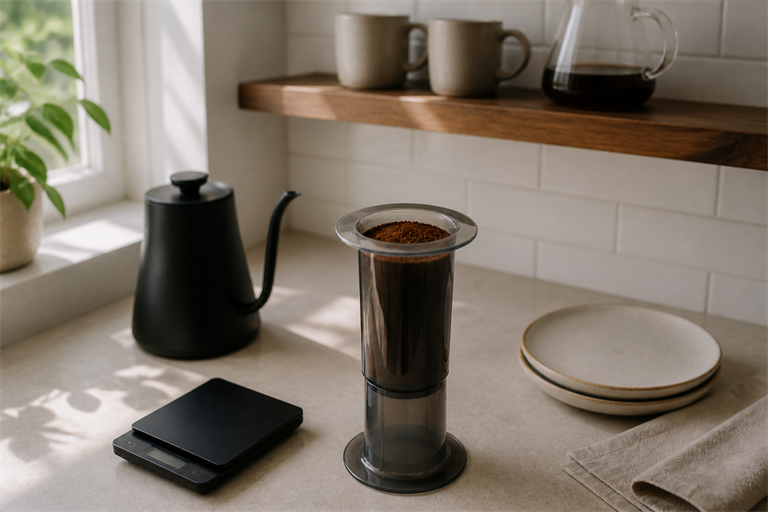
Bitter AeroPress usually traces back to one of five measurable levers: grind, water temperature, dose, steep time, and bean age. Fix the right one, and the same beans taste sweet on the next cup.
Why Your AeroPress Tastes Bitter in the First Place
Bitter compounds come out of the grounds late in the brew, after the acids and sugars have already dissolved into the water. Chlorogenic acid breakdown products and heavier phenolics extract faster in hotter water and over longer contact, which is why AeroPress punishes small mistakes (SCA brewing temperature reference). The brewer is small, the grind sits fully submerged, and the plunger holds pressure that keeps water hugging the coffee bed.
Five variables cause almost every bitter cup:
- Grind too fine for your steep time
- Water above 92°C, especially on medium and dark roasts
- Too much coffee for the water you poured
- Steep and press longer than 2:30 total
- Beans past their sweet spot (over 5 weeks off roast, or under 5 days)
The official AeroPress starting temperature is 80°C (175°F) for dark roasts and 85°C (185°F) for medium and light roasts, well below the SCA filter standard of 93°C ±3°C (AeroPress official brewing help). That gap is deliberate. The immersion style and fine grind extract quickly, so cooler water keeps the bitter compounds locked in the puck. If you are not sure which roast band you actually have on the shelf, what actually changes between light, medium, and dark roasts is worth a quick read before you dial in temperature.
Match the Taste to the Fix
The taste on your tongue points at the variable to change. Adjust one lever at a time so you can hear what each change actually does.
| What you taste | Most likely cause | First lever to change |
|---|---|---|
| Harsh, ashy finish | Water too hot for the roast | Drop temperature by 3–5°C |
| Dry, mouth-puckering (astringent) | Grind too fine or press too slow | Go one notch coarser |
| Bitter and heavy | Steep time too long | Cut total time to 1:30 |
| Bitter and hollow | Old or under-rested beans | Check the roast date |
| Bitter and thin | Over-dosed, then over-pressed | Drop to 14 g per 220 g water |
Astringency is a tongue-scraping feeling rather than a flavor. It reads as bitter but comes from a different set of compounds, mostly linked to fine fragments and long contact (Gigawatt Coffee Roasters). Treat it as an over-extraction signal.
A Sweeter Recipe: Inverted, 15 g, 2:00 Total
Use this as your baseline. It sits close to the official brewer instructions, with a slightly higher dose and a fixed steep time so you can compare cups fairly.
- Weigh 15 g of coffee roasted within the last 7–28 days. Fresher beans still off-gas CO₂ and tend to read harsh; older beans go flat and bitter.
- Grind medium-fine, roughly the texture of table salt. Finer than pour-over, coarser than espresso. Grind is the single biggest bitterness lever on AeroPress.
- Heat 220 g of water to 85°C for medium roast, 80°C for dark roast, 88°C for light roast. Boiling water in a cool kettle drops to about 85°C after 45 seconds off the boil.
- Rinse a paper filter with hot water. A dry filter can leave a papery, bitter edge on the first sip.
- Assemble the AeroPress inverted (plunger down, chamber up). Add the grounds, tare the scale, then pour water to 220 g in a slow spiral over 15 seconds.
- Stir gently three times at 0:20 with a paddle or a chopstick to knock down clumps. Cap the filter and screw it on.
- At 1:30, flip onto your mug or server. Press slowly and steadily so the plunger reaches the bottom at 2:00. If it feels like squeezing a stress ball, your grind is too fine.
- Stop the press the instant you hear the hiss. Do not push the last drops through: that final layer carries the most bitter fines.
The finished cup should smell sweet, taste round in the middle, and leave a clean finish. If it does not, the next section is your decision tree.
Still Bitter? Change One Lever at a Time
Work through these in order. Change one variable per brew and taste the difference.
- Coarsen the grind by one notch. On a hand grinder like the 1Zpresso Q2, that means 2–3 clicks. Grind is the fastest way to pull extraction back. If your current grinder is fighting you, a burr set built for filter work makes a real difference — see our 12-month verdict on the Timemore C2 for a budget option that holds its setting.
- Drop the water by 3°C. If you were at 85°C, try 82°C. Cooler water slows the extraction of the heavy bitter compounds that come out last. A gooseneck kettle with temperature control makes hitting these numbers repeatable instead of a guessing game.
- Cut steep to 1:15 and press by 1:45. Shorter contact caps how much of the puck you actually pull.
- Check dose and ratio. 15 g of coffee to 220 g of water is roughly 1:14.6. Over-dosing forces a harder press, which extracts more fines.
- Confirm the roast date. Coffee between 7 and 28 days off roast tastes sweetest for most home setups. Older beans read flat and often bitter.
- Clean the plunger seal and cap. Old oils oxidize and add a stale, bitter note that no recipe change will fix. Wash both in warm soapy water weekly.
If you have moved all six levers and the cup is still harsh, the beans themselves are likely the problem. Buy a small bag from a roaster with a printed roast date, then restart at the recipe above.
The single highest-impact change to try tonight: coarsen your grind by two notches and drop your water to 82°C. That one pairing fixes more bitter AeroPress cups than any other adjustment.