
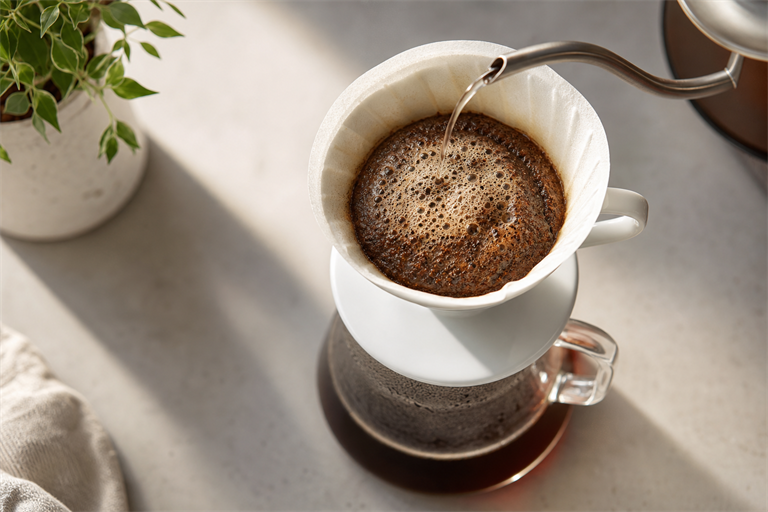
This list is for home brewers who already follow a recipe (15 grams in, 250 grams out, a four-minute target) and still pull a different cup every morning. I ranked the seven mistakes by how badly each one distorts extraction in my own kitchen tests over the last year, brewing the same Ethiopian Guji from Onyx on a Hario V60 02 and a Timemore C2 hand grinder. Each entry pairs a flavor symptom with its cause and a fix you can run tomorrow. No refractometer required.
1. Skipping or rushing the bloom
When you lift the cup, you should smell the coffee before you taste it. A rushed bloom strips that aroma and leaves the cup thin and faintly sour.
Fresh coffee is loaded with CO2. Skip the bloom or cut it short, and that gas blocks water from soaking the grounds, so extraction stalls in the first minute. For beans roasted within the last three weeks, pour twice the dose in water (30 g for a 15 g dose), swirl gently, and wait 40 to 45 seconds. You’ll see the bed dome up, then sigh as bubbles release. When the surface stops actively bubbling and looks matte and damp, the bloom is done.
If the bed is still puffing CO2 when you start the main pour, you waited too little.
2. Wrong grind size, and the hand-grinder calibration trap
Sour and weak usually means too coarse. Bitter and drippy-slow means too fine. Recipe blogs say “medium-fine,” but every grinder defines that differently.
The trap with cheap hand grinders is assuming the click numbers mean anything universal. On my Timemore C2, the V60 sits around 18 clicks from zero. On a 1Zpresso Q2 it’s closer to 70. Calibrate to drawdown time, not clicks. A 15 g dose into a V60 02 should finish dripping between 2:45 and 3:30 from the start of bloom. Faster than 2:30, go two clicks finer. Slower than 3:45, two clicks coarser. The timer tells the truth your dial cannot.
3. Water temperature guesswork
Sour and grassy means too cool. Harsh and ashy means too hot.
Without a variable kettle, most beginners either pour at a rolling boil or wait a vague “minute or two.” The SCA brewing chart recommends 92 to 96 °C (198 to 205 °F) at the grounds. A cheap fix: after your kettle clicks off at boil, leave the lid open and wait 30 seconds for a light roast, 60 seconds for a medium, 90 seconds for a dark. That lands you somewhere around 94 °C. A $10 instant-read thermometer removes the guesswork entirely, and it’s the single best sub-$15 upgrade in this list.
Boil, wait, pour. Never pour at the boil.
4. Pouring only into the center, or pouring from too high
Muddy. Uneven. Sometimes sour and bitter in the same cup. Both pour faults produce that confused profile.
Pouring only into the center floods the middle and leaves the outer ring of grounds underextracted. Pouring from 15 cm above the bed agitates too hard and digs a channel. Keep a 2 to 3 cm gap between the kettle spout and the slurry surface, and move in slow concentric circles from a coin-sized center out to about 1 cm from the filter wall, then back in. Aim for a flow rate around 4 g per second. If you see the filter paper exposed above the slurry line, your pour is too aggressive.
A 4-minute brew with a calm, spiraling pour beats a 3-minute one with a violent center dump.
5. Ignoring water quality
Flat. Dull. No sweetness, even with great beans. That’s the water talking, not the coffee.
Coffee is 98.5% water. Hard tap water mutes acidity and leaves a chalky finish. Pure distilled water tastes hollow because there are no minerals to bind flavor compounds. The cheap middle path: buy a gallon of supermarket spring water labeled around 50 to 150 ppm TDS. Crystal Geyser and Volvic both work in my kitchen, and the difference on a light Ethiopian was obvious the first morning I switched. If you want to go further, Third Wave Water sachets give you a known mineral profile for about 60 cents a brew.
Swap your water before you swap your beans.
6. Beans too fresh, or too stale
A wild fizzy bloom and a sour cup usually means the bag is too fresh. Papery, woody, no aroma means it’s gone past.
The roast date matters more than a best-by date. The usable window for filter coffee runs roughly 7 to 28 days post-roast. Brewing on day 2 means a volcanic bloom and a thin cup because the CO2 is fighting your water. Brewing on day 60 means the aromatic oils have oxidized. Store beans in a one-way-valve bag, sealed, at room temperature, away from sunlight. Freezing in single-dose portions extends the window to 3 or 4 months, but only if you weigh and seal them on day 7.
Check the roast date before the price tag.
7. Eyeballing the dose and ratio
The symptom is inconsistency. Monday is great, Wednesday is sour, Friday is muddy. Volume scoops lie.
A tablespoon of light-roasted Ethiopian beans weighs about 5 g. The same scoop of dark Sumatran is closer to 7 g. Without a 0.1 g scale, you can’t hold a ratio. Pick one and stick to it for a week. A 1:16 ratio (15 g coffee to 240 g water) is a safe starting point per Scott Rao’s Coffee Brewing book. Weigh both the dry coffee and the brewed water on the same scale, and write down the result each morning until your cup stops moving.
A $20 scale fixes more cups than any new dripper.
Sour, bitter, thin, muddy: how to triage
| Symptom | Most likely cause | First fix to try |
|---|---|---|
| Sour, sharp | Underextracted: too coarse, too cool, or rushed bloom | Grind 2 clicks finer; extend bloom to 45 s |
| Bitter, drying | Overextracted: too fine or too hot | Grind 2 clicks coarser; wait 60 s after boil |
| Thin, watery | Wrong ratio or channeling | Re-weigh dose; pour in slower spirals |
| Muddy, flat | Hard water or stale beans | Switch to spring water; check roast date |
| Wildly inconsistent day to day | Eyeballed dose | Buy a 0.1 g scale |
The one fix to run this week
Across every kitchen I’ve brewed in, the single pattern behind inconsistent cups is unmeasured variables stacking on top of each other. You can’t debug five things at once. Pick the entry above whose taste signal matches your last bad cup, change only that variable for seven days, and keep everything else identical. The scale and the thermometer together cost less than a bag of specialty beans, and between them they end more arguments with your morning coffee than any new gear ever will.