
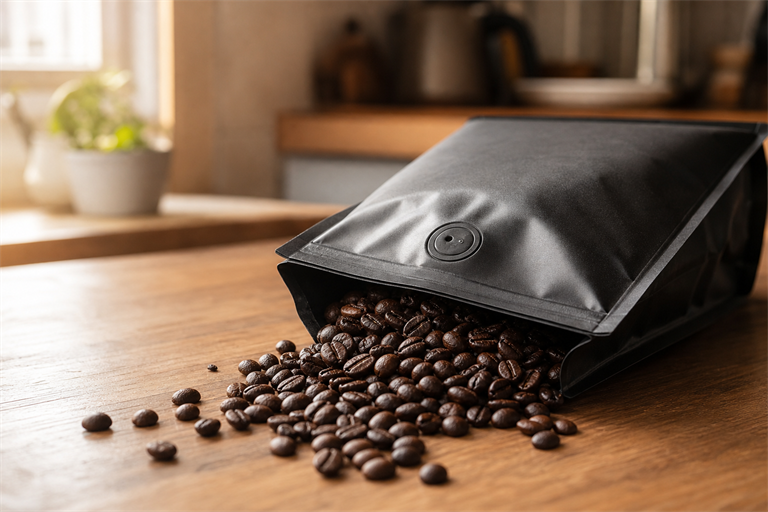
Coffee begins releasing carbon dioxide as soon as roasting ends, but there is no single “best day” that applies to every bean. Roast degree, roast profile, coffee species, storage and grind size all change how much gas remains and how quickly it leaves. For a home brewer, the useful answer is therefore a test process: follow the roaster’s rest guidance when it is available, then brew the same recipe at intervals until wetting becomes easier and the cup tastes balanced.
What coffee degassing means
Roasting creates gases, most notably carbon dioxide. Some escapes during roasting, while some stays within the porous structure of the roasted bean and is released during storage. Grinding greatly increases the exposed surface area, so gas is also released more rapidly after the beans are ground and while water contacts the coffee.
A peer-reviewed time-resolved study of roasted coffee degassing describes this sequence directly: gas retained after roasting is released steadily during storage and more abruptly during grinding and extraction. That is why a recently roasted coffee may bubble strongly during a pour-over bloom or behave differently in espresso than the same coffee several days later.
The visible bloom is useful evidence that gas is escaping. It is not, by itself, a freshness meter or a guarantee of flavor. Bloom height depends on the coffee, dose, grind, water delivery and dripper as well as age.
Why there is no universal resting window
Advice such as “all coffee peaks on day seven” sounds convenient but ignores measured differences between coffees. In a Food Research International study, retained carbon dioxide and release behavior changed with roast degree and the time-temperature profile used during roasting. At the same roast degree, high-temperature, short-time roasting produced a faster degassing rate than low-temperature, long-time roasting. Grinding finer also accelerated gas loss.
These findings explain why two bags with the same roast date may not brew best on the same day. A dark roast can retain more carbon dioxide immediately after roasting while also releasing it rapidly because its structure differs from a lighter roast. The species and roast process matter too. A calendar can organize a test, but it cannot replace tasting.
A practical roast-date decision table
| What you observe | What it may mean | What to do next |
|---|---|---|
| Grounds swell strongly and are difficult to wet evenly | The coffee may still be releasing substantial gas | Use a thorough initial wetting, keep the recipe fixed and test the coffee again later |
| Bloom is active but the bed wets evenly | Gas is present without obviously disrupting the brew | Judge the cup rather than the bloom size; record sweetness, acidity and finish |
| Little visible bloom but the cup is aromatic and balanced | The coffee may simply be less gassy | Keep brewing it; a small bloom does not prove staleness |
| Little bloom plus muted aroma and a papery or stale character | Age or oxygen exposure may be affecting quality | Confirm with a second brew before discarding the bag |
None of these signs is diagnostic on its own. The goal is to combine the roast date, repeatable brewing and taste rather than assigning quality from one visual cue.
How excess gas can affect brewing
Carbon dioxide is relevant to extraction, but it is more accurate to say that active gas release can make wetting and flow less predictable than to claim that gas creates one specific defect every time. The degassing research links carbon dioxide to extraction and sensory behavior without establishing a universal “CO2 blockade” or a fixed number of rest days.
- Pour-over: escaping gas may make complete initial wetting harder. Pour enough water to wet the full bed, use a consistent bloom routine and compare the result over time.
- Immersion: all grounds remain in contact with water, so the method may feel easier to manage with a gassy coffee. It still benefits from complete wetting.
- AeroPress: keep grind, water temperature and contact time consistent while evaluating the coffee. A changing recipe makes age effects difficult to separate.
- Espresso: retained gas contributes to crema and can change shot behavior. Follow the roaster’s espresso-rest recommendation when one is supplied, then dial in by taste and flow.
How to find the best day for your bag
- Record the roast date. Use the printed date rather than the day the bag was opened.
- Start with the roaster’s advice. The roaster knows the coffee and roast profile better than a generic chart does.
- Choose one baseline recipe. Fix coffee dose, water mass, grind, temperature and pouring pattern.
- Brew at sensible intervals. If a cup is difficult to wet or tastes unbalanced, repeat the unchanged recipe after additional rest.
- Write down the result. Note aroma, acidity, sweetness, body and finish, plus whether the bed wet evenly.
- Change the recipe only after the age comparison. Otherwise it is impossible to know whether rest or technique changed the cup.
This approach gives a personal rest window for that coffee without presenting it as a rule for every future bag.
Storage while coffee rests
Keep the coffee in a clean, dry package intended for roasted beans and close it after each use. A one-way-valve coffee bag is designed to let internal gas escape while limiting outside air movement. Store it away from heat, direct sunlight, moisture and strong odors. Avoid repeatedly opening a large reserve if the coffee will be kept for an extended period; smaller sealed portions reduce repeated air exposure.
Do not transfer very fresh coffee into a completely rigid, airtight container unless the container is intended to manage pressure from degassing. Follow the coffee producer’s storage directions where supplied.
Common degassing myths
- “The biggest bloom is the freshest and best.” Bloom activity reflects gas release, not overall cup quality.
- “No bloom means stale coffee.” Roast style, processing, grind and age all affect visible gas release.
- “Every light roast needs exactly two weeks.” Published work shows that roast profile and other variables change release kinetics.
- “Coffee is ruined if brewed too early.” It may simply need a different technique or more rest. Taste it, document it and compare.
- “A date chart can identify peak flavor.” A chart can schedule tests, but sensory preference and the individual coffee determine the useful window.
Frequently asked questions
How soon after roasting can coffee be brewed?
It can be brewed at any point once it is safely cooled and packaged, but very recent coffee may release enough gas to make wetting or espresso flow less predictable. Use the roaster’s recommendation or compare identical brews over several days.
Do darker roasts degas faster?
Roast degree affects both retained carbon dioxide and the structure through which it escapes. The research supports a roast effect, but not a simple universal timetable based on color alone.
Does grinding accelerate degassing?
Yes. Reducing particle size exposes much more surface area. The roasting-condition study found substantially greater gas loss after grinding and faster release from smaller particles.
Should bloom size decide whether to brew?
No. Use bloom behavior as one observation. Complete wetting, repeatable flow and the flavor of the finished cup are more useful together.
The takeaway
Coffee degassing is real, measurable and highly variable. The most defensible home-brewing rule is not “wait exactly X days.” It is: note the roast date, keep the recipe stable, follow the roaster’s guidance and compare the cup over time. That method respects the science and gives a more useful answer than a universal rest chart.