
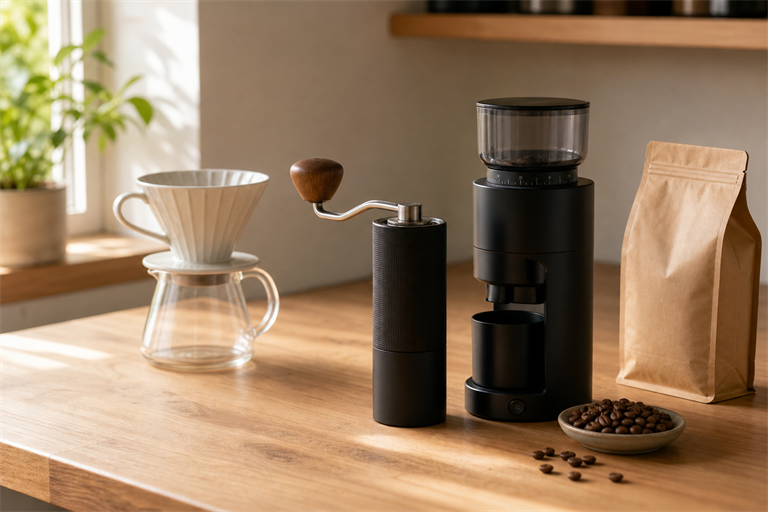
You’re not really picking between two grinders. You’re picking between two morning routines, two upgrade paths, and two ways your kitchen will sound at 6:45 a.m.
I’ve been brewing on a 1Zpresso Q2 for two years. Recently I spent six weeks rotating between it, a Timemore C2, and a Baratza Encore on the same Ethiopian washed lot from Onyx Coffee Lab (their Geometry blend). The differences that mattered weren’t the ones the spec sheets brag about.
The 60-second answer
One or two cups a day, exclusively pour-over or AeroPress, budget capped near $80? Buy a hand grinder. Three or more cups daily, a shared kitchen where two people want coffee at once, or any plan to try espresso within the year? Buy an entry electric. The rest of this piece explains why, and when to switch.
What actually matters for a beginner
Forget motor wattage and burr coatings for a second. Four variables decide whether you keep using the grinder you buy:
- Daily volume. How many cups, how many people, how often back-to-back.
- Brew method. Pour-over and AeroPress forgive small inconsistencies. Espresso doesn’t.
- Grind quality per dollar. Sub-$100 manuals beat sub-$150 electrics on burr geometry, full stop.
- Friction. Cranking, noise, retention cleanup, counter footprint.
A grinder you avoid using is worse than one tier down that you reach for daily.
Side-by-side: hand vs electric for beginners
| Criterion | Hand Grinder (sub-$100) | Entry Electric (sub-$200) |
|---|---|---|
| Representative model | 1Zpresso Q2 ( |
Baratza Encore ( |
| Burr type | 38–40mm conical steel | 40mm conical steel (Encore) / 40mm flat (Opus) |
| Grind time, 18g medium | 45–70 seconds | 12–20 seconds |
| Grind time, 30g coarse | 90–110 seconds | 18–25 seconds |
| Noise (subjective) | Quiet ratchet, ~50 dB | Loud motor, 75–85 dB |
| Capacity per batch | 20–30g | 250g+ hopper |
| Retention | 0.1–0.3g | 1–3g (Encore), under 0.5g (Opus) |
| Counter footprint | Stores in a drawer | 13–35cm tall, permanent spot |
| Pour-over grind quality | Excellent | Good to excellent |
| Espresso capable | Q2 no, JX-Pro yes (~$165) | Encore no, Opus yes |
| Realistic 5-year cost | $80 + zero | $170 + one burr clean kit (~$15) |
Numbers above are my own stopwatch tests on the same 18g and 30g doses of Onyx Geometry, ground for a V60 02 at an SCA-style medium setting. Your seconds will vary by 10–15 percent depending on bean density and how aggressive you are on the crank.
Where grind quality actually matters
At pour-over settings, a $70 Timemore C2 and a $170 Baratza Encore produce drawdowns within 10–15 seconds of each other on a 15g, 250g brew. Both are clean enough to land in the 19–21 percent extraction window without obvious channeling. The Q2 actually edges the Encore on fines distribution, because its 38mm hardened steel burrs run at zero rpm. No heat smear on the particles.
Electrics pull ahead at coarse settings for French press and cold brew. A hand grinder cranked coarse takes 90+ seconds per 30g, and your forearm will let you know about it. The Encore handles the same dose in under 25 seconds and produces a more uniform coarse cut, because the motor holds constant burr speed.
For espresso, neither sub-$200 electric I tested is acceptable. The Encore can’t grind fine enough. The Opus can, but its stepped adjustment makes dialling in painful. A 1Zpresso JX-Pro at $165 is the honest entry point for budget espresso, and it’s a hand grinder.
Daily friction is the real story
The spec sheets don’t capture this, so here’s what six weeks of side-by-side living looked like.
The Q2 lives in a drawer. I pull it out, grind 15g in 50 seconds, brush the catch cup, put it back. Zero counter real estate. My partner sleeps through it.
The Encore lives on the counter. It’s 35cm tall, has a 225g hopper I never fill because beans go stale, and at 78 dB it wakes the apartment. It also retains around 2g of old grounds between sessions, which matters when you switch beans (and I switch beans constantly for reviews).
Brewing solo, once a day, the hand grinder wins on every friction metric except the 50 seconds of cranking. If two people want coffee inside ten minutes, the electric wins immediately, because grinding 36g back-to-back by hand is genuinely unpleasant.
Cost per cup over five years
A Timemore C2 at $70, used once a day, works out to roughly 4 cents per brew amortised over five years. Burrs are still sharp at year five for most home users. A Baratza Encore at $170 with one $15 burr cleaning kit lands near 10 cents per brew. Neither is expensive. The Encore isn’t “twice as good,” but it’s twice as fast and three times louder.
If you upgrade from a $70 manual to a $400 Fellow Ode Gen 2 in year two, total spend is $470. Start with the Ode, it’s $400. Manual-first is only cheaper if you stay manual, or if your eventual electric is also entry-level.
Specific picks under $200
Hand, pour-over only: Timemore C2 (~$70). Honest burrs, smooth adjustment, fits inside AeroPress travel kits.
Hand, pour-over plus future espresso: 1Zpresso JX-Pro (~$165). External numbered dial, holds 35g, good for ratio-curious beginners.
Electric, pour-over and French press: Baratza Encore (~$170). Parts available for a decade, burrs swappable for $40.
Electric, low retention and quieter: Fellow Opus (~$195). Flat burrs, single-dose hopper, espresso-capable but fiddly.
Skip any sub-$80 electric. Blade grinders and the cheapest “burr” boxes produce a bimodal particle distribution that ruins pour-over no matter how careful your pour is. I’ve tested several. The chart on a laser diffraction printout looks like two camels in a sandstorm.
When to graduate from manual
Move from hand to electric when at least two of these are true:
- You’re brewing 30g or more of beans per day on average.
- You’re making coffee for two or more people at the same time more than three days a week.
- You’ve started experimenting with espresso, where 8–12 second cranks become a daily chore.
- Cranking has become the reason you skip days, or you’ve started feeling your wrist on cold mornings.
Until then, the hand grinder isn’t a compromise. It’s the right tool.
Pick by scenario
- Solo pour-over drinker, one cup a day, under $100: Timemore C2. You won’t outgrow it for two years.
- AeroPress traveller or office brewer: 1Zpresso Q2. Fits inside an AeroPress chamber, and pairs well with a handful of recipe variables worth tweaking.
- Two-person household, daily V60 plus occasional French press: Baratza Encore.
- Curious about espresso, want one grinder for now: 1Zpresso JX-Pro, then add a dedicated espresso grinder later.
- Hate noise, want low retention, willing to pay the premium: Fellow Opus.
- Already cranking 30g+ daily with a tired forearm: that’s the trigger. Move to the Encore or Opus this month.
Buy for the routine you actually have, not the one you imagine. The grinder you reach for at 6:45 a.m. is the one that improves your coffee.