
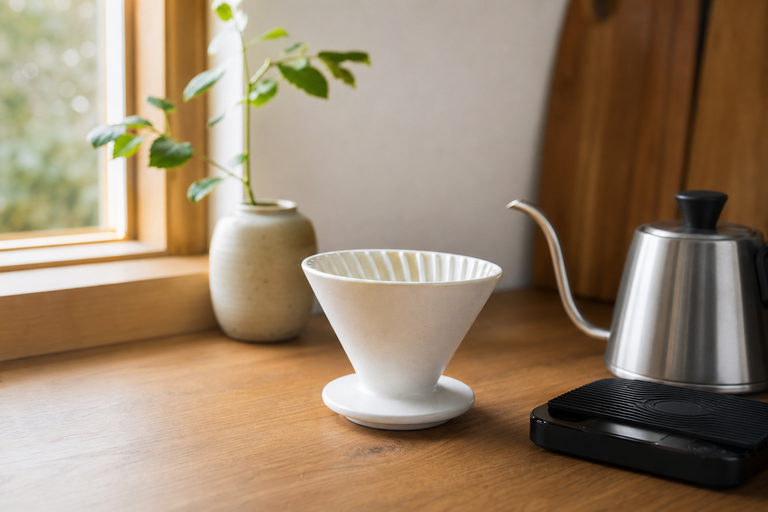
Short answer: the Hario MUGEN can simplify the pouring stage, but no specification proves that one pour will match the flavor clarity of a well-dialed V60 recipe. Hario designed the MUGEN with flatter walls, limited ridges and more flow restriction so the paper clings to the brewer and slows drawdown. The classic V60 uses spiral ridges and minimal built-in restriction, giving the brewer more direct control through grind and pouring.
This article is a specification- and workflow-based review. Home Coffee Journal has not performed controlled sensory testing, long-term ownership testing or refractometer measurements on these drippers. Flavor descriptions should therefore come from your own side-by-side brews, not from invented scores.
MUGEN vs V60: the verified differences
| Feature | Hario MUGEN 02 | Hario V60 02 |
|---|---|---|
| Intended workflow | One slow, continuous pour | Flexible; continuous or pulse-pour recipes |
| Interior design | Flat walls with limited ridges | Spiral ridges |
| Flow behavior described by Hario | More restriction; paper clings to the wall, slowing drawdown and extending contact | Little built-in restriction; pouring, paper and grind exert more control |
| Paper | Compatible with 02 V60 filters | Uses matching 02 V60 filters |
| Materials | AS-resin or ceramic body, depending on model | Available in plastic, ceramic, glass and metal versions |
| Rated range | 1–2 cups in Hario’s global catalog | Ceramic 02 is rated 1–4 cups |
| Main reason to buy | A simpler, deliberately restricted one-pour workflow | More control and a larger ecosystem of established recipes |
Sources: Hario MUGEN product page, Hario global catalog, and Hario V60 Ceramic 02 product page.
How the MUGEN simplifies brewing
With a V60, the spiral ridges help keep the paper from sealing against the wall. Hario describes the brewer as having little flow restriction, so the person pouring can raise or lower the slurry, split water into pulses and vary agitation. That freedom is useful, but it creates more decisions.
The MUGEN deliberately reduces that freedom. Hario says its paper clings to the flatter walls, increasing flow restriction and contact time. The intended method is one slow continuous pour. You still need to choose an appropriate dose, grind and water temperature, but you do not need to reproduce a multi-pulse schedule.
“One pour” does not mean “no technique.” Pour height, rate and where the stream lands can still move the coffee bed. A basic kettle may be usable, but Hario does not promise that any kettle and any pour rate will produce the same result.
Can it match V60 clarity?
That question cannot be answered honestly with a universal percentage. Clarity is a sensory description rather than a product specification, and the same MUGEN can produce different cups when the paper, grinder, water or coffee changes.
The design does support a reasonable workflow distinction:
- The MUGEN restricts flow by design and reduces the need to manage several pours.
- The V60 leaves more flow control to the brewer, which creates more ways to adjust a recipe and more ways to miss it.
That is a trade between simplicity and control, not automatically a trade between “body” and “clarity.” A restricted brewer is not guaranteed to taste heavy, and a fast-flowing brewer is not guaranteed to taste clean. Extraction and sensory results depend on how the full recipe interacts with the coffee.
What Hario recommends for grind
Hario’s MUGEN product page suggests starting slightly coarser than the grind used for a standard V60. That is the most useful default when converting an existing V60 recipe, because the MUGEN provides more flow restriction.
Hario also publishes a separate Tetsu Kasuya MUGEN recipe using 25 g of finely ground coffee, 300 ml of water and a listed brew time of 1:30. These instructions are not contradictory once they are treated as different starting systems: one is general conversion advice relative to a V60, while the other is a specific high-dose recipe. Do not combine the fine grind from one recipe with the dose and timing from another and expect the published result.
A practical starting workflow
For a first brew, follow the instructions supplied with your exact MUGEN model or use Hario’s attributed recipe above. If you prefer to adapt your familiar V60 ratio, keep the experiment modest:
- Use the same coffee-to-water ratio you know from the V60.
- Start slightly coarser than your V60 setting, following Hario’s product guidance.
- Rinse the 02 paper and preheat the brewer and vessel.
- Add the water in one slow, controlled continuous pour.
- Record dose, water mass and drawdown.
- Taste after cooling, then change only one variable.
If the cup is sour or weak, a somewhat finer grind or hotter water may increase extraction. If it is drying, harsh or very slow, try a coarser grind. These are general dialing-in responses, not results from a Home Coffee Journal test.
Who should choose the MUGEN?
- A brewer who wants fewer pouring stages on a weekday morning.
- Someone who already buys V60 02 papers and wants to keep one filter format.
- A household where several people need an easy-to-explain baseline method.
- A traveler who values a simple workflow; the lighter resin version is the more obvious travel candidate than ceramic.
Who should stay with the V60?
- A brewer who enjoys changing pulse structure and agitation.
- Someone who already gets repeatable results and does not need another workflow.
- A light-roast enthusiast who wants maximum freedom to adapt recipes rather than built-in restriction.
- Anyone who needs the V60 02’s broader 1–4-cup rating rather than the MUGEN’s cataloged 1–2-cup range.
What this comparison cannot tell you
It cannot responsibly rank the MUGEN against the Kalita Wave or ORIGAMI without holding coffee, paper, material, recipe and tasting conditions constant. It also cannot claim that the MUGEN delivers a fixed drawdown across a wide grind range, eliminates channeling, or reaches a defined percentage of V60 quality. Those are testable claims, but Hario’s product specifications do not establish them.
Verdict
The MUGEN is best understood as a V60-paper-compatible brewer designed around a slow, continuous one-pour method. Its flatter interior and extra restriction make the workflow less dependent on a sequence of pulses. The classic V60 remains the more adjustable platform.
Buy the MUGEN if simplifying the pour is the feature you need. Keep the V60 if control and recipe flexibility are the point of brewing for you. Whether one matches the other for clarity can only be answered for a specific coffee, grinder, water and recipe—not by an unsupported score or a universal claim.