
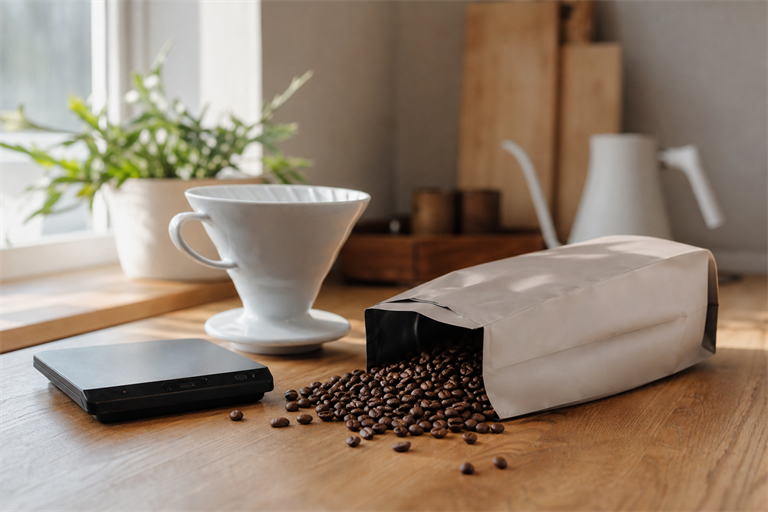
Two bags sat on my counter last month, both labelled “single origin Ethiopia,” bought from two different roasters. One was £11. The other was £19. I brewed them back to back on my V60 at 93°C, 15g to 250g, same grind setting on my Comandante. The cheaper one read as generic citrus and faded after two sips. The pricier one moved through ripe peach, bergamot tea, and a dry cocoa finish as it cooled. Both labels were honest. They just weren’t telling me the same kind of truth.
That gap is the whole problem with “single origin.” It isn’t a regulated term. It can mean a whole country, or it can mean one farmer’s 60kg pick on a specific Tuesday in November. For anyone at home with a scale and a kettle, that range matters more than the marketing suggests, because it changes what you should taste and how you should brew.
The words promise almost nothing
There is no legal definition of “single origin” anywhere I know of, and no certifying body audits it. A roaster can print it on a bag whose beans came from twenty farms across three regions of one country, blended in a warehouse, and they are not lying in any enforceable sense. The phrase only promises that the coffee is not a multi-country blend like a typical supermarket “Italian roast.”
Low bar. The useful information lives one layer down, in how specifically the bag names where the coffee came from.
Four tiers of traceability, and what each one predicts
Here is the hierarchy I use when I pick up a bag at my local roaster. Each tier predicts something different about the cup.
| Tier | What the label says | What it predicts in the cup |
|---|---|---|
| Country | “Ethiopia,” “Brazil,” “Colombia” | Broad flavour family only. Could be anything within that country’s range. |
| Region | “Yirgacheffe,” “Huila,” “Cerrado” | A recognisable style. Yirgacheffe leans floral and citric; Huila leans sweet and balanced. |
| Farm or co-op | “Finca El Paraiso,” “Konga Cooperative” | Consistent processing and a specific altitude band. Cup gets repeatable. |
| Micro-lot | “Finca El Paraiso, Pink Bourbon, Lot 14, Nov 2025 pick” | One varietal, one process, one harvest window. Distinct, often unusual flavours. |
Going from country to region is the biggest practical jump for a £12 bag. Going from farm to micro-lot is where prices climb fast, and where you start tasting things like white grape, jasmine, or stewed strawberry that don’t show up in cheaper bags.
What you actually taste when traceability is real
When a single origin is genuinely traceable to a farm or micro-lot, three things tend to show up that blends rarely deliver.
The first is clarity. One flavour at a time, in sequence, instead of a single “coffee” impression. My peach Ethiopian goes peach, then black tea, then a dry cocoa finish as it cools.
The second is distinct acidity. Not sourness. A specific fruit acid: malic (green apple), citric (lemon, bergamot), tartaric (grape). You can name it.
The third is terroir markers. Flavours tied to where the coffee grew. High-altitude Kenyans often show blackcurrant. Sumatrans show cedar and tobacco. These are not poetic guesses; they repeat year after year from the same regions.
A country-level “single origin Brazil” usually gives you none of those three things in a recognisable form. It just tastes like reasonable coffee.
Single origin vs blend, for home pour-over
I keep both in my cupboard. They do different jobs.
Reach for a single origin when you want to taste something specific, like a Kenyan SL28 with blackcurrant or a washed Gesha with jasmine. Brew it on a V60 or AeroPress, where clarity shines. These coffees reward 92–94°C water and a slightly coarser grind, because you want to draw out the high notes without dragging bitterness behind them.
Reach for a blend when you want a daily cup that’s consistent across the bag and forgiving with milk. Blends are built by roasters to balance body and sweetness on purpose. They are not a lesser thing. They are a different thing.
Reading the bag like a buyer
When I pick up a bag now, I look for five concrete pieces of information. If three or more are missing, the “single origin” claim is mostly marketing.
- Country and region (e.g., Ethiopia, Yirgacheffe)
- Farm, washing station, or co-op name (e.g., Konga, Chelbesa)
- Varietal (e.g., Heirloom, SL28, Pink Bourbon, Caturra)
- Process (washed, natural, honey, anaerobic)
- Harvest date or roast date (harvest tells you freshness of the green; roast date tells you freshness of the bean)
Elevation in metres is a nice bonus. Above 1,600m generally means denser beans and brighter acidity, which matters for your brew temperature.
Brewing to show off origin character
A traceable single origin gives you more to work with, so small changes show up clearly. Here is what I adjust on my V60 when I open a new micro-lot bag.
- Start at 18g coffee to 300g water on a Hario V60 02 (1:16.7). A clean baseline ratio. Too strong (1:14) muddies delicate florals; too weak (1:18) loses the body that carries the finish.
- Use 93°C water for washed coffees, 90°C for naturals. Naturals already carry a lot of fermented sweetness; hotter water tips them into boozy and heavy.
- Bloom with about 54g water for 40 seconds, then pour again to keep the bed moving. Roughly 3× the coffee weight, long enough to release CO2 without stalling the brew. Skipping that second pour after the bloom is what flattens most home brews.
- Target a total brew time of 2:45–3:15. If your last drawdown finishes before 2:30, grind one notch finer. After 3:30, one notch coarser.
- Taste at three temperatures: hot, warm, cool. Single origins change as they cool. If it tastes better warm than hot, you over-extracted; ease the grind coarser next time.
For reference, the SCA brewing chart puts a balanced cup somewhere around 1.15–1.45% TDS at 18–22% extraction. I rarely measure mine, but the chart is a useful sanity check when a brew tastes off and you can’t decide which lever to pull.
If a bag only says “single origin Colombia” with no farm, no process, no varietal, don’t bother fine-tuning. Brew it as a daily cup at 1:16 and 93°C and enjoy it. The information for fine-tuning isn’t there.
The single highest-impact next step today: pull whatever bag is open in your kitchen, read the label, and decide which of the four tiers it actually belongs to. That alone changes how you brew it tomorrow.