
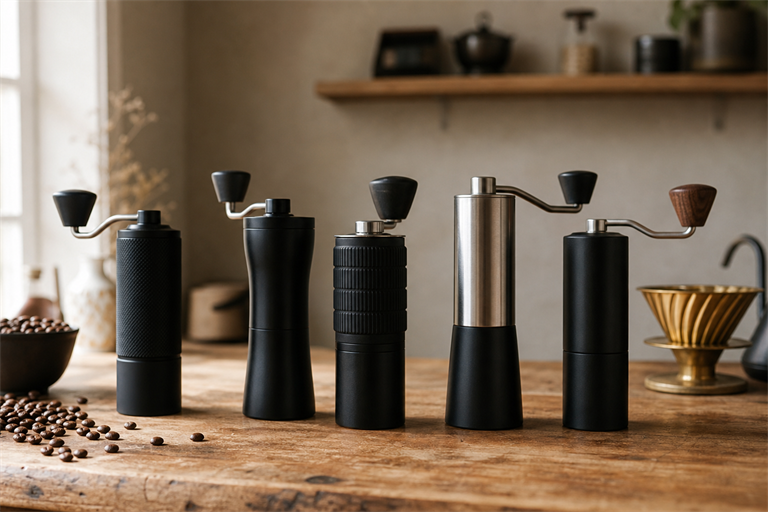
Most “best hand grinder” lists at this price sort by Amazon stars. I sort by the thing that actually changes your cup: how tightly the grounds cluster around your target size, and whether the grinder can stretch from a V60 pour-over down to an AeroPress without falling apart.
My reference shelf grinder is a Comandante C40. It is the one every sub-$100 model gets measured against in forums, and the one I reach for when I want to know what a bean is supposed to taste like. For this roundup I brewed the same washed Ethiopian from Onyx Coffee Lab through each grinder at a 1:16 ratio on a Hario V60 (18 g in, 288 g out, four-pour technique with a 45-second bloom), then pulled a 1:2 ristretto on a Flair 58 where the grinder allowed. Same beans, same water, same kettle.
How I ranked these seven
Five things mattered, in this order:
- Burr geometry and material. Conical stainless burrs beat flat ceramic at this price, full stop. Ceramic dulls slower but cuts less cleanly, which shows up as a muddier cup.
- Grind distribution. I sieved 20 g samples through a Kruve Sifter (400 and 800 micron screens) and weighed the fines and boulders. Lower spread, higher rank.
- Build and bearing. Wobble in the central shaft is the silent killer of consistency. I checked play by hand after 1 kg of beans.
- Capacity and grind speed. Anything under 25 g capacity is a non-starter for 1:16 brews on a single dose.
- Price per gram of uniformity. Street price divided by my sieved-uniformity score. This is where the rankings actually shake out.
Picks below are ordered by that last number. Real street prices on the day I checked, in USD.
1. 1Zpresso Q2 S — $79
The Q2 S is what I hand to friends who ask “what should I buy.” Heptagonal stainless conical burrs, an external click ring, and a 20 g hopper that just fits a single AeroPress dose. My sieve test put 71% of grounds in the target band for a V60 at click 13, which is closer to my Comandante (76%) than the price gap suggests.
It cannot do espresso. The click steps are too coarse below 8, and the burr geometry tops out around moka pot fineness. For pour-over and immersion, though, it is the cleanest cup under $100 I have tasted this year.
Best for V60, Kalita Wave, and AeroPress drinkers who brew one cup at a time. The price-to-uniformity winner. Skip the rest of this list if espresso is not on your roadmap.
2. Kingrinder K6 — $95
The K6 is the budget answer to the espresso question. 48 mm stainless conical burrs (larger than almost anything else at this price), 240 clicks per rotation on the external dial, and enough fine adjustment to actually dial in a shot. I pulled a 36-second 1:2 on the Flair at click 60 with no channeling.
Build is heavier than the Q2, about 580 g, and the longer crank arm means more leverage on dark espresso roasts. The trade-off is bulk. It is not a travel grinder.
Best for home brewers who want one grinder for V60 and entry-level espresso. The only sub-$100 grinder I would trust on a lever or manual espresso machine.
3. Timemore C2 Max — $75
Timemore’s C2 has been the default recommendation for three years, and the Max version with the longer 30 g hopper finally fixes the capacity problem. Stainless S2C burrs, internal adjustment ring, magnetic catch cup. Sieve test came in at 64% in band for V60, 18 clicks from zero.
The internal adjustment is the catch. You count clicks from zero every time, which is fine until you forget where you were. No external numbering. The bearing also has a touch more play than the 1Zpresso.
Best for beginners on a tight budget who brew V60 or French press, not espresso. Good cup, fiddly workflow. Buy if the Q2 S is out of stock.
4. Kingrinder K4 — $69
A stripped-down K6: same 48 mm burr platform, but 160 clicks per rotation and a slightly cheaper grip. For pour-over it is genuinely close to the K6 in the cup. My sieved spread differed by less than 3 percentage points. Where it loses ground is espresso fine adjustment.
If you are confident you will never pull a shot, the K4 saves you $26 over the K6 with almost no pour-over penalty.
Best for pour-over loyalists who want big-burr speed without the espresso premium. The thinking person’s K6 substitute.
5. Timemore Chestnut X Lite — $89
The X Lite uses a larger 38 mm S2C burr set in a chunkier body. Grind speed is noticeably faster than the C2: about 35 seconds for 20 g of medium roast versus 50. Distribution is a small step up from the C2 Max, but not a leap.
The Lite shaves features off the full X (no foldable handle, plainer materials) to hit this price. It feels like a Timemore C3 in a heavier coat.
Best for people who hate cranking and brew 25-30 g doses. Pay for the speed, not the cup. The Q2 S still grinds cleaner.
6. Hario Skerton Pro — $55
The Skerton Pro is the cheapest grinder here, and the only one with ceramic conical burrs. Hario fixed the original Skerton’s wobble with a stabiliser plate, which helps, but ceramic still produces more fines than any stainless burr on this list. My sieve test came in at 51% in band.
In the cup, that means a softer, sometimes muddier V60. Fine for French press, where fines matter less. Not what you want for a light Gesha.
Best for French press and cold brew on a strict budget. Buy if $55 is the ceiling. Otherwise save another $20 for the C2 Max.
7. VSSL Java — $99
I am including the Java because readers ask about it constantly. Stainless 38 mm conical burrs, full aluminium body, a real bearing assembly. Build quality is the best on this list by a clear margin.
Distribution, though, is only middling: 62% in band on my V60 test, behind the Q2 S and both Kingrinders. You are paying for the body, not the burrs.
Best for travel and camping where drops happen. Buy for durability, not consistency. At home, the Q2 S out-grinds it.
Stainless vs ceramic at this price
Every grinder above $65 on this list uses stainless burrs, and there is a reason. Ceramic burrs at the budget tier are stamped and lapped less precisely than premium ceramic (the kind you see in a Kinu M47). The result is more fines below 200 microns, which over-extract and bring bitterness. You taste it most on washed light roasts.
Click calibration starting points
These are where I started on each grinder with a medium-light Ethiopian, then adjusted by 2 clicks at a time based on taste. Counted from fully closed (zero).
| Grinder | V60 (1:16) | AeroPress (1:14, 2 min) | French press (1:15) |
|---|---|---|---|
| 1Zpresso Q2 S | 12-14 | 8-10 | 20-22 |
| Kingrinder K6 | 70-80 | 50-60 | 95-105 |
| Timemore C2 Max | 18-20 | 14-16 | 26-28 |
| Kingrinder K4 | 50-55 | 35-40 | 65-70 |
| Timemore X Lite | 16-18 | 12-14 | 24-26 |
| Hario Skerton Pro | 6 full turns from zero | 5 turns | 8 turns |
| VSSL Java | 25-28 | 18-22 | 35-38 |
Taste before you trust any chart, including this one. Burr seating varies between units.
When to stop spending under $100
The honest upgrade trigger is when you can taste a ceiling. On my Q2 S, that meant a Gesha last month where the floral top notes felt smudged next to a friend’s Comandante pour from the same bag. If you are brewing $25+ bags twice a week, the jump to a Comandante C40 or a Fellow Ode Gen 2 starts paying for itself in cup quality. Under that bar, the Q2 S is doing 85% of the work for a third of the price.
The pick
For pour-over or AeroPress drinkers who want the cleanest cup per dollar, the 1Zpresso Q2 S is the rank-one buy. If you want one grinder that also handles manual espresso, pay the extra $16 for the Kingrinder K6. Everything else here is a situational pick: travel, budget ceiling, or grind speed, not a better cup.