
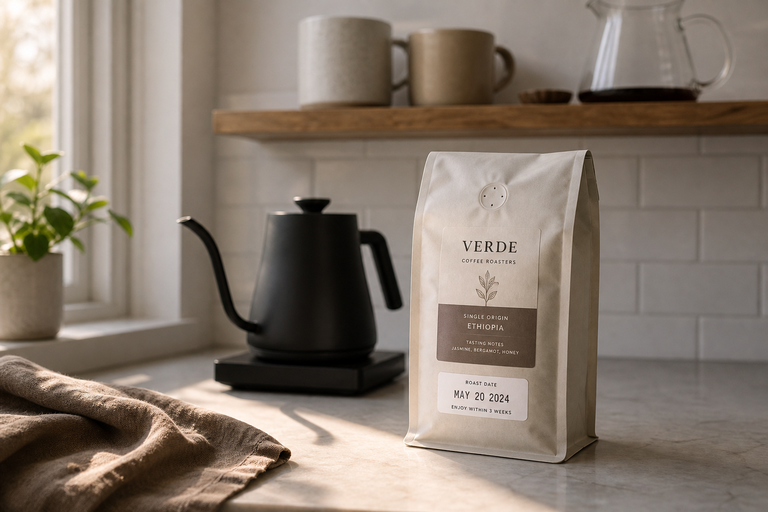
You flip the bag over hoping for a clear date. Instead you find a cryptic “094” stamped on the seam, or a “Best By” that is nine months out. Which number actually tells you the coffee is fresh?
That question is the whole point of the roast date. A good roast date tells you when to buy the bag, when to open it, and when the coffee will stop tasting like coffee and start tasting like paper. Below is how to read the label at the shelf and make it work at home.
The three dates you might see, and only one really matters
Coffee bags can carry up to three date labels, and they mean very different things.
- Roast date (sometimes “Roasted on”): the day the beans came out of the roaster. This is the number you want.
- Packaged on: the day the beans were sealed into the bag. Sometimes that matches the roast day, sometimes it lands a week later.
- Best by or Best before: a shelf-life estimate set by the roaster, usually 6 to 12 months out.
A “Best By 02/2027” stamp on a bag with no roast date can easily hide beans that are already six months old. Tasting Table describes best-by dates as a safety window rather than a flavor promise (source). Trade Coffee puts it plainly: peak flavor lives inside a short window measured in weeks, not months (source).
If a bag shows only a best-by date, treat it as a red flag. Ask when it was actually roasted before you pay.
Where the roast date hides, and how to decode it
Roasters print the date in five common places: a small sticker on the front, a printed block on the back label, a hand-written note beside the valve, a stamp on the crimped seal, or a sticker on the base of the bag.
Two format traps trip up shoppers.
MM/DD/YY vs DD/MM/YY. In the US, 03/08/26 usually means March 8, 2026. In most of Europe, Korea, and Japan, the same string means August 3, 2026. That is a five-month gap. Check the roaster’s country before you trust the order.
Julian date codes. Some roasters print a three-digit number like 094 or 217. That is the day of the year: 094 is April 4, and 217 is August 5. If you see a four-digit code, the first digit is often the year, so 6094 reads as April 4, 2026. A quick converter clears this up in seconds (source).
The 4 to 21 day sweet spot
Fresh out of the roaster, beans off-gas carbon dioxide for days. Too much CO2 pushes water out of the grounds during brewing and blocks even extraction. Clive Coffee describes coffee brewed too early as sharp, hollow, or fizzy in the cup (source).
Use this rough map counted from roast day, aligned with Trade Coffee’s freshness guidance:
| Days since roast | What you notice | What to brew |
|---|---|---|
| 0–3 | Loud bloom, uneven pours, sour or fizzy cup | Wait |
| 4–10 | Bloom settles, sweetness starts to show | Pour-over and drip shine |
| 7–14 | Balanced flavor separation, deeper sweetness | Espresso peak, filter still great |
| 14–21 | Slightly quieter, still expressive | Any method |
| 21–35 | Aromatics fade, cup goes flat | Drinkable, not exciting |
| 35+ | Cardboard notes, oily surface on dark roasts | Cold brew or compost |
Espresso often tastes best a few days later than filter because the larger dose and 9 bars of pressure force more CO2 through the puck.
How to judge a bag at the shelf
Before you pay, run a five-second check.
- Find the roast date. If there is none, put it back.
- Count the days. Anything past 21 days is a discount purchase, not a splurge.
- Look for a one-way valve on the bag. It vents CO2 without letting oxygen back in.
- Match the pack size to your habit. A 340 g (12 oz) bag brews roughly 20 to 24 pour-overs at a 1:16 ratio. One cup a day means you have about three weeks to finish it.
- If you subscribe, set delivery so the bag arrives within 7 days of roasting.
After you open the bag
The clock speeds up the moment you break the seal. Oxygen is the enemy from here on.
Keep beans in the original valved bag with the top rolled tight and clipped, or move them to an opaque, airtight canister. The Specialty Coffee Association recommends dark, airtight storage in a cool, dry spot (source). Skip clear jars on the sunny counter. Skip the fridge too, since it invites moisture and traps nearby smells.
Grind right before brewing. Ground coffee stales within hours, because far more surface area meets far more oxygen.
Awkward cases, quick answers
No date on the bag. Ask the shop when it arrived. If no one knows, assume the bag is at least a month old and pay a month-old price.
Vacuum-sealed brick. Nitrogen-flushed bricks can buy months of shelf life, but the clock restarts hard once you cut them open. Aim to finish within two weeks.
Frozen beans. Freezing whole beans in a sealed bag pauses staling. Portion into weekly bags before freezing so you thaw only what you will drink that week.
Espresso vs filter timing. Rest espresso beans 7 to 14 days from roast. Pour-over and drip taste balanced from day 4 through day 21.
Your next move: pull the bag on your counter, find the roast date, and write the “brew by” day (21 days later) on the bag itself. That single mark will do more for tomorrow’s cup than any new piece of gear.