
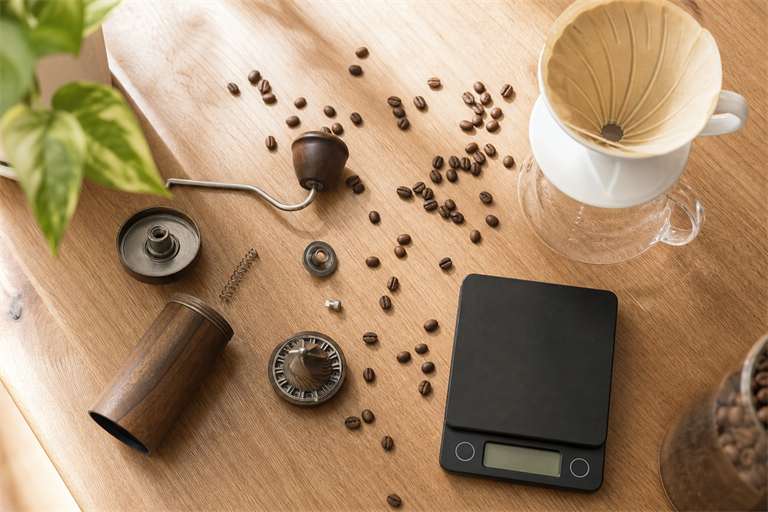
Last Tuesday I followed a roaster’s recipe to the decimal. Fifteen grams in, 250 out, water at 94°C. The cup arrived thin and pinched-sour, the sort of result that sends you back to check the kettle thermometer twice. The recipe wasn’t wrong. My grinder was lying to me.
Budget hand grinders ship with burrs seated at slightly different positions from the factory. The 1Zpresso Q2, Timemore C2, and Kingrinder K1 all share this quirk. “18 clicks” on your Q2 is not the same particle size as 18 clicks on mine, which is why borrowed numbers so rarely reproduce on someone else’s bench. A zero-point reset plus a repeatable test brew fixes it. Once you’ve done that, you own a number that actually means something on your grinder.
What you need on the counter
- A hand grinder with stepped clicks (Q2, C2, K1, or similar).
- Hario V60 02 dripper and a paper filter.
- Digital scale with 0.1g resolution.
- Kettle (gooseneck preferred) with water at 94°C (201°F). If yours pours unevenly or sputters, it may be time to descale the kettle before you trust any calibration result.
- 60g of one fresh medium-roast single origin (roasted 7–21 days ago).
- A small notebook or notes app.
Session goal: a 15g-in, 250g-out V60 that finishes draining between 2:30 and 2:45 and tastes balanced. Sweet, no sour pucker, no dry bitter finish. Three variables actually matter here: your grinder’s true zero point, click count from zero, and total brew time. Everything else is noise.
Typical landing spots after calibration, for reference: 1Zpresso Q2 around 9–11 clicks, Timemore C2 around 18–22 clicks, Kingrinder K1 around 55–70 clicks, all for a medium roast.
Step 1: Disassemble and find true zero
Unscrew the adjustment ring (or numbered dial) completely. On the Q2 and K1, lift it off the shaft. On the C2, turn the bottom dial counter-clockwise until it stops, then a quarter turn more to free it. Factory markings assume the burrs were aligned perfectly at the assembly line. They often aren’t. That one misalignment is the single biggest reason published recipes refuse to reproduce on your grinder.
Step 2: Seat the burrs at contact
Hold the grinder upright, empty. Slowly turn the adjustment ring clockwise (finer) until you feel the inner burr just kiss the outer burr. You’ll feel a faint scrape if you turn the handle. Back off one click. That is your true zero. Mark it with a dot of nail polish or a pencil scratch so you never lose it again.
Step 3: Set a starting click count
From zero, count clockwise outward (coarser):
| Grinder | Starting clicks from zero |
|---|---|
| 1Zpresso Q2 | 10 |
| Timemore C2 | 20 |
| Kingrinder K1 | 60 |
These are educated starting points for a medium roast. Not final numbers. Think of them as a midpoint you can bracket from. If you’re dialing in a lighter roast instead, the starting clicks shift finer; see the light-roast V60 dial-in guide for that bracket.
Step 4: Run the baseline test brew
- Dose: 15.0g beans, weighed.
- Water: 250g total at 94°C.
- Filter: rinse with hot water, discard.
- Bloom: pour 45g, swirl, wait until 0:45.
- Main pour: bring to 150g by 1:15, then to 250g by 1:45.
- Target total drawdown: 2:30–2:45.
The point of this protocol is to isolate grind size as the only variable. Same dose, same water, same pour schedule every time. Change two things at once and you’ll learn nothing.
Step 5: Taste, then adjust by clicks
Let the cup cool for two minutes. Sip.
- Sour, thin, watery, drains before 2:15 → grind finer: -2 clicks (Q2/C2), -5 clicks (K1).
- Bitter, dry, ashy, drains after 3:00 → grind coarser: +2 clicks (Q2/C2), +5 clicks (K1).
- Sweet, syrupy, clean finish at 2:30–2:45 → you’ve found your number.
Why small steps? Each Q2/C2 click moves particle size roughly 8–12 microns. Two clicks is usually enough to flip a brew from sour to balanced. My own Q2 sits at 10 clicks for an Ethiopian Yirgacheffe I’ve been working through from Onyx Coffee Lab. The first try at 12 overshot into sour territory. 10 landed cleanly the next morning.
Step 6: Lock it in and log it
Write down: bean name, roast date, click count from zero, drawdown time, and a one-line taste note. Burrs wear in over the first 2–3 kg of coffee, and different beans want different settings. A log turns guesswork into pattern recognition over a few weeks. Keeping that bag stored properly between brews also keeps your log honest. Stale beans will shift your numbers for the wrong reason.

When the timer disagrees with the taste
| Symptom | Likely cause | Fix |
|---|---|---|
| Drawdown under 2:00, sour | Too coarse | -2 clicks (Q2/C2) |
| Drawdown over 3:00, bitter | Too fine, or clogged bed | Coarsen +2 clicks; pour more gently |
| Inconsistent times brew-to-brew | Loose adjustment ring | Tighten ring; re-check zero |
| Empty grinder rattles between brews | Retention (0.3–0.8g stuck) | Tap chamber 5x before grinding; weigh out, not in |
| Click count drifted by 1–2 over weeks | Burrs bedded in | Re-zero; expect to go 1–2 clicks finer |
| Tastes hollow even at correct time | Uneven plunge speed on handle | Crank at steady 1.5–2 rotations/sec |
The short version, pinned to the fridge
- True zero = burrs just touching, backed off 1 click.
- Baseline brew: 15g / 250g / 94°C / 2:30–2:45.
- Sour → finer. Bitter → coarser. Move 2 clicks (Q2/C2) or 5 (K1) at a time.
- Re-zero after the first 2 kg of beans.
- Log every brew: bean, roast date, clicks, time, taste.
Your next step today: disassemble your grinder, find true zero, and mark it. Everything else is just counting from there.