
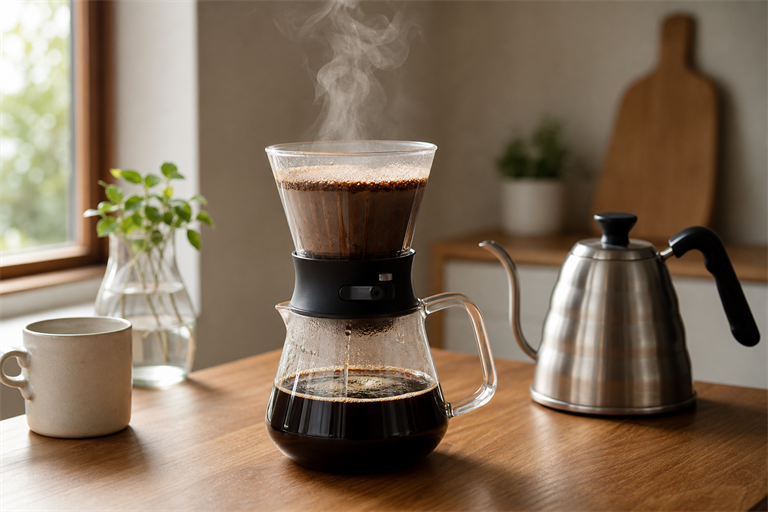
The Hario Switch sat on my counter for a month before I figured out what it actually wanted from me. I kept treating it like a slow V60 with a fancy stopper, and the cups came out either thin and sharp or chalky on the back of the tongue. The valve is the whole reason this dripper exists. Ignore the steep, and you might as well brew with a regular cone.
What that little silicone valve actually does
The Switch is a V60 cone with a silicone valve at the bottom. Flip the valve down and water stays in the cone, steeping the grounds the way a French press would. Flip it up and the slurry drains through the paper filter, behaving like a V60.
That hybrid is the point. Immersion extracts evenly because every ground sees the same water for the same length of time, and the paper still catches sediment and oils on the way out. The cup ends up sitting between an AeroPress brew and a V60: clean, sweet, with a soft body.
Three variables decide whether you get there:
- Steep time with the valve closed (the immersion phase)
- Grind size (coarser than V60, because water sits longer)
- Drawdown pour speed (slow and centered, or you channel)
Target ratio: 1:16 (20 g coffee to 320 g water). Total brew time: 3:00 to 3:30.
Gear and beans for this brew
- Hario Switch (SSD-200 size, 02 cone)
- Hario V60 02 paper filters (white, tabbed)
- Gooseneck kettle, any model, just for a controlled pour
- Scale with 0.1 g resolution and a timer
- Burr grinder. Blade grinders make the grind too uneven for a steep this long. On a budget hand grinder, here is how to dial in the clicks.
- 20 g of fresh coffee, ideally 2 to 4 weeks off roast
- 320 g of filtered water at 94 °C (201 °F) for light roasts, 90 °C (194 °F) for medium-dark
The recipe, step by step
- Rinse the filter with hot water, valve open. This pulls the paper taste out and preheats the cone. Discard the rinse water and reset the scale to zero.
- Grind 20 g of coffee to medium, about table salt, slightly coarser than your V60 setting. The grounds steep for almost two minutes, so a V60 grind will over-extract and turn bitter.
- Close the valve (flip down). Add the grounds, tap to level the bed. A flat bed means water contacts every ground at the same moment when you pour.
- Start the timer. Pour 60 g of water in a slow spiral over 15 seconds. This is the bloom. Even with the valve closed, CO₂ escapes during the bloom and stops it from blocking water flow later. (If your blooms collapse or never rise, check these common bloom mistakes first.)
- At 0:30, gently swirl the cone twice. This breaks the dry clumps floating on top and submerges every ground. Skip it and you get the classic sour Switch cup.
- At 0:45, pour the remaining 260 g in a steady stream, aiming to hit 320 g total by 1:15. Pour into the center, no aggressive spiraling. The valve is closed, so you are filling, not percolating.
- Let it steep, valve still closed, until 2:00 on the timer. That is 45 seconds of true immersion after the pour ends. Light roasts can sit until 2:15.
- At 2:00, give one gentle swirl, then flip the valve open. The swirl resettles the bed so water drains evenly instead of channeling down one side.
- Drawdown should finish between 3:00 and 3:30. If it stalls past 3:45, your grind is too fine. If it drains before 2:45, too coarse.
- Swirl the carafe, pour, and taste before adding anything. A balanced Switch brew tastes sweet up front, with a clean finish and no astringency on the sides of your tongue.
One small note from my counter. I ran this last week with a washed Ethiopian Yirgacheffe from Onyx, three weeks off roast, on a Comandante set two clicks coarser than my usual V60. First try the drawdown finished at 2:55 and the cup was a touch sour. Two clicks finer the next morning landed at 3:15, with the jasmine note I was chasing. The grind window is narrow, but forgiving once you find it.
Reading the cup when something is off
| Symptom | Likely cause | Fix |
|---|---|---|
| Sour, thin, watery | Under-extracted: grind too coarse, or water too cool | Grind two clicks finer, or raise water to 96 °C |
| Bitter, dry finish | Over-extracted: grind too fine, or steep too long | Grind two clicks coarser, or cut steep to 1:45 |
| Drawdown stalls past 4:00 | Fines clogged the filter; grind uneven or too fine | Coarsen grind; check for static-clumped fines |
| Channeling (water rushes one side on open) | Skipped the pre-open swirl, or bed was uneven | Always swirl at 2:00 before flipping the valve |
| Muddy body, silty cup | Pour broke the filter seal during drawdown | Pour gentler, dead center, never on the paper |
If you want to take the guesswork out of “under” versus “over,” a refractometer reading tells you exactly where you landed. Here is what 18–22% extraction yield actually means in the cup. The SCA brewing chart pegs that band as the sweet spot for a reason, and in my experience the Switch lands inside it more reliably than a pure V60 once your steep time is locked.
The recipe at a glance
| Parameter | Value |
|---|---|
| Coffee dose | 20 g |
| Water total | 320 g (1:16 ratio) |
| Water temperature | 94 °C light / 90 °C medium-dark |
| Grind | Medium, ~table salt, coarser than V60 |
| Bloom | 60 g, 0:00 to 0:15 |
| Swirl 1 | 0:30 |
| Main pour | 0:45 to 1:15 (260 g) |
| Swirl 2 + valve open | 2:00 |
| Total brew time | 3:00 to 3:30 |
Pushing the recipe in either direction
- Light roast: push water to 96 °C and steep to 2:15. Light roasts are dense and resist extraction.
- Medium-dark: drop water to 88 °C and open the valve at 1:45. These beans give up flavor fast and turn bitter past two minutes.
- Iced Switch: use 200 g hot water and 120 g of ice in the carafe. Keep the coffee dose at 20 g; the ice dilutes everything to the same 1:16 final strength.
Your next step today: brew this exact recipe once, taste it, and write down whether it leaned sour or bitter. That single data point tells you which direction to move your grind tomorrow.