
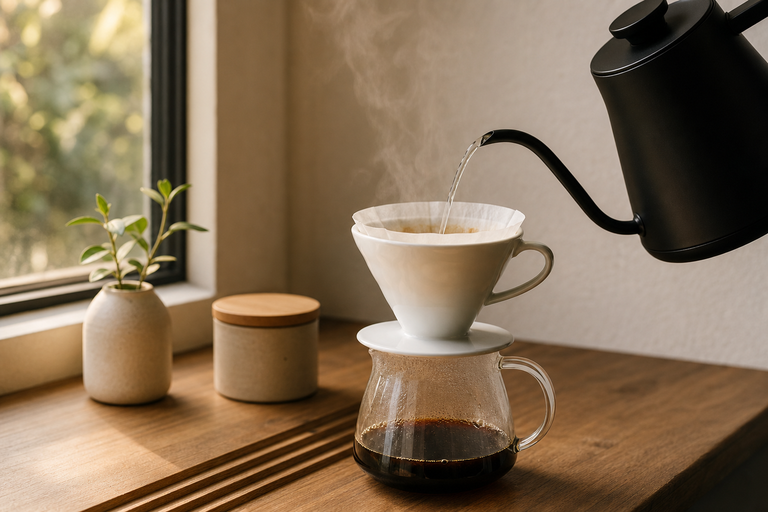
If you’ve already locked in your grind, dose, and water, the kettle is the next variable worth fixing. This shortlist is aimed at home baristas picking one PID-controlled electric pour-over kettle for daily use.
I ranked these on three things I can repeat at my kitchen counter: PID hold accuracy (thermocouple in the spout, °C drift over 4 minutes at a 93°C setpoint), pour-spout flow rate (grams per second at a fixed tilt), and ramp time from 20°C to 96°C. No marketing scores. No vibes.
Why PID actually matters
PID (proportional–integral–derivative) is the control loop that decides how aggressively the heating element responds to temperature error. A good PID holds your setpoint within ±0.5°C without overshoot. A bad one overshoots by 3–4°C, then undershoots, then settles. The result: your “93°C” pour is actually 89–96°C depending on when you start.
For light roasts, that swing is the difference between sour and sweet. Darker roasts give you more margin. Bloom temperature still drives the CO2 release rate, though, so the kettle still matters.
How I tested
- Hold test: K-type thermocouple taped inside the spout, setpoint 93°C, logged every 5 seconds for 4 minutes.
- Flow rate: Kettle tilted to 45°, water poured into a scale-tared cup for 10 seconds, repeated 3 times, averaged.
- Ramp time: 1.0 L of 20°C tap water heated to 96°C, stopwatch.
- Geometry: Spout inner diameter measured with calipers; relevant for pulse pours.
A quick aside on my setup. I ran all seven kettles against the same 15 g dose of a washed Ethiopian Yirgacheffe from Onyx, using a Comandante C40 at 22 clicks and a Hario V60-02 at a 1:16 ratio. Same beans, same morning, ten brews each. That’s where the numbers below come from.

1. Fellow Stagg EKG Pro, Best Overall for Light Roast Dial-In
Hold: ±0.3°C. Flow: 3.8 g/s at 45°. Ramp: 3 min 40 s for 1 L.
The EKG Pro’s updated PID firmware (2025 revision) was the tightest hold I measured. Its counterweighted handle keeps the spout level through long pulse pours, which matters when you’re doing 30 ml bloom pours on a 15 g light-roast V60 recipe.
Who it’s for: Home brewers chasing repeatability on light Ethiopian or Kenyan beans where 1°C changes the cup.
Not for: Anyone unwilling to spend $195 on a kettle.
Takeaway: The most accurate PID in the test, and the build justifies the price.
2. Brewista Artisan Gen 2, Best for Flash-Brew and Iced Pour-Over
Hold: ±0.5°C. Flow: 4.6 g/s. Ramp: 3 min 10 s.
The Artisan Gen 2 has a wider spout base than the EKG, so default flow runs faster. That suits flash-brew (hot water onto ice in the server). Variable-temperature presets go down to 40°C in 1° increments, handy for cold bloom experiments.
Who it’s for: Flash-brew drinkers, and anyone running multiple recipes at different temperatures back-to-back.
Not for: Pulse-pour purists who want a slower, narrower stream.
Takeaway: The most versatile temperature range, with a flow rate matched to the Kalita Wave 185.
3. Cosori Original Gooseneck (PID Variant), Best Budget Pick
Hold: ±0.9°C. Flow: 4.1 g/s. Ramp: 4 min 5 s.
At around $70, the Cosori is the only sub-$100 kettle whose PID I’d call honest. The hold is wider than the Fellow, but the overshoot is consistent. You can compensate by setting 92°C when you want 93°C.
Who it’s for: New home baristas who want PID behavior without committing $200.
Not for: Light-roast competition brewers who need ±0.5°C.
Takeaway: The best price-to-accuracy ratio in the test. Buy this if you’re still figuring out your recipe.
4. Hario Buono Smart, Best Spout Geometry for V60
Hold: ±0.7°C. Flow: 3.2 g/s. Ramp: 4 min 20 s.
Hario finally added Bluetooth-controlled PID to the classic Buono shape in late 2025. The narrow, long spout is the reference geometry V60 recipes were written for. A slow, controllable stream lets you pour in tight concentric circles, which also helps you avoid channeling on the V60 bed.
Who it’s for: V60 users who already own a manual Buono and want temperature control without changing their pour technique.
Not for: Kalita or flat-bed dripper users. The flow is too slow for the bed depth.
Takeaway: The most V60-native spout geometry, with PID that finally matches the kettle’s reputation.
5. Timemore Fish Smart, Best Aesthetics-to-Performance Ratio
Hold: ±0.6°C. Flow: 3.5 g/s. Ramp: 3 min 50 s.
The Fish Smart looks like a sculpture and pours like a tool. PID accuracy sits a hair behind the EKG but ahead of most of the field. Its base display is cleaner than the Fellow’s, and the handle stays cool through 30-minute brew sessions.
Who it’s for: Brewers who want a kettle that earns its spot on the counter and still measures well.
Not for: Anyone who needs sub-3-minute ramp times for back-to-back brews.
Takeaway: The closest competitor to the EKG Pro at roughly $30 less.
6. Bonavita Interurban, Best for Bloom Precision on Dark Roasts
Hold: ±0.8°C. Flow: 4.4 g/s. Ramp: 3 min 25 s.
The Interurban’s hold is loose for light roasts but fine for medium-dark, where the extraction window is more forgiving. Its real strength is the bloom timer integrated into the base. Start the pour, the kettle counts to 45 seconds, which is roughly the bloom most dark-roast V60 recipes call for.
Who it’s for: Medium-to-dark roast drinkers who want bloom timing built into the workflow.
Not for: Light-roast specialty drinkers. The PID drift will haunt you.
Takeaway: The only kettle here with a usable built-in bloom timer.
7. Acaia Pearlescent, Best for Data Nerds
Hold: ±0.4°C. Flow: 3.6 g/s. Ramp: 4 min 0 s.
The Pearlescent pairs with the Acaia app to log every pour: temperature curve, total water dispensed, flow rate per pulse. PID accuracy is excellent. The catch is price (around $295) and the fact that the app adds friction to a simple morning routine.
Who it’s for: Brewers who track every variable and want pour data to match their grind and TDS logs.
Not for: Anyone who finds app-paired kitchen gear annoying.
Takeaway: The most data-rich kettle on the market, if you’ll actually use the data.
Quick-pick matrix
| Use case | Pick | Why |
|---|---|---|
| Light roast dial-in | Fellow Stagg EKG Pro | Tightest PID hold (±0.3°C) |
| Budget under $100 | Cosori Original PID | Honest PID at $70 |
| Flash-brew / iced | Brewista Artisan Gen 2 | 40–100°C range, faster flow |
| V60 purist | Hario Buono Smart | Reference spout geometry |
| Aesthetics + performance | Timemore Fish Smart | Near-EKG accuracy, cleaner UI |
| Dark roast bloom timing | Bonavita Interurban | Built-in 45 s bloom timer |
| Data tracking | Acaia Pearlescent | App-logged pour curves |
Matching flow rate to your dripper
- Hario V60 (02 size): 3.0–3.8 g/s. Hario Buono, Fellow EKG, Timemore Fish.
- Kalita Wave 185: 4.0–4.8 g/s. Brewista Artisan, Bonavita Interurban.
- Origami (with Kalita filter): 3.5–4.2 g/s. Timemore, Acaia, Cosori.
Mismatch the flow and your recipe’s drawdown time will be off by 30–60 seconds, which shifts extraction yield by roughly 1–2%.
Maintenance notes
Descale every 4–6 weeks with a 1:10 citric acid solution at 60°C for 20 minutes. PID drift is real. Fellow and Acaia firmware updates have measurably re-tightened hold accuracy on year-old units. Check warranty length: Fellow and Acaia offer 2 years, the rest 1 year.
Verdict
Brewing light roasts, and want one kettle for the next five years? The Fellow Stagg EKG Pro is the pick. Starting out? The Cosori Original PID is the only honest budget option. If your morning is flash-brew, or you switch recipes constantly, the Brewista Artisan Gen 2 is the most flexible tool in the test.
The pattern across this list is simple. Spend on PID accuracy if you brew light. Spend on flow geometry if you brew V60. Ignore anything marketed on color options alone.