
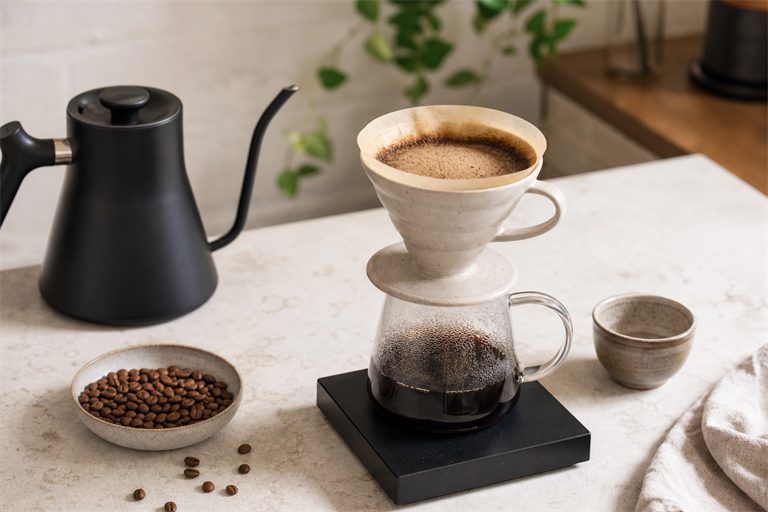
Last Tuesday I weighed out 15 g of a washed Guji from Onyx, ran my usual medium-roast V60 recipe, and got back a cup that tasted thin, sour, and faintly salty. The beans weren’t the problem. My recipe was tuned for a different roast level, and light roast asks for its own setup.
Why a medium-roast recipe falls apart on these beans
Light roast beans are denser and less soluble than their medium or dark counterparts. At identical settings, less of the bean dissolves into the cup. Brew a light roast with a medium-roast recipe and you sit firmly in under-extraction territory: sour, thin, salty, with a short finish.
The fix is to push extraction harder without tipping into bitterness. Finer grind, hotter water, a touch more agitation. Three levers do most of the work, roughly in this order:
- Grind size, finer than you think (medium-fine, not medium)
- Water temperature, 95–96°C (203–205°F), close to boiling
- Total brew time, 3:00–3:45 for a 15 g dose on a Hario V60 02
Everything else refines on top of those three.
What you need on the counter
- Hario V60 (size 02) with matching paper filters
- Burr grinder (blade grinders won’t get you there; the grind is too uneven)
- Gooseneck kettle with temperature control, or a thermometer
- Digital scale that reads to 0.1 g, with a timer
- 15–20 g of a light roast single origin, ideally 7–21 days off roast
- Filtered water (around 75–150 ppm total dissolved solids, per SCA water guidelines)
If pour-over itself is new to you, run through a beginner-friendly pour-over walkthrough first, then come back for the fine-tuning below.
The baseline recipe to brew first
| Parameter | Value | Why |
|---|---|---|
| Dose | 15 g coffee | Easy math, fits V60 02 |
| Water | 250 g (1:16.7 ratio) | Balanced strength for light roast |
| Grind | Medium-fine (Comandante ~22 clicks, 1Zpresso JX ~2.2) | Slows flow, raises extraction |
| Water temp | 96°C (205°F) | Helps dissolve dense beans |
| Bloom | 45 g water, 45 seconds | Degasses fresh coffee |
| Pour pattern | 3 pours, finish by 2:15 | Even saturation, controlled flow |
| Drawdown end | 3:15–3:45 | Target window for a clean cup |
The pour breakdown
- 0:00–0:10, Pour 45 g in slow circles to saturate all the grounds.
- 0:10–0:45, Bloom. Gently swirl the dripper once at 0:30.
- 0:45–1:15, Pour to 150 g in steady spirals from center outward.
- 1:15–2:15, Pour to 250 g, slower, keeping the bed flat.
- 2:15–3:30, Drawdown. One final small swirl at 2:30 to flatten the bed.
On that Onyx Guji I mentioned, the first pass landed exactly where the theory predicts: thin and salty, telegraphing under-extraction. Two clicks finer on the Comandante and the second brew opened up into jasmine and lemon. The recipe is a starting point. The cup tells you where to go.
Read the cup before you touch a setting
Brew the baseline. Let it cool to about 50°C, then taste. Match what you got to one of these:
| Symptom | Likely cause | Fix |
|---|---|---|
| Sour, sharp, salty, thin finish | Under-extraction | Grind finer, raise temp 1–2°C, or extend brew |
| Dry, bitter, ashy aftertaste | Over-extraction | Grind coarser, lower temp 2°C |
| Watery, weak, but not sour | Low strength, not extraction | Use less water (1:15) or more dose |
| Fast drawdown (under 2:30), muddy cup | Channeling | Swirl more, grind finer, pour gentler |
| Stalled drawdown (over 4:00) | Too fine, or filter clogged | Grind 2 clicks coarser, rinse filter better |
Sour and bitter can show up in the same cup when channeling is at play: water races through some spots and over-extracts others. The swirl matters more than most people think. That same sour-and-salty profile follows you to other brewers, by the way. If you also pull AeroPress shots, this troubleshooting guide for sour AeroPress walks through the parallel fixes.
Change one thing at a time
Change one variable per brew. Touch two and you’ve lost the ability to tell which one moved the cup.
My usual order:
- Grind first. It’s the biggest lever. Move 2 clicks at a time on a hand grinder, one notch on most electrics.
- Temperature next. Adjust in 2°C steps. Most light roasts want 94–96°C.
- Then pour pattern. Slower, more centered pours raise extraction. Aggressive edge pours add agitation.
- Bloom last. Try 2x dose (30 g) for 45 s, or extend to 60 s for very fresh beans (under 10 days off roast).
Keep notes after every brew. A phone note is plenty: date, dose, grind setting, temp, total time, one line on taste.
Starting points by origin
Treat these as a launch pad, not a verdict. Origin behavior varies a lot by farm and process.
| Origin (washed) | Grind | Temp | Notes |
|---|---|---|---|
| Ethiopian (Yirgacheffe, Guji) | Slightly finer | 96°C | Delicate florals; aim 3:30 total |
| Kenyan (Nyeri, Kirinyaga) | Standard medium-fine | 95°C | Dense, acidic; watch for stalling |
| Colombian washed | Standard | 94°C | Forgiving; pull back temp for sweetness |
| Ethiopian natural | Slightly coarser | 94°C | Already fruity; avoid over-extracting |
Before you pour, the short list
- Beans 7–21 days off roast
- Filter rinsed with hot water, dripper preheated
- Scale tared with dripper + carafe
- 15 g coffee, ground medium-fine
- Water at 96°C
- Bloom: 45 g, 45 s, swirl at 0:30
- Pours hit 150 g by 1:15, 250 g by 2:15
- Final swirl at 2:30
- Drawdown finishes 3:15–3:45
- Tasted at ~50°C, logged in brew notes
What to do tomorrow morning
Brew the baseline recipe exactly as written. Write one sentence about the taste. Then change only the grind for the next brew. Two cups from now, you’ll know which direction your beans want to go.