
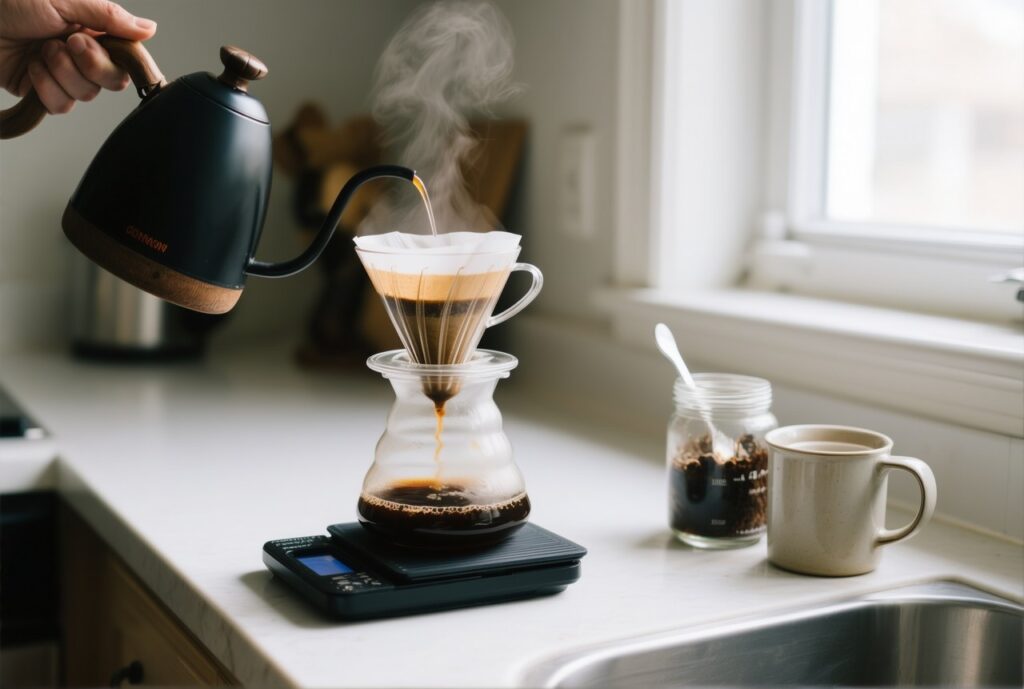
Most home brewers hit a wall somewhere around the second month. The bag tastes flat, or sharp, or just nothing like what the roaster promised on the label, and the obvious suspect is the beans. Usually it isn’t. Grind size, water temperature, and pour rate carry the cup, and dialing those in turns the same bag into something that drinks like the café version.
The Three Numbers Worth Memorising
A 1:16 ratio (say, 20 g coffee to 320 g water), water at 94–96°C (200–205°F), and a medium grind that looks like coarse sand. Total brew time lands around 3:00–3:30 for a single cup on a Hario V60-02. Those three variables drive roughly 80% of what ends up in the cup. Everything else is decoration.
The Kit You Actually Need
Expensive gear is not the gate. You need:
- A dripper. A Hario V60, Kalita Wave, or Origami all work, and each one wants a slightly different pour. Pick one and learn it.
- Paper filters sized for that specific dripper
- A burr grinder. Hand grinders like the Timemore C2 are fine. Blade grinders are not.
- A digital scale that reads to 0.1 g
- A kettle. Gooseneck is nicer, but a regular kettle and a steady hand will get you there.
- A thermometer, or a kettle you can boil and let rest for 30 seconds
- Fresh beans, roasted within the last 3–4 weeks
- Filtered water. Not distilled. Not straight from a hard tap.
Why Ratio, Grind, and Temperature Dominate
| Variable | Target | Why it matters |
|---|---|---|
| Ratio | 1:16 (coffee:water) | Controls strength. Lower (1:15) = stronger, higher (1:17) = lighter. |
| Grind | Medium, like coarse sand | Controls extraction speed. Finer = slower, more extracted. |
| Water temp | 94–96°C (200–205°F) | Hotter water pulls more flavor compounds; too cool = sour. |
Water mineral content sneaks in as the fourth quiet factor. Distilled water tastes flat because minerals are what carry flavor across the tongue. Filtered tap water at roughly 50–150 ppm total dissolved solids is the sweet spot the SCA brewing chart points to, which also frames the 1.15–1.45% TDS extraction window most home brewers should aim inside of.
A Real Brew, Start to Finish (20 g coffee, 320 g water on a V60-02)
-
Heat 400 g of water to 96°C (205°F). You’ll use 320 g for the brew and the rest to rinse the filter. If your kettle only boils, wait 30 seconds after the click. That drops it to roughly 96°C.
-
Rinse the paper filter with hot water. Pour through until the paper is soaked, then dump the water from your carafe. This pulls out the papery taste and preheats the dripper, which keeps brew temperature stable.
-
Grind 20 g of beans on a medium setting. Between your fingers, the grounds should feel like coarse sea salt or kosher salt. Too fine, water stalls. Too coarse, water rushes through.
-
Add grounds, tare your scale to zero, start a timer. Give the dripper a gentle shake to level the bed. An uneven bed means uneven extraction. Some grounds over-brew, others under-brew, and the cup goes muddy.
-
Bloom: pour 40 g of water (2× the coffee weight) over the grounds in a spiral. Stop between 0:00 and 0:10. Fresh coffee releases CO₂ when wet, and that gas blocks water from soaking the grounds. The bloom lets it escape. Wait until 0:45.
-
First main pour: from 0:45 to 1:15, pour slowly to 160 g total. Concentric circles starting from the centre, avoiding the filter walls. Slow, steady pours extract evenly.
-
Second pour: from 1:30 to 2:00, pour to 320 g total. Keep the water level low and consistent. Don’t flood the bed.
-
Let it drain. Target finish: 3:00–3:30 from the start of the bloom. Swirl the dripper once at the end to flatten the bed for an even final draw.
-
Remove the dripper, swirl the carafe, and pour. Taste it before adding anything.
One small thing from my own counter: last week I ran the same washed Ethiopian bag through my V60 at 94°C and then again at 96°C, identical grind and timing. The 96°C cup had the floral, jasmine-ish top note I’d been missing for days. Two degrees, real difference.
Troubleshooting by Taste
| Symptom | Likely cause | Fix |
|---|---|---|
| Sour, sharp, lemony | Under-extracted: water didn’t pull enough | Grind finer one notch, OR raise temp to 96°C, OR extend brew by 20 s |
| Bitter, ashy, harsh | Over-extracted: too much pulled out | Grind coarser one notch, OR drop temp to 93°C, OR shorten pour |
| Weak, watery, thin | Wrong ratio or too coarse | Use less water (try 1:15) or grind one step finer |
| Hollow, flat, lifeless | Stale beans or low-mineral water | Use beans within 4 weeks of roast; switch to filtered tap, not distilled |
| Brew finishes under 2:30 | Grind too coarse, or pour too fast | Grind finer; slow your pour rate |
| Brew stalls past 4:00 | Grind too fine, or filter clogged | Grind coarser; agitate less during pour |
Change one variable per brew. Just one. Tweak grind, temp, and ratio at once and you’ll never know which one fixed it. Scott Rao makes this point repeatedly in Coffee Brewing: The Theory and Technique, and it’s the single habit that separates dialled-in brewers from frustrated ones.
Dialing In With Small Steps
Once your baseline brew is drinkable, adjust in tiny steps:
- Grind: one notch at a time on the grinder
- Temperature: 2°C increments
- Ratio: shift by 10 g of water, not 50 g
Keep a short brew log. Beans, grind setting, time, taste. After five brews the pattern usually jumps out at you, sometimes embarrassingly so. My own log lives on the back of a torn-off envelope taped to the cupboard, and it works fine.
One Thing Before You Brew Tomorrow
- 20 g coffee, 320 g water (1:16)
- Water at 94–96°C
- Medium grind, like coarse sand
- Rinse filter, level bed
- Bloom 40 g, wait to 0:45
- Pour to 160 g by 1:15
- Pour to 320 g by 2:00
- Finish draining by 3:30
- Taste, then adjust ONE variable
Your single next step: weigh your coffee and water for the next brew. If you change only one habit this week, make it that one. Eyeballing is the biggest reason home pour-over tastes different every morning.