
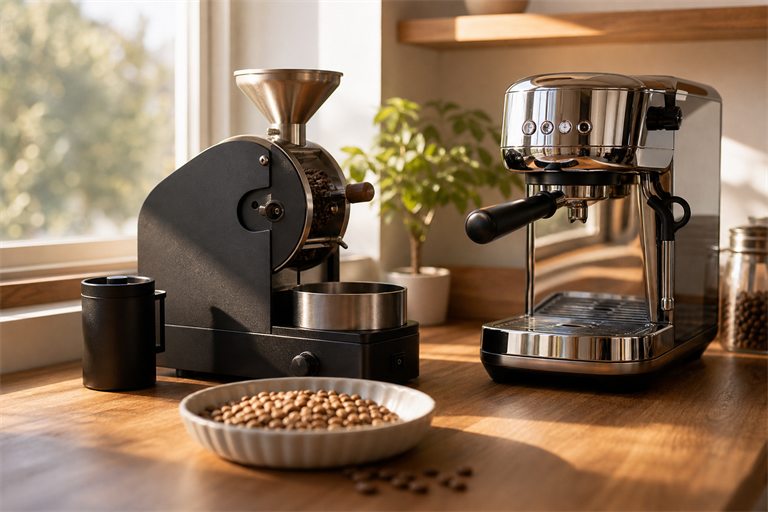
Two Perfect Daily Grind features landed on May 27, and read like one continuous story for any home brewer with counter space to spare. The first argues that countertop roasters are pulling home roasting out of the hobbyist corner. The second argues that correct dosing, not detergent choice, is the lever that actually keeps a home espresso machine clean.
Put them next to each other and a pattern shows up. The same person buying their first 200-gram countertop roaster is very often the same person pulling shots an hour later on a single-boiler machine they barely know how to service.
What ran on May 27
Perfect Daily Grind’s roasting piece reports that countertop machines have narrowed the gap between sample roasters and consumer kit. Smaller batch sizes, electric heating, and improved smoke handling are making them realistic for apartment kitchens (PDG, 27 May 2026). The angle is accessibility: price, learning curve, and the practical question of where the smoke goes.
The cleaning piece, published the same day, reframes a maintenance topic as a dosing topic (PDG, 27 May 2026). Overdosing a basket, the article argues, drives channeling, residue, and faster fouling of the screen and group. Underdosing is gentler but leaves its own oily film. Either way, the dose decides the cleaning interval more than the cleaner does.
Neither piece names a specific machine. Both are category-level reads. For broader context on the day’s other headlines, see our roundup of what specialty coffee’s maturity phase looked like on May 27.
Why these two headlines belong together
Home roasts trend lighter and oilier than supermarket beans, depending on how the operator chases first crack. Fresh light-to-medium roasts can be deceptively dense, which means they need a finer grind and tighter dose tolerance to pull cleanly. That is where the cleaning story collides with the roasting story.
A new home roaster meeting a new espresso workflow tends to overshoot the basket because the grind feels coarse for the roast level. The result is channeling, sour shots, and a portafilter screen that gums up within a week. The PDG cleaning piece’s central claim, that dosing drives cleaning frequency, lands hard on exactly this user.
What’s actually changed on the countertop
Here is what the PDG roasting article identifies as the shifts worth tracking, paired with what each one means at the brew bar:
| Shift on the roasting side | What PDG flags | What it changes for home espresso |
|---|---|---|
| Batch size | Sub-200g electric drums and fluid-bed units | Beans rotate faster, so oils on the grinder and basket are fresher and stickier |
| Smoke handling | Built-in catalytic or filter stages | Roasting indoors becomes plausible, raising session frequency |
| Learning curve | Pre-set roast profiles | First-time roasters reach drinkable results faster, before they learn dose discipline |
| Price floor | Entry units priced near a mid-range grinder | The roaster-plus-espresso pairing becomes a single-weekend purchase |
The cleaning article is the counterweight. Accessibility on the roasting side accelerates a maintenance problem on the espresso side that most beginners do not see coming.
Three reads on the same news
Equipment-side optimism, per the PDG roasting feature: countertop machines have closed enough of the gap with commercial sample roasters that meaningful learning can happen at home, without venting through a window fan.
Maintenance-side caution, per the PDG cleaning feature: the variable that quietly governs how often a home machine needs backflushing and a group-head scrub is dose accuracy, not product choice. A 0.3-gram drift, repeated twice a day, compounds. The same dose-sensitivity story is playing out on the filter side too, where sub-1:16 ratios and 12g brews are reshaping pour-over recipes in 2026.
And a working home-barista read, drawn from my own kitchen. I ran a 180-gram batch on a borrowed countertop drum last month, rested it four days, and watched my usual 18.0g VST basket overflow at the screen. Dropping to 17.4g and tightening the grind cleared the channeling. More tellingly, the group screen wiped clean that night instead of needing a soak. The PDG cleaning piece’s framing matched the experience exactly.
A weekly rhythm when roasting feeds espresso
- Reweigh your dose every time you change roast batch. Fresh home roasts shift density within the first week.
- Purge and wipe the grinder chute on roast-change day. Light home roasts leave more fines than expected.
- Backflush with water daily, with detergent twice a week, if you are pulling two-plus doubles a day on home-roasted beans.
- Pull the screen and gasket weekly. Inspect for a brown ring around the edge: that ring is channeling residue, not just oil.
- Keep a log of dose, grind setting, and shot time per roast batch. Cleaning intervals will track that log more than the calendar. If you want a numerical anchor for that log on the filter side, a refractometer workflow at home is the cleanest way to tie extraction back to dose.
What to watch through autumn
The countertop category is moving fast enough that the next six months should clarify two things. First, whether sub-€500 units can match the smoke handling that PDG credits to higher-priced models, since that single feature decides whether apartment roasting scales. Second, whether grinder makers respond with profiles tuned for home-roasted light beans, which currently sit awkwardly between filter and espresso settings.
For the home brewer, the practical takeaway from May 27 is narrow and useful. If a countertop roaster is tempting you this summer, budget the same weekend for a scale that reads to 0.1g and a fresh group gasket. Watch PDG’s roasting coverage through the autumn trade shows for the next round of category news, and keep an eye on our ongoing coffee industry news coverage for the headlines that follow.